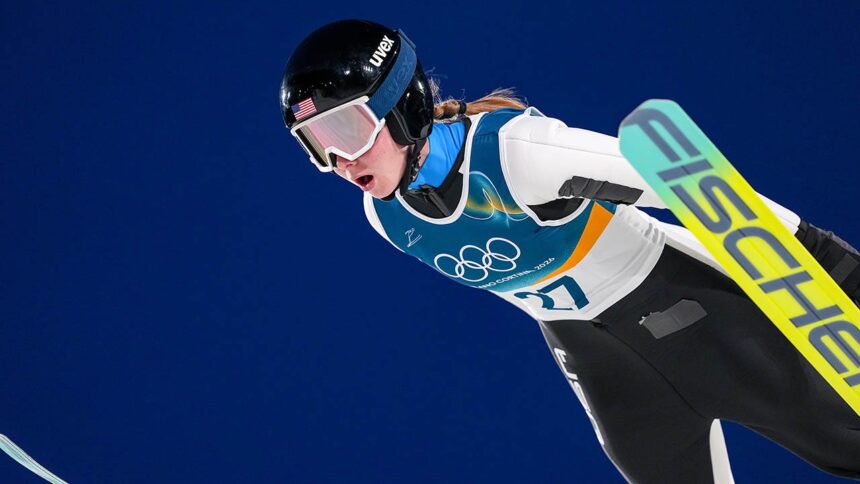
American Ski Jumper Annika Belshaw Disqualified from 2026 Olympic Finals Over 1-Centimeter Equipment Violation
The thin, frigid air of Predazzo, Italy, was thick with shock and disbelief on Sunday as American ski jumper Annika Belshaw saw her 2026 Winter Olympic dreams vanish not in a crash or a poor performance, but in a measurement. In a devastating turn of events, Belshaw was disqualified from the women’s large hill finals after officials determined her skis were one centimeter over the maximum permitted length. The ruling, which came after she had successfully qualified for the final round, echoes the identical fate of Austria’s Daniel Tschofenig earlier in the Games, casting a long shadow over the sport’s relentless pursuit of equipment-based marginal gains and the human cost of its unforgiving regulations.
- The Millimeter Margin: How a Tiny Measurement Altered an Olympic Journey
- History Repeats: The Ghost of Tschofenig’s Disqualification
- The Broader Impact: Trust, Fairness, and the Soul of the Sport
- Looking Ahead: Predictions for a Post-Measurement Controversy Future
- Conclusion: A Lesson Etched in Heartbreak
The Millimeter Margin: How a Tiny Measurement Altered an Olympic Journey
Annika Belshaw’s day had begun with promise. Soaring through the Italian Alps during the qualifying round, she secured her spot in the prestigious finals, a testament to years of grueling training and mental fortitude. The scene was set for a career-defining moment. However, in the high-stakes, hyper-technical world of elite ski jumping, the competition often begins long before an athlete steps onto the in-run. Post-qualification equipment control is a standard, nerve-wracking procedure where every piece of gear is scrutinized against the International Ski Federation’s (FIS) meticulous rulebook.
It was here that officials found the critical discrepancy. Belshaw’s skis, the very tools of her flight, were deemed non-compliant. The violation was minuscule to the naked eye—a mere 1 centimeter over the maximum ski length for her height and the specific event. Yet, in a sport where the difference between gold and obscurity can be measured in millimeters of forward lean or suit porosity, there is zero tolerance for deviation. The ruling was immediate and absolute: disqualification. Her spot in the finals was erased, her scores nullified. The emotional whiplash for the athlete, her coaches, and the U.S. team was profound, transforming anticipation into anguish in a matter of moments.
History Repeats: The Ghost of Tschofenig’s Disqualification
What makes Belshaw’s disqualification particularly jarring is its eerie familiarity. Just days prior, Austrian medal hope Daniel Tschofenig suffered the same fate in the men’s competition, also for skis that were 1 cm too long. Two athletes, from different nations and genders, felled by the same precise, brutal regulation. This repetition is not a coincidence but a stark highlight of the intense pressure in the Olympic environment.
Expert analysis suggests several potential root causes for such back-to-back infractions:
- Aggressive Equipment Pushing: Athletes and technicians constantly seek any legal advantage. Skis at the absolute maximum permitted length can theoretically provide more lift and stability. The line between “maximized” and “illegal” is perilously thin.
- Measurement Variables: Slight variations in how skis are measured (temperature, equipment calibration, exact positioning) could theoretically contribute, though Olympic controls are designed to eliminate such doubt.
- Pre-Game Adjustments: A last-minute change or tuning error, perhaps in response to changing wind or snow conditions, could have led to the oversight.
“This is the nightmare scenario every team has,” stated a former Olympic ski jumping technician who wished to remain anonymous. “You live in a world of microns and grams. The focus is so intense on aerodynamics, suit tension, and wind gates that a fundamental box-check like absolute length can, catastrophically, become an assumption. After Tschofenig, every team should have been on red alert. That it happened again is a systemic failure for that athlete’s support team.”
The Broader Impact: Trust, Fairness, and the Soul of the Sport
While rules are unequivocally necessary for fair competition, the dual disqualifications of Tschofenig and Belshaw ignite a fierce debate about the spirit of the Olympics. The equipment violation was not one of deliberate cheating with hidden mechanisms or illegal materials; it was a 1 cm oversight on a piece of equipment that, by all accounts, provided no decisive performance benefit in the qualifying round Belshaw had already passed.
The incident strikes at the heart of sportsmanship and tragedy. Fans witness an athlete’s physical and mental prowess rendered irrelevant by a technicality. It raises difficult questions: Does the punishment fit the crime? Does this level of draconian enforcement, while ensuring uniformity, sometimes betray the Olympic ideal of celebrating human achievement? The ski jumping competition is undoubtedly fairer for having strict rules, but its narrative is now partially defined by heartbreak over a centimeter, a outcome that feels dissonant to many watching around the world.
For the United States Ski Jumping team, it is a devastating blow. Belshaw represented a key hope for visibility and momentum in a program that fights for resources and recognition. Her chance to inspire a new generation on the Olympic stage was abruptly canceled.
Looking Ahead: Predictions for a Post-Measurement Controversy Future
The fallout from these twin disqualifications will reverberate far beyond the hills of Predazzo. We can expect several immediate consequences and shifts:
- Pre-Olympic Scrutiny Will Intensify: For the remainder of the 2026 Games and into future cycles, team equipment checks will become paranoid, multi-layered processes. Expect teams to implement redundant internal measurement systems.
- FIS Rulebook Examination: While the length rule itself is unlikely to change, there may be calls for or discussions about standardized, foolproof measurement protocols at events, or even FIS-provided equipment calibration services in the Olympic village.
- Athlete Advocacy: Athletes, through their commissions, may push for even more transparency in the control process or clarity on tolerance margins for measurement equipment itself.
- Legacy of the “Centimeter Curse”: The stories of Tschofenig and Belshaw will become a permanent cautionary tale in winter sports lore, cited by coaches forever as the ultimate example of “leaving nothing to chance.”
Conclusion: A Lesson Etched in Heartbreak
The image of Annika Belshaw soaring through the air during her trial jump will forever be juxtaposed with the crushing administrative reality that followed. Her disqualification, mirroring Daniel Tschofenig’s, is a sobering reminder that at the modern Olympic Games, excellence is not solely built on courage and skill, but on an exhaustive, unforgiving compliance with a vast web of technical specifications. In the quest for absolute fairness, the human element of error—whether in a workshop or a moment of oversight—is met with the harshest penalty.
This episode will be remembered not for a record distance or a medal-winning leap, but for the millimeter-thin line between Olympic glory and Olympic oblivion. It underscores a poignant truth: in the arena where humans fly, their dreams can be grounded by the smallest of things. As the sport moves forward, it must balance its scientific pursuit of perfection with the preservation of its essence—the breathtaking spectacle of an athlete, alone against the mountain, defying gravity. The hope is that future competitions are decided by the jumps, not just the tape measure.
Source: Based on news from Fox Sports.