Alcaraz Navigates ‘Difficult’ Rinderknech Test in Doha, Extends Perfect Season Start
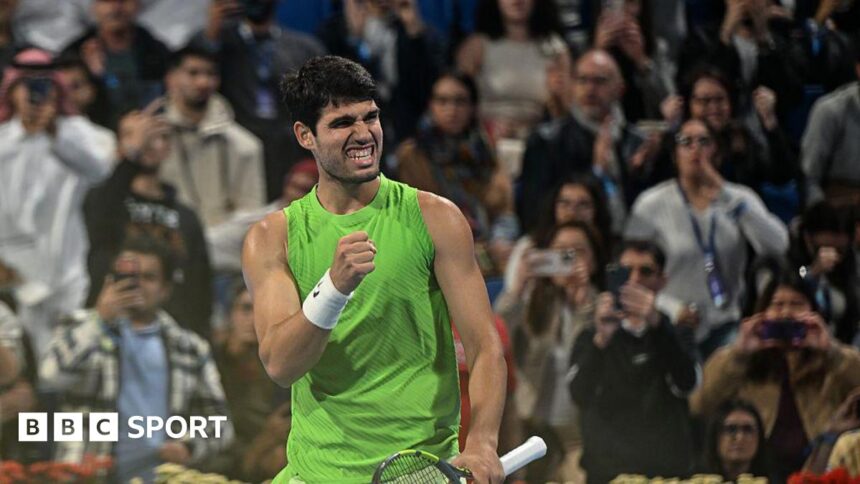
The roar of the Rod Laver Arena had barely faded, the confetti from a historic Australian Open triumph still a fresh memory. For Carlos Alcaraz, the transition from Grand Slam champion to tournament top seed is a relentless cycle, and his first steps back onto the court are rarely a coronation. In Doha, under the lights of the Khalifa International Tennis and Squash Complex, the young Spaniard was reminded that every opponent carries a dangerous script. Battling through what he termed “difficult moments,” Alcaraz edged past France’s powerful Arthur Rinderknech 6-4, 7-6(5) in the first round of the Qatar Open, extending his flawless start to the season to eight consecutive victories.
A Welcome Test: Shaking Off Rust with Grit
Returning to competition after a life-altering achievement is a unique psychological challenge. The aura of invincibility can be a heavy cloak, and the hunger of a player with nothing to lose, like the world No. 73 Rinderknech, is a potent weapon. Alcaraz, now a seven-time Grand Slam champion and the youngest man to complete the career Grand Slam, acknowledged the hurdle.
“It was really difficult,” Alcaraz stated candidly after the match. “I’m really happy to get through. There were difficult moments in the match, especially in the second set.” This admission is a hallmark of his maturity. Rather than expecting a facile victory, he embraced the struggle as a necessary step in his post-Melbourne journey. The match served as a vital recalibration, shaking off any residual celebratory inertia against an opponent whose massive serve and flat groundstrokes are tailor-made for fast hard courts.
Decoding the Doha Battle: Where the Match Was Won
On paper, a straight-sets win for the top seed seems routine. The reality was a tense, high-wire act that showcased Alcaraz’s problem-solving prowess. The first set was a display of controlled aggression, with Alcaraz securing a crucial break. The second set, however, unveiled the “difficult moments” he referenced.
- Rinderknech’s Serve Catching Fire: The Frenchman began landing his first serve with alarming consistency, using his 6’8″ frame to generate unreturnable power and sneak into the net.
- Set Point Crisis: Alcaraz found himself staring down two set points on his own serve at 4-5, 15-40. The prospect of a deciset loomed large.
- Champion’s Response: Here, the Melbourne mettle shone through. He saved the first with a fearless forehand approach, and the second with clutch serving, navigating back to deuce before holding.
- Tie-Break Tenacity: In the ensuing tie-break, Rinderknech’s power kept him close, but at 5-5, Alcaraz summoned a moment of magic—a signature drop shot or a blistering passing shot—to seize the mini-break and closed out the match on his first opportunity.
This sequence was the entire match in microcosm: facing adversity, trusting his weapons, and executing under pressure. While his forehand was occasionally erratic, his defensive scrambles, tactical drop shots, and competitive ferocity never wavered.
Expert Analysis: The Significance of a Grind
For a player of Alcaraz’s soaring standards, this performance was less about dazzling fireworks and more about foundational reinforcement. “This is precisely the type of match Alcaraz needed,” says veteran tennis analyst Robert Masters. “After a Grand Slam win, especially one as monumental as Melbourne, there’s an unconscious emotional drop. Rinderknech, with his game style, forced Carlos to engage every part of his tennis brain—problem-solving, patience, and clutch serving. Winning ugly early in a tournament can be more valuable than a straightforward blowout. It recalibrates focus and reinforces the ‘find a way’ mentality that defines champions.”
The victory underscores a critical evolution in Alcaraz’s game: the ability to win without his absolute A-game. His physicality and point construction were tested, and he passed. Furthermore, navigating such a tricky opponent early minimizes the risk of a sharper, more drawn-out battle in later rounds, preserving energy for the tournament’s business end.
Predictions: Momentum for Doha and Beyond
Clearing this first hurdle in Doha is a massive boost for Alcaraz’s campaign. With the match’s tension now in his rearview, expect his game to flow more freely in subsequent rounds. The win injects immediate confidence and sharpens his competitive edge for the battles ahead in Qatar, where he will face a mix of veteran savvy and rising talent.
Looking at the broader 2024 landscape, this gritty performance is a positive omen. The season is a marathon of different surfaces, conditions, and pressures. Alcaraz’s capacity to manage the psychological weight of success and handle dangerous, lower-ranked opponents with efficiency is as important as his Grand Slam prowess. It suggests a player who is not just riding a wave of confidence, but one who is diligently building a fortress of resilience around it. As the tour moves towards the Sunshine Double in Indian Wells and Miami, this ability to grind will be paramount.
Conclusion: The Unrelenting Path of a Champion
Carlos Alcaraz’s debut in Doha was not a victory parade. It was a declaration. A statement that the pursuit doesn’t end with a trophy, no matter how glittering. His difficult, hard-fought win over Arthur Rinderknech was a masterclass in professional perseverance. It demonstrated that beyond the breathtaking forehands and the youthful exuberance lies a hardened competitor who understands the value of a struggle.
By saving set points, battling through a tie-break, and acknowledging the challenge, Alcaraz proved his champion’s mentality is fully operational. He moves forward in Doha not just with an 8-0 record for the season, but with a timely reminder of what it takes to win on a day when perfection is out of reach. For the rest of the tour, that may be the most daunting fact of all: Carlos Alcaraz is learning to win in every conceivable way, and his education shows no signs of slowing down.
Source: Based on news from BBC Sport.