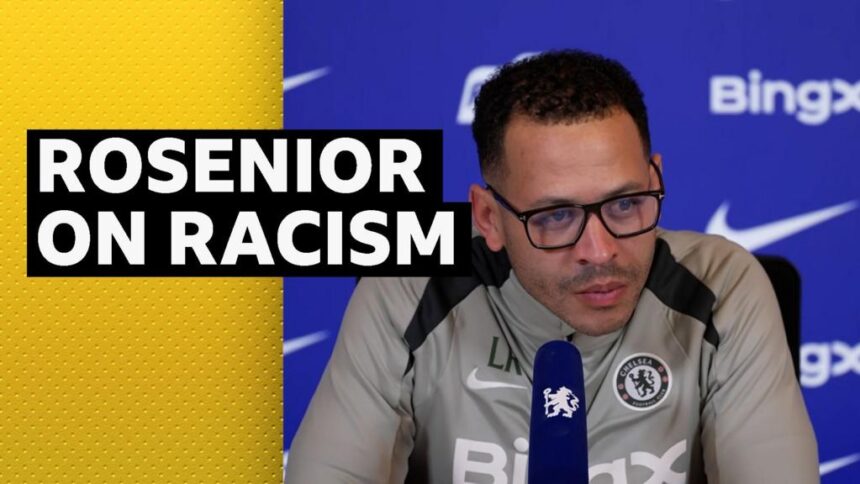
Liam Rosenior’s Uncompromising Stand: Demanding Lifetime Bans for Racism in Football
The beautiful game, a global tapestry woven from passion and skill, is once again stained by the ugly specter of racism. A fresh allegation, this time involving Real Madrid’s Vinicius Jr. and Benfica’s Gianluca Prestianni during a Champions League play-off, has ignited a fierce and necessary debate. In response, Chelsea head coach Liam Rosenior has delivered a powerful, zero-tolerance ultimatum that resonates far beyond the touchline: anyone found guilty of racism shouldn’t work in football. This isn’t a call for a fine or a short suspension; it’s a demand for permanent exclusion, a line in the sand for the sport’s moral future.
Beyond Fines and Empty Gestures: The Case for Permanent Exclusion
For years, football’s governing bodies have treated racism with a playbook of inadequate penalties. Fines that are mere accounting footnotes for wealthy clubs, partial stadium closures, and short-term bans have proven to be ineffective deterrents. They are reactive, temporary measures that fail to address the profound damage racism inflicts on players, the sport’s integrity, and its millions of fans. Rosenior’s stance cuts through this bureaucratic inertia. By advocating for a lifetime ban from football, he reframes the punishment from a sporting sanction to a profound professional and social consequence. The message is simple: football is a privilege, not a right, and racism irrevocably forfeits that privilege.
This approach targets all individuals within the football ecosystem. Rosenior’s “shouldn’t work in football” applies with equal force to:
- Players who racially abuse opponents or teammates.
- Coaches and Managers who perpetuate discriminatory attitudes.
- Club Executives and Owners who foster or tolerate a toxic culture.
- Fans engaged in abuse, facing not just stadium bans but exclusion from the sport’s employment sphere.
This holistic view is crucial. Racism is not solely a problem in the stands; it can fester in boardrooms, dressing rooms, and on the pitch itself. A unified, severe penalty across all levels is the only way to create a genuine culture of accountability.
Vinicius Jr.: The Persistent Face of a Systemic Failure
The alleged incident involving Vinicius Jr. is depressingly familiar. The Brazilian winger has been subjected to vile racist abuse repeatedly in Spain, becoming a symbol of both the problem and the frustrating lack of progress. Each new case underscores the failure of existing protocols. When high-profile players like Vinicius are consistently targeted, it signals to perpetrators that the risk is minimal and the consequences manageable.
Rosenior’s proposal directly addresses this failure. A zero-tolerance policy with permanent bans would fundamentally alter the risk calculus. A player like Gianluca Prestianni, if found guilty, would face not just a few missed games but the end of his career at the highest level. For a club, knowingly employing someone with a proven record of racism would carry existential risk. This shifts the dynamic from managing public relations crises to implementing rigorous, preventative internal policing. The onus falls on clubs to educate and eradicate prejudice before it manifests, knowing the penalty for failure is catastrophic.
Practical Challenges and the Path to Implementation
While morally compelling, Rosenior’s vision faces significant practical hurdles. The immediate questions are legal and jurisdictional. Football’s authorities operate across continents with differing legal standards for evidence and proof. Implementing a global lifetime ban would require unprecedented cooperation between FIFA, UEFA, and national federations, backed by watertight legal frameworks to withstand inevitable appeals.
Key implementation steps would need to include:
- Independent Investigative Bodies: Moving investigations away from clubs and even federations to neutral, expert panels with subpoena power.
- Clear, Universal Definitions: Establishing a global standard for what constitutes racist abuse, on and off the pitch.
- Unified Registries: Creating a shared database of individuals sanctioned for racism, accessible to all clubs worldwide.
- Education Mandates: Tying licensing for clubs, agents, and coaches to mandatory, proven anti-racism education programs.
The journey from proposal to policy would be complex, but it starts with a powerful figure like Rosenior setting the agenda. His authority as a respected coach and a prominent Black figure in the game lends his words immense weight, forcing institutions to respond.
A Watershed Moment for Football’s Soul
Liam Rosenior has done more than comment on an incident; he has issued a moral challenge to the entire football world. His call for permanent bans is a demand for the sport to finally align its punishments with the severity of the crime. It recognizes that racism is not a “mistake” or a moment of passion, but a corrosive belief that has no place in a sport that aspires to unite the world.
Predicting the immediate outcome is difficult. Institutional change is slow. However, Rosenior’s intervention marks a potential turning point in the anti-racism fight. It moves the conversation from “what should we do?” to “this is what must be done.” It empowers other voices within the game to demand the same uncompromising standards. The pressure on UEFA regarding the Vinicius-Prestianni case is now exponentially higher; anything less than a severe, groundbreaking sanction will be seen as cowardice.
In the end, this is about more than rules and regulations. It is about the soul of football. Rosenior is arguing that the sport’s integrity is non-negotiable. By stating that racists “shouldn’t be in the game,” he is fighting to protect the very essence of competition: respect, fairness, and the pure celebration of talent. If football is truly for everyone, then it must be actively, aggressively hostile to those who violate that principle. The beautiful game’s future depends on whether it has the courage to listen.
Source: Based on news from BBC Sport.