From New York to Nashville: How Robert Saleh’s Evolution Fuels the Titans’ Revival
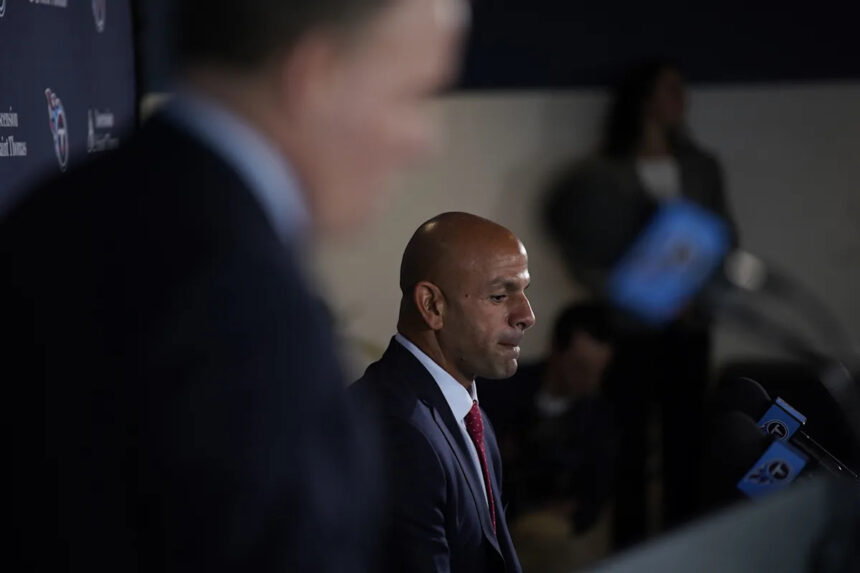
The journey from a first-time NFL head coach to a second chance is often a path paved with introspection, hard lessons, and a quiet, burning determination to prove that past struggles were not a definition, but an education. For Robert Saleh, now at the helm of the Tennessee Titans, that education is the foundation upon which he aims to build a new contender. In a revealing sit-down with Rich Eisen at the NFL Scouting Combine, Saleh peeled back the layers on his growth, offering a blueprint for how his experiences with the New York Jets are shaping a more poised and prepared leader in Nashville.
The Unwritten Handbook: Saleh’s Candid Reflection on Jets Tenure
Unlike the broad strokes of an introductory press conference, Saleh’s conversation with Eisen provided tangible details on his professional evolution. He framed his first head-coaching experience not as a failure, but as a necessary, if painful, curriculum.
“There’s no handbook for a first time at anything you do,” Saleh stated, capturing the universal challenge of stepping into the league’s most pressurized role. “You just have to go through it, experience the highs and lows.” This acknowledgment is more than cliché; it’s a window into a coach who has moved past defensiveness and into a phase of analytical growth.
He pinpointed specific areas of development drawn directly from his time with the Jets:
- Enhanced Player Communication: Moving from a coordinator focused on a unit to a CEO managing 53 personalities requires a different touch. Saleh suggests he’s learned how to connect more effectively on an individual level, crucial for managing modern locker rooms.
- Navigating Locker Room Adversity: The Jets’ seasons were marred by injuries and losing streaks. Saleh’s reference to “handling adversity in the locker room” indicates a refined approach to maintaining culture and morale when the season’s trajectory turns south.
- Scheme Refinement Under Fire: As a defensive mastermind, Saleh’s schemes were sometimes picked apart. He admits to learning how to adjust and refine his defensive philosophies amid the weekly crucible of NFL game-planning, a sign of tactical flexibility.
Perhaps most telling was his willingness to compartmentalize his past. “There’s a lot of things that I’m leaving behind, some decisions that didn’t pan out, some approaches that needed tweaking,” he said, demonstrating a clear-eyed audit of his own performance. This ability to self-scout, to discard what didn’t work without discarding his core beliefs, is a hallmark of coaches who find success on their second attempt.
A Calmer Presence: The Nashville Effect and a Veteran Staff
Observers in Indianapolis noted a palpable difference in Saleh’s demeanor. The famous intensity remains, but it’s now coupled with a more relaxed, assured presence. This isn’t accidental. Two key environmental shifts are contributing to this steadier version of Saleh.
First, the move from the New York media maelstrom to the more focused football environment of Nashville cannot be overstated. In New York, every decision, quote, and loss is amplified under a relentless microscope. In Tennessee, while expectations are high, the daily noise is dialed down, allowing for greater focus on the building process itself.
Second, and arguably more critical, is the experienced coaching staff General Manager Ran Carthon and Saleh have assembled. The Titans’ roster of assistants reads like a who’s who of seasoned leaders:
- Nick Holz (Offensive Coordinator): A highly-regarded schematic mind from Jacksonville.
- Defensive Staff with HC Experience: The staff is fortified with multiple former NFL head coaches, including senior defensive assistant Mike Vrabel. This creates a built-in brain trust of individuals who have sat in the same seat, offering invaluable perspective and absorbing some of the strategic burden.
This structure allows Saleh to delegate with confidence and seek counsel from a depth of experience he did not previously have, enabling him to be more of a holistic manager and less a micromanager.
Translating Lessons into On-Field Results: The 2025 Blueprint
All the reflection and relaxed vibes are meaningless without translation to the field. Saleh’s growth will be tested through specific, tangible decisions in Tennessee.
We can expect his evolved approach to manifest in several key areas. Look for a defensive system that is more adaptive, learning from stretches in New York where rigidity was a critique. With a talent like Jeffery Simmons up front, Saleh can build a versatile, aggressive unit that plays to its players’ strengths rather than forcing a pure system.
His improved communication should directly impact quarterback development, whether it’s Will Levis or a new addition. Creating a stable, supportive environment for a young QB—something that was challenging in New York—is paramount. Furthermore, his stated focus on handling adversity will be crucial in managing the inevitable rough patches of a rebuild, ensuring the team’s culture remains resilient and forward-looking.
The true test of Saleh’s second chapter won’t be found in Combine interviews, but in his ability to instill a tough, consistent identity in a Titans team that has recently lacked one. It’s about marrying the physical, run-first tradition of Tennessee with modern schematic wrinkles and a locker room that believes in the process, even when wins are hard to come by early on.
The Verdict: A Promising Reset, But Patience is Required
Robert Saleh’s second act in Tennessee is built on a more realistic and robust foundation than his first. He enters with a veteran support staff, a less frenetic environment, and, most importantly, a processed and applied set of hard-earned lessons. He is no longer the promising coordinator learning on the job; he is a scarred, educated coach with a point to prove.
However, as the man himself would likely admit, none of this matters in February. The NFL forgives no one, and the AFC South is becoming increasingly competitive. The real evaluation begins when the Titans hit the field in 2025. Will the improved communication foster quicker in-game adjustments? Will the defensive schemes show new layers? Will the team weather early storms with unity?
The prediction here is one of measured optimism. Saleh’s self-awareness and environmental changes set the stage for significant improvement. The Titans may not contend immediately, but they should field a fundamentally sound, harder-to-beat team that clearly reflects its head coach’s evolution. Robert Saleh’s first head coaching stint provided the painful handbook he never had. In Tennessee, he’s now writing his second edition, and the early drafts suggest a far more compelling read.
Source: Based on news from Yahoo Sports.