Titans’ Robert Saleh Unveils Vision for T’Vondre Sweat’s Crucial System Fit
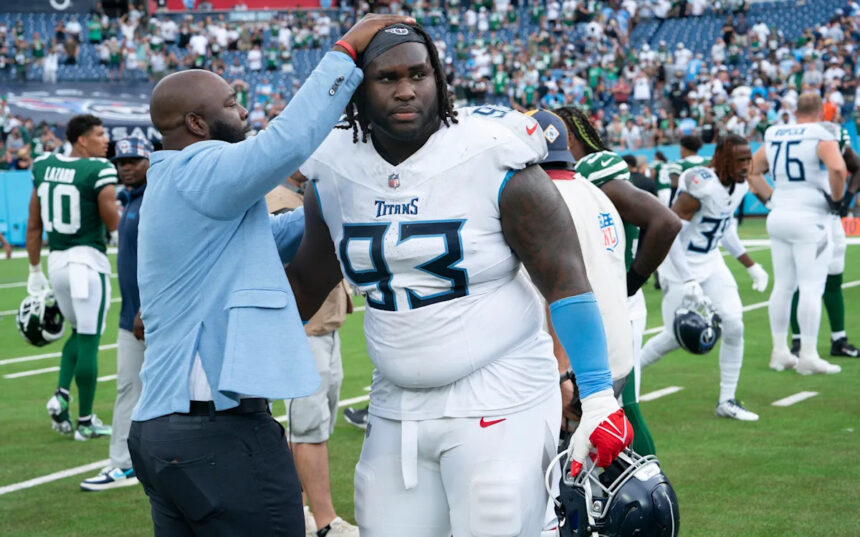
The arrival of a new head coach in the NFL always sparks a wave of speculation, but few debates have captured the Tennessee Titans’ fanbase quite like the T’Vondre Sweat Conundrum. Since Robert Saleh took the reins, social media and sports talk radio have been alight with one pressing question: How does a 6’4″, 366-pound defensive tackle—a classic, space-eating nose—fit into a defensive scheme historically built on explosive, penetrating linemen? At the NFL Scouting Combine in Indianapolis, Saleh provided the first crucial clues, offering an answer that not only clarifies the plan but should excite Titans faithful about the untapped potential in their mountainous second-year defender.
Beyond the Prototype: Saleh’s Blueprint for Defensive Disruption
Robert Saleh’s defensive reputation was forged with the San Francisco 49ers, a unit synonymous with the ferocious, athletic play of Nick Bosa and Arik Armstead. This has led to a widespread, albeit simplistic, assumption that his system only values lean, agile pass-rushers. Saleh’s comments on Tuesday served as a vital course correction. He immediately pivoted from stereotypes to a specific and telling comparison: veteran defensive tackle Al Woods.
Woods, a 6-4, 330-pound journeyman, thrived under Saleh with the Seattle Seahawks and later into his 30s. He was never a double-digit sack artist, but a critical, consistent force who commanded double teams, shut down interior run lanes, and created chaos that allowed linebackers and edge rushers to flow freely to the football. By invoking Woods, Saleh signaled a fundamental truth about his philosophy: system fit is about function, not just form.
“Sweat plays numbers to numbers, and has great feet and speed given his massive size,” Saleh stated. This is a coach seeing beyond the scale. “Numbers to numbers” refers to an offensive lineman’s jersey numbers, meaning Sweat’s primary domain is the brutal, confined space between the guards. In that phone booth, his surprising agility and powerful hands can dominate. Saleh isn’t looking to turn Sweat into something he’s not; he’s identifying how Sweat’s unique traits can be weaponized within a broader, multiple-front scheme.
The Al Woods Archetype: A Roadmap for Sweat’s Success
To understand the future, we must look at the past. Al Woods’ role in Saleh’s defenses provides a clear template for what T’Vondre Sweat could become. Woods was the anchor, the immovable object that stabilized the entire defensive front. His responsibilities were less about chasing stats and more about creating them for others. This is the nuanced value Saleh sees in Sweat.
- Two-Gap Capability: The ability to control both gaps on either side of an offensive lineman, absorbing blocks and allowing linebackers to remain clean.
- Pocket Collapse: By driving the center or guard backward with sheer power, the pocket shrinks from the inside, funneling quarterbacks toward edge rushers.
- Run Game Eradication: A true force that demands a double team on every running down, effectively eliminating an entire side of the offensive line’s blocking scheme.
For the Titans, this is a game-changer. Imagine Jeffery Simmons, one of the league’s most dynamic interior disruptors, facing more one-on-one blocks because Sweat is commanding constant attention beside him. The ripple effect on Harold Landry, Arden Key, and the linebacker corps could transform the entire unit’s productivity.
The Grind Ahead: Acknowledging the Transition
Saleh’s optimism was tempered with a crucial dose of reality. He was clear that this will be a “difficult transition” and that Sweat will be asked to take on “new responsibilities.” This is the heart of the offseason challenge. While the Al Woods comparison is apt, Saleh’s system in Tennessee will have its own nuances and demands.
The difficult transition likely refers to technique and mental processing. Saleh’s fronts are complex and require linemen to read blocks and react swiftly. For a player like Sweat, who was often tasked with a simpler, vertical attack in college, mastering the footwork, hand placement, and diagnostic skills for two-gapping will be paramount. It’s less about losing weight and more about gaining a new football IQ.
This is where Saleh’s mention of Sweat’s motivation to work with Jeffery Simmons becomes the most important footnote of the offseason. Simmons is the Titans’ defensive leader and a technician. An offseason spent training with Simmons, learning the professional approach to film study and technique refinement, could accelerate Sweat’s development more than any coaching clinic. This peer-driven offseason work is an intangible that points to Sweat’s commitment to meeting this challenge head-on.
Predictions and What to Watch For in Tennessee
The Combine insight gives us a framework to forecast Sweat’s 2024 season and identify key milestones to monitor.
Prediction 1: A Breakout in Disruption, Not Stats. Don’t expect a sudden 10-sack season. Sweat’s success will be measured in the Titans’ overall run defense ranking (which was porous in 2023) and the increased sack and pressure numbers for Simmons and the edge rushers. His stat line may look modest, but his impact will be glaring on tape.
Prediction 2: A Formidable Early-Down Pillar. Initially, Sweat’s role will be clearly defined: be the unmovable anchor on first and second down. As he masters his responsibilities, his snap count could increase, potentially staying on the field for more obvious passing downs to utilize his shocking push-up-the-middle.
What to Watch: All eyes should be on OTAs and minicamp. The real test begins when Sweat puts the helmet on and lines up in Saleh’s defense for the first time. How does he move in drills? What is his conditioning level? The reports from these voluntary and mandatory sessions will be the first true indicator of how smoothly the transition is progressing.
Conclusion: A Perfect Storm of Need and Opportunity
The narrative that T’Vondre Sweat was a square peg for Robert Saleh’s round hole was always premature. Saleh’s combine comments reveal a coach with a flexible, intelligent approach to building a defense. He doesn’t see a problem in Sweat’s size; he sees a foundational solution. The comparison to Al Woods is a masterstroke in managing expectations and illustrating a proven path to value.
For the Tennessee Titans, this isn’t just about fitting a player into a scheme. It’s about constructing an identity. A defensive front featuring the raw, powerful gravity of T’Vondre Sweat alongside the elite, playmaking talent of Jeffery Simmons has the potential to be among the most physically intimidating in the NFL. The system fit is there, painted clearly by Saleh himself. Now, the onus shifts to Sweat to embrace the grind of his difficult transition. If he does, the Titans may have just unlocked the keystone to a defensive renaissance, building their new era not just on speed, but on devastating, controlled power.
Source: Based on news from Yahoo Sports.