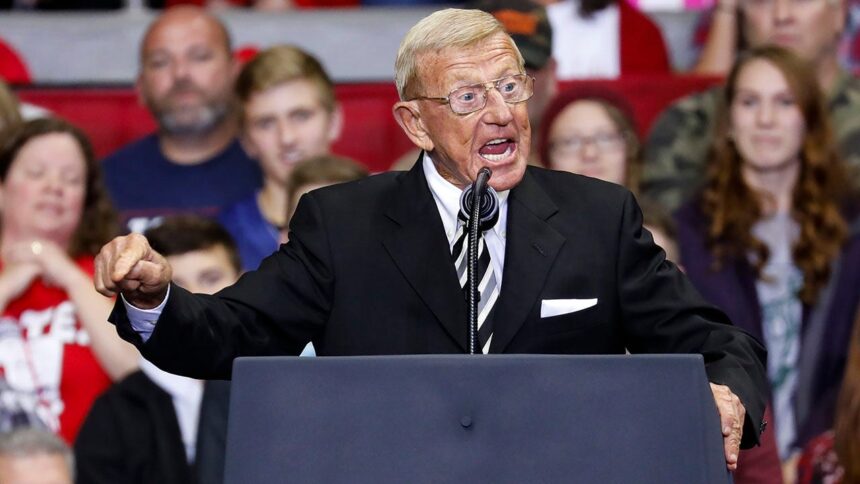
Beyond the Playbook: Kam Buckner’s Tribute Highlights Lou Holtz’s Enduring Legacy of Character
The passing of a sports legend often triggers a flood of statistics and championship highlights. But when news broke of Coach Lou Holtz’s death at 87, the tributes that resonated most spoke a different language. They spoke of loyalty, life lessons, and the profound impact one man could have far beyond the gridiron. In a poignant reflection that bridges politics, sports, and personal history, Illinois State Representative Kam Buckner offered a unique tribute, revealing a side of Holtz that statistics can never capture: the relentless builder of men.
A Chicago Kid’s Idol Becomes a Personal Mentor
For Kam Buckner, a Democrat representing Chicago’s 26th District, Lou Holtz was first a fixture of his childhood. “Like a lot of Chicago kids, I grew up watching Lou Holtz on the sidelines at Notre Dame,” Buckner told Fox News Digital. “South Bend always felt like it was right next door to us, and Coach Holtz was synonymous with that program and with college football in general.” This was the Holtz known to millions: the iconic leader of the Fighting Irish, the master strategist with the distinctive lisp, holding a national championship trophy aloft.
Yet, Buckner’s story took a personal turn years later. As a standout football prospect at Morgan Park High School, Buckner’s path intersected with Holtz’s in an unexpected chapter. After his tenure at Notre Dame, Holtz had taken the helm at the University of South Carolina. “I was incredibly honored that our paths crossed years later when he recruited me during his time at South Carolina,” Buckner shared. This shift from distant idol to direct recruiter framed Holtz’s legacy not in wins, but in personal investment.
The Holtz Philosophy: Raising People, Not Just Athletes
Buckner’s personal anecdote perfectly aligns with the core philosophy echoed by other football giants mourning Holtz. Appearing on ‘Fox & Friends,’ icons like Urban Meyer and Irv Smith didn’t lead with his 249 career wins. Instead, they highlighted his unwavering loyalty and, most powerfully, his commitment to “raising people, not athletes.” This was the bedrock of the Holtz method.
His coaching was a holistic curriculum in accountability and excellence. Former players consistently recount lessons that served them long after their playing days ended:
- Demanding Discipline: Holtz’s famous rules and attention to detail were less about control and more about teaching personal responsibility.
- Instilling Belief: His ability to motivate, often with self-deprecating humor and unwavering optimism, convinced young men they could achieve the improbable.
- Prioritizing Education: A graduate himself, Holtz stressed the non-negotiable nature of academic progress, understanding the playbook for life was written in the classroom.
- Leading with Integrity: In an era of increasing pressure, his old-school approach emphasized character as the ultimate measure of success.
For a young Kam Buckner, being recruited by such a figure was a validation of potential that transcended athletic skill. It was an invitation into a program built on this broader developmental mission.
The Lasting Impact: From the Locker Room to the Legislative Floor
While Buckner ultimately attended the University of Illinois, where he played defensive line, the impression left by Holtz endured. The values Holtz preached—teamwork, perseverance, and service—are the very currencies of public life. Buckner’s career trajectory, from athlete to lawmaker advocating for his community, embodies the “raising people” ethos Holtz championed.
This is the subtle, generational impact of a coach like Holtz. His legacy isn’t confined to the players who suited up for him on Saturday. It extends to the prospects he genuinely connected with during recruitment, the fans who adopted his maxims for their own lives, and the coaches like Meyer who carried his principles forward. It exists in the recognition, as Buckner demonstrated, that the most meaningful coaching happens in the one-on-one conversations, the letters of encouragement, and the sincere effort to see a person’s full potential.
A Legacy That Outlasts Any Championship Trophy
In today’s era of college athletics, defined by transfer portals and name, image, and likeness (NIL) deals, the Holtz model of program-building can seem like a relic. The intense, familial loyalty he fostered appears at odds with the modern player’s mobility. However, the universal mourning from across the sports world suggests his philosophy addresses a timeless hunger.
Predicting the future of coaching in Holtz’s image is complex. The economic and structural realities of the sport have irrevocably changed. Yet, the most successful leaders of the next generation will likely be those who can adapt Holtz’s core tenet—authentic mentorship—to this new landscape. The coaches who understand that building a culture of trust and personal growth isn’t antithetical to winning, but foundational to sustained success, will thrive. Players, despite new freedoms, will still gravitate toward environments where they are developed as whole individuals.
Kam Buckner’s tribute, a heartfelt statement from a state legislator to a coach who believed in him decades ago, cuts through the noise of modern sports. It reminds us that Lou Holtz’s greatest victory wasn’t a national title in 1988. It was the countless young men, both those he coached and those he merely inspired, who learned that the discipline to block a defensive end and the courage to draft a piece of legislation can spring from the same well of character. As Buckner said he prays for Holtz’s family, a nation of football fans and beneficiaries of his wisdom gives thanks for a coach whose playbook for life will continue to call audibles for generations to come.
Source: Based on news from Fox Sports.