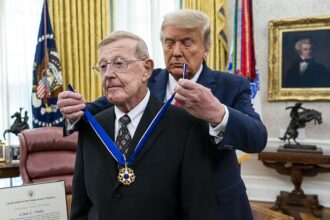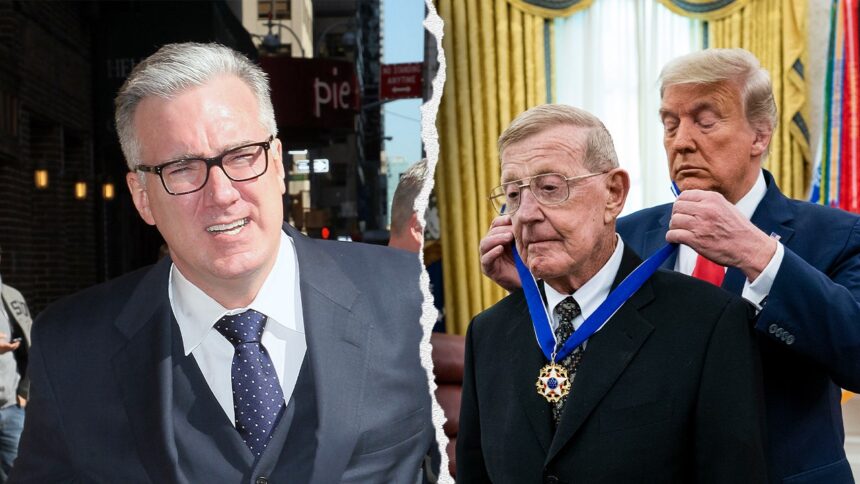
Keith Olbermann’s “Scumbag” Salvo at Late Lou Holtz Ignites Fiery Debate on Decorum, Legacy, and Politics
The worlds of sports, media, and politics collided with jarring force this week, as the passing of a coaching titan was met not with universal reverence, but with a blistering, posthumous rebuke. The death of Lou Holtz, the iconic 89-year-old former Notre Dame football coach who led the Fighting Irish to a national championship in 1988, was announced Wednesday. In the ensuing flood of tributes celebrating his motivational genius and historic career, a starkly dissonant note was struck by former ESPN broadcaster Keith Olbermann. On the social media platform X, Olbermann labeled the late coach a “legendary scumbag,” reigniting a fierce and familiar debate about the boundaries of commentary, the sanctity of legacy, and the ever-widening chasm of American discourse.
A Clash of Icons: The Incendiary Tweet and the Backlash
The spark was a resurfaced 2020 video clip. In it, Lou Holtz, a lifelong Republican and devout Catholic, explained his support for then-President Donald Trump at the Republican National Convention, criticizing Democratic candidate Joe Biden’s stance on abortion rights as contrary to Holtz’s core beliefs. In response to this clip posted on the day of Holtz’s death, Olbermann, a vocal and often acerbic liberal commentator, issued his terse, two-word verdict: “Legendary scumbag, yes.”
The reaction was immediate and scathing. The digital public square fractured along predictable lines, but a significant wave of criticism washed over Olbermann for his timing and tone.
- Critics accused Olbermann of a profound lack of decorum, arguing that a day of mourning for a family, a university, and millions of fans was not the moment for settling political scores.
- Many highlighted the personal nature of Holtz’s beliefs, rooted in his faith, and saw Olbermann’s attack as needlessly venomous.
- Others pointed to Holtz’s vast, positive impact on countless players, his public battles with anxiety, and his philanthropic work, framing Olbermann’s reduction of the man to a single political stance as journalistically bankrupt.
Olbermann, no stranger to controversy, stood his ground in the thread, doubling down on his characterization and engaging with detractors. Yet, the episode transcended a simple social media spat. It became a case study in modern media ethics and the complicated evaluation of a public figure’s life.
Expert Analysis: Deconstructing the Firestorm in Sports Media
To understand the magnitude of this incident, one must examine the profiles of the two men involved. Lou Holtz was more than a coach; he was a cultural institution, a symbol of a certain brand of disciplined, faith-based leadership. His “Do Right” rule was quoted in locker rooms and boardrooms alike. Keith Olbermann, meanwhile, represents the evolution—or devolution, depending on one’s perspective—of the sports commentator into the political pundit. His early career at ESPN was marked by brilliant, cutting-edge highlights but also by clashes that previewed his later style.
“This isn’t just about one tweet,” explains Dr. Elena Martinez, a professor of Media and Public Discourse. “It’s about the final, full erosion of the separation between the sports desk and the opinion desk. Olbermann is operating from a playbook where provocation is the primary metric of engagement. By attacking a beloved figure at his most vulnerable moment—the moment of his death—he guarantees amplification. The ethical question for media consumers is whether we reward that calculus with our attention.”
Furthermore, the incident lays bare the challenge of holistic legacy assessment. Can a man’s positive contributions to thousands of young men’s lives be invalidated by political opinions others find objectionable? Conversely, should those opinions be shielded from criticism because of athletic achievements? In an era of cancel culture and heightened sensitivity, Olbermann’s blast rejected nuance in favor of a stark, polarizing judgment.
Predictions: The Lasting Repercussions for Commentary and Culture
The fallout from this digital confrontation will ripple beyond a single news cycle. We can anticipate several key developments:
1. The Further Niche-ification of Sports Media: This event will harden the boundaries between traditional, apolitical sports coverage and the growing field of politicized sports commentary. Audiences will increasingly self-select into outlets that match their worldview, making broadly trusted, neutral voices even rarer.
2. The “Olbermann Model” Will Be Emulated and Condemned: Regardless of one’s view of his tactics, Olbermann’s engagement metrics will be studied. Expect more commentators, especially those building personal brands on subscription or social media platforms, to employ similar shock-and-awe rhetorical strategies, targeting sacred cows to generate viral momentum.
3. Legacy Becomes a Battlefield: The obituaries of future polarizing sports figures—coaches, owners, or athletes with strong political footprints—will be contested territory. The immediate hours after a death will no longer be a respectful pause but may become the opening salvo in a war over how that person is remembered. Digital memorials will be instantly politicized.
4. A Boomerang Effect on Olbermann: While solidifying his standing with a progressive base that applauds his takedowns of conservative figures, this incident likely permanently burns any bridge to mainstream, neutral sports media roles. His brand becomes synonymous with a specific, combative form of commentary, limiting its scope but intensifying its appeal to a dedicated audience.
Conclusion: Beyond the Insult, a Symptom of a Deeper Malady
At its core, the firestorm over Keith Olbermann’s “scumbag” comment is not really about Lou Holtz. The late coach’s legacy, forged over six decades of public life, is robust enough to withstand a single ugly tweet. Nor is it solely about Olbermann, who has long occupied his self-defined role as a partisan agitator.
This incident is a stark symptom of a deeper cultural malady: the inability to separate the person from the politics, and the collapsing of all public discourse into a binary, winner-take-all conflict. It highlights a world where respect for the dead is conditional upon ideological alignment, and where the complex tapestry of a human life—flaws, faith, triumphs, and convictions—is shredded to isolate a single thread for condemnation or praise.
Lou Holtz coached football. He held political opinions. He inspired millions and, like all humans, possessed contradictions. Keith Olbermann chose, at the moment of the man’s passing, to define him solely by the most divisive of those threads. In doing so, he provided less a critique of Holtz and more a revealing reflection of our fractured times, where the final score of a culture war is mistakenly believed to outweigh simple humanity. The true loss is not just a legendary coach, but the shared space where we could once remember him without immediately picking a side.
Source: Based on news from Fox Sports.