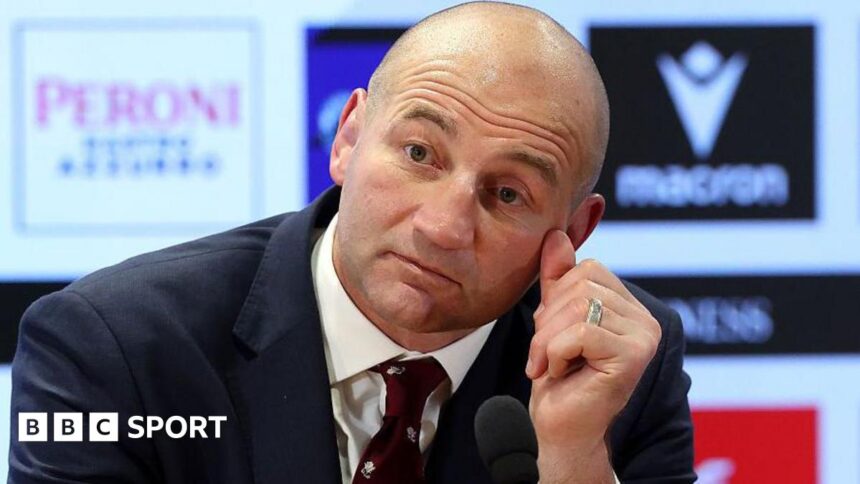
Does Rome Defeat Mark the Beginning of the End for Steve Borthwick’s England?
The Stadio Olimpico in Rome has witnessed many historic afternoons, but few as seismic for English rugby as the one on February 3rd, 2024. As a cacophony of Italian celebration engulfed the pitch, England’s players stood in isolated pockets of despair, their postures slumped, their expressions blank. The 27-24 scoreline wasn’t just a first-ever Italian victory in this fixture; it felt like a fracture. The questions that have simmered around Steve Borthwick’s project since its inception are now boiling over. Was this more than a bad day? Does this historic defeat in Rome mark the beginning of the end for the Borthwick empire?
A Defeat That Transcends the Scoreboard
Losses happen in sport. Even great teams suffer unexpected setbacks. But England’s performance in Rome transcended the category of a mere upset or a “blip.” This was a systemic failure, a display so devoid of cohesion, clarity, and conviction that it laid bare the fundamental flaws Borthwick has struggled to address. For over a year, the narrative has been one of building, of foundational work, of incremental progress. In Rome, that narrative crumbled.
The statistics are damning, but the optics were catastrophic. England, a team with vastly greater resources and player pool, was out-thought and out-fought by an inspired Italian side. The critical period came early in the second half when, already under pressure, England saw two players sent to the sin-bin in quick succession. Playing with 13 men against a confident Azzurri was a death knell. As Borthwick himself conceded, “Going down to 13 hurt us badly.” Yet, the problem was not the cards themselves, but the ill-discipline and tactical panic that preceded them, and the total lack of a survival plan that followed.
This was not a dip in form or a slip on the road. This was a team appearing to regress at an alarming rate. The attack, a persistent worry, was shapeless. The defence, Borthwick’s supposed forte, was porous and disorganised. The leadership on the field was invisible. When a team shows no discernible identity or improvement after 15 months under a coach, the spotlight turns inexorably to the man in charge.
Dissecting the Borthwick Project: Promise vs. Reality
Steve Borthwick was appointed as the antidote to the chaotic final days of Eddie Jones’s reign. He was the meticulous planner, the detail-obsessed technician who would restore England’s set-piece dominance and tactical discipline. The early promise of a run to the World Cup semi-final papered over some significant cracks, but the facade has now well and truly fallen away.
Let’s examine the core pillars of Borthwick’s mandate and their current state:
- Tactical Clarity: England’s game plan remains a mystery. Is it a power-based game? A territorial kicking game? The team seems caught between philosophies, resulting in a stodgy, predictable, and ineffective hybrid. Contrast this with Italy’s clear and adventurous plan, executed with belief.
- Player Development: Key players look shackled or are in decline. Marcus Smith’s mercurial talent is intermittently utilised. The midfield combination remains a revolving door. There is no sense of a cohesive unit growing in understanding with each Test.
- Leadership Core: On-field leadership in times of crisis is non-existent. When Italy gained momentum, no English player took control, rallied the troops, or altered the course. This points to a potential disconnect between the coaching room and the pitch.
- Public and Pundit Confidence: The reservoir of goodwill is empty. The patience afforded to a “new project” has expired. The discourse has shifted from hopeful analysis to frank discussion about the coach’s future.
The reality is that the Borthwick era is defined by stagnation. The World Cup provided a temporary shield, but the Six Nations is an unforgiving examination of progress, and England is failing spectacularly.
The Road Ahead: Crisis Point or Turning Point?
The immediate fixture list offers no respite. England now faces a wounded Wales, a formidable Ireland, and a resurgent Scotland. The prospect of a first-ever Wooden Spoon since 1987 is no longer a hyperbolic scare story; it is a genuine mathematical possibility. This is the defining period for Steve Borthwick.
So, what happens next? Several paths are now possible:
- Immediate Backing with Ultimatum: The RFU could publicly back Borthwick for the remainder of the Championship but demand a visible, tangible shift in performance and results. Moral victories will not suffice.
- Coaching Staff Shake-up: The pressure may fall on his assistants, particularly attack coach Richard Wigglesworth. A high-profile consultant could be brought in, but this often signals a coach living on borrowed time.
- The Point of No Return: If heavy defeats follow and the team shows no reaction, the RFU may be forced to act before the summer tour. The financial and reputational damage of a full-blown crisis may outweigh the disruption of a mid-cycle change.
Borthwick’s challenge is now existential. He must prove, and quickly, that he can:
- Instill a clear and effective tactical identity.
- Unlock the potential of his most creative players.
- Restore the confidence and belief of a squad that looks mentally fragile.
The coming weeks are not about winning a championship; they are about proving he is still the man to lead England to the 2027 World Cup.
Verdict: An Empire on the Brink
The term “crisis” is often overused in sport. After Rome, for England, it feels entirely apt. This defeat was not an accident; it was a manifestation of deep-seated issues that have festered under Borthwick’s tenure. The lack of progress, the absence of a coherent style, and the palpable lack of spirit are indictments of the current regime.
While it may be premature to say the end has definitively arrived, the beginning of the end is undoubtedly here. The foundations of Borthwick’s empire are cracked. The faith of the players, the media, and the fans is evaporating. History tells us that when such a tide turns, it is nearly impossible to reverse.
Steve Borthwick now stands on the precipice. The Rome defeat was the clearest warning siren yet. He has a handful of matches to demonstrate a revolution in his team’s fortunes. If he cannot, the RFU will be faced with an unavoidable decision. Empires do not fall in a day, but the cracks that presage their collapse are now glaringly visible in the ruins of the Stadio Olimpico. The clock is ticking, and for Borthwick, time is running out.
Source: Based on news from BBC Sport.