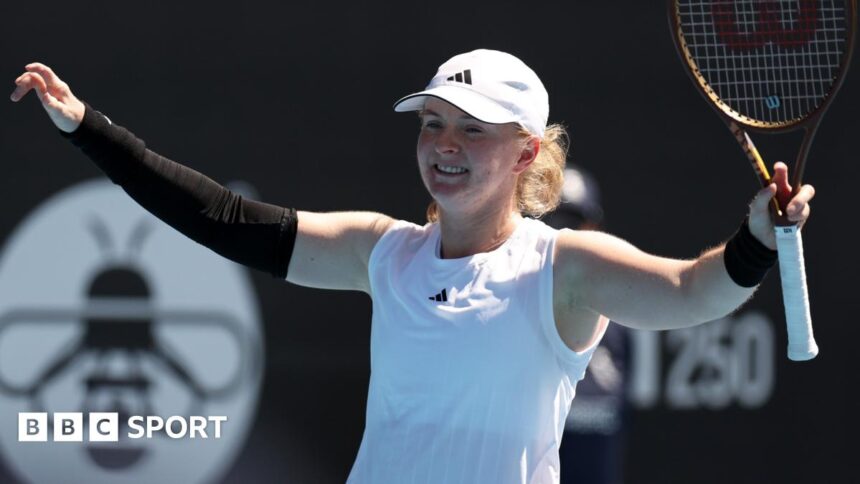
‘No Idea What Just Happened’: Francesca Jones’ Gritty Auckland Triumph Over Injury
The most compelling sports stories aren’t always about flawless victory; they are about the chaotic, painful, and utterly bewildering journey through adversity. Britain’s Francesca Jones authored one such chapter at the ASB Classic in Auckland, scripting a comeback that left even its protagonist searching for words. “No idea what just happened,” Jones confessed, a statement that perfectly captured the surreal nature of her three-set, injury-hampered victory over Austrian qualifier Sinja Kraus to storm into the quarter-finals. This win, hot on the heels of the biggest triumph of her career, revealed not just a rising tennis talent, but a formidable depth of character.
From Career-High to Physical Low: A Rollercoaster 24 Hours
To understand the magnitude of Jones’ effort against Kraus, one must rewind just one day. On Monday, the world number 72 produced a stunning performance, dismantling world number 15 and top seed Emma Navarro in three sets. It was a victory that signaled her arrival on the main stage, a validation of years of work overcoming unique challenges—Jones was born with a rare genetic condition, ectrodactyly ectodermal dysplasia, affecting her fingers and toes.
The physical toll of that career-defining win, however, was immediately apparent in her next match. Facing the gritty qualifier Sinja Kraus, Jones was a shadow of her previous self. She moved tentatively, her service motion looked compromised, and she twice summoned the physiotherapist for treatment. Trailing 1-6, 0-2, the narrative seemed set: a heroic effort followed by an inevitable physical letdown.
“You could see she was really struggling,” noted one courtside analyst. “The spring in her step from the Navarro match was gone. It looked like a matter of when, not if, Kraus would close it out.”
The Anatomy of an Improbable Comeback
What transpired from that precipice was nothing short of remarkable. Jones, digging into reserves she likely didn’t know she had, began to reset. The comeback wasn’t instantaneous magic; it was a gritty, point-by-point reconstruction of the match.
- Regrouping at the Brink: Down a set and a break, Jones focused on holding her own serve to stop the bleeding. A single hold built a sliver of confidence.
- Targeted Aggression: Despite her physical woes, she began to redirect the ball, using her intelligent court sense to move Kraus and create openings, winning 12 of the next 14 games.
- Mental Fortitude: This was the key differentiator. Jones compartmentalized the pain, while Kraus, faced with a resurgent and determined opponent, saw her error count rise and her first-serve percentage plummet.
The 1-6 6-4 6-1 scoreline tells a tale of two matches. The first was dominated by Kraus and Jones’ physical limitations. The final two sets were a masterclass in competitive heart, a testament to Jones’ ability to problem-solve under extreme duress.
Expert Analysis: What This Means for Jones’ 2024 Season
This week in Auckland represents a potential watershed moment for Francesca Jones. Beating a top-15 player is a milestone, but battling through injury to back it up with another win is often a greater indicator of future success. It proves the first win wasn’t a fluke, but a manifestation of a new level.
Key takeaways for her season:
Ranking Surge Incoming: These points will propel Jones significantly closer to, or potentially inside, the Top 60. This means direct entry into bigger tournaments, avoiding gruelling qualifiers, and a more manageable schedule.
Proof of Resilience: The tennis tour is a brutal physical grind. Players now have concrete evidence that Jones is not only skilled but also one of the tour’s tougher outs. She can win ugly, a prerequisite for consistency.
Health is the Only Question: The obvious caveat is her physical condition. Managing her body, especially after such a taxing effort, will be paramount. If she can maintain fitness, her intelligent, counter-punching style blended with newfound belief makes her dangerous on any surface.
Predictions and Pathway Forward in Auckland and Beyond
Jones’ immediate focus will be recovery before her Auckland quarter-final. Regardless of the result, her week is already a resounding success. However, the momentum she has built is a precious commodity.
Looking at the broader 2024 landscape, Jones has positioned herself as a dark horse for Grand Slam relevance. A seeding at a major is now a realistic goal for the latter part of the year. Her game, built on variety and tactical acumen rather than sheer power, can disrupt higher-ranked players, as Navarro can now attest.
The upcoming Australian Open will be a fascinating test. Can she carry this physical and mental momentum into a best-of-five-sets environment? Based on her Auckland display, writing her off in any match situation would be a mistake. She has announced herself not just as a player of skill, but as a competitor of the highest order.
Conclusion: The Power of Not Knowing
Francesca Jones’ bewildered statement, “No idea what just happened,” is the most authentic summary possible. The best athletes sometimes operate on a plane beyond conscious thought, driven by instinct, habit, and sheer will. In those 14 devastating games against Sinja Kraus, Jones tapped into that zone. She transformed a match defined by injury into a statement of intent.
This week in New Zealand, the tennis world learned more about Francesca Jones than her ranking or her backhand. It learned about her heart. She didn’t just win two matches; she conquered pain, expectation, and probable defeat. For a player who has navigated a unique path to the tour, this gritty Auckland run is a fitting emblem of her career: unpredictable, hard-fought, and ultimately triumphant. The rest of the WTA tour is now firmly on notice.
Source: Based on news from BBC Sport.