Broncos’ Calculated Cap Move: Dre Greenlaw Designated as Post-June 1 Cut
In the high-stakes chess game of NFL roster management, timing is often as critical as talent. The Denver Broncos, under the meticulous direction of General Manager George Paton, are executing a strategic financial maneuver that underscores this very principle. According to a report by Chris Tomasson of the Denver Gazette, the team has not released veteran linebacker Dre Greenlaw outright. Instead, they will wait for the new league year to formally designate him as a post-June 1 cut, a procedural decision with significant ramifications for the team’s salary cap health and future plans. This move, while signaling the end of Greenlaw’s brief tenure in Denver, is a masterclass in navigating the league’s complex financial rules.
Decoding the Financial Playbook: Why the Post-June 1 Designation Matters
To the casual fan, a cut is a cut. But in the NFL’s accounting universe, the calendar date is everything. The post-June 1 designation is a tool that allows teams to spread the “dead money” — the remaining prorated signing bonus acceleration — over two league years instead of one. For the Broncos and Greenlaw, the numbers tell a compelling story of necessity.
- Immediate Cap Savings: By using the designation, the Broncos will save $8.19 million against the 2025 salary cap. If they had released him before June 1, the savings would have been only $6.023 million.
- Dead Cap Impact: The flip side is the dead money. The 2025 hit is reduced to $2.166 million (instead of $4.33 million), but the team will carry an additional $2.164 million in dead money into the 2027 cap.
This decision is a clear indicator of Denver’s pressing need for cap flexibility this offseason. The extra $2+ million in immediate space is crucial for addressing other roster holes, re-signing key players, or making a strategic addition in free agency. It’s a classic case of kicking a small financial can down the road to address a more urgent need today.
A Denver Tenure Defined by Adversity
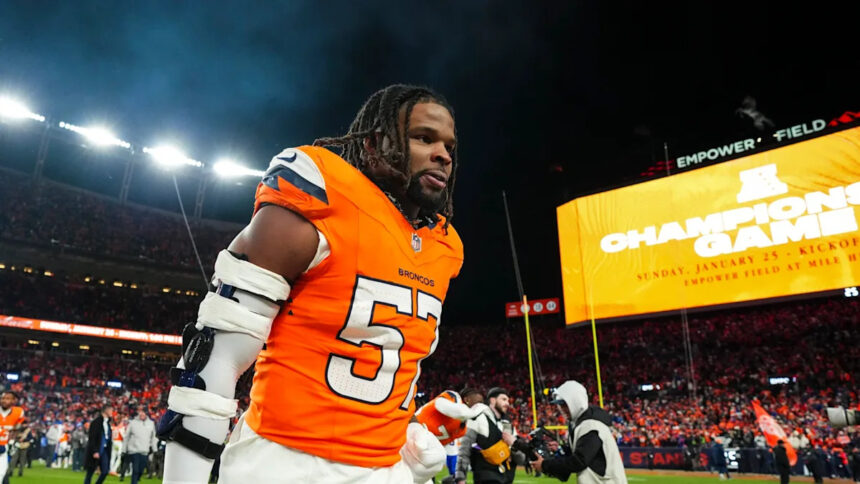
Dre Greenlaw’s arrival in Denver just last March was met with optimism. Signed to a three-year contract worth up to $21 million, he was brought in to bring toughness, veteran leadership, and playmaking ability to the heart of Vance Joseph’s defense. Unfortunately, his season never found its rhythm. A quad injury sidelined him early, and a subsequent suspension further disrupted his availability and continuity.
In his eight regular-season appearances, Greenlaw’s stat line—43 tackles, a sack, an interception, and a forced fumble—showed flashes of the impact player he was in San Francisco. However, his inability to stay on the field consistently made it difficult for him to anchor the unit as envisioned. When he was healthy, the defense performed at a higher level, but his absences created instability. The Broncos’ decision to re-sign linebackers Justin Strnad and Alex Singleton to new deals last month was the first signal that Greenlaw’s future with the team was in serious jeopardy, providing the roster depth needed to facilitate this move.
Expert Analysis: The Ripple Effects on Denver’s Defense
This move is more than a simple salary dump; it’s a pivot point for the Broncos’ defensive identity. Greenlaw was intended to be a tone-setter. His departure, coupled with the re-signing of Strnad and Singleton, suggests a shift in philosophy or at least a recalibration of resources.
“The Broncos are prioritizing availability and cost certainty,” says a veteran NFL scout we spoke to under condition of anonymity. “Greenlaw, when right, is a top-15 linebacker in this league. But the injury and suspension raised valid questions about reliability. By moving on and utilizing the post-June 1 rule, Paton is freeing up capital to invest in positions of greater long-term need, perhaps along the defensive line or in the secondary. This is a front office saying they’d rather have two reliable, known commodities in Singleton and Strnad, plus $8 million to spend elsewhere, than one potentially elite player who might not be on the field.”
The immediate onus will now fall on Jonas Griffith and Drew Sanders to step into larger roles. Sanders, a 2023 third-round pick, now faces a critical third-year leap opportunity. The linebacker room becomes younger and less proven, placing greater schematic pressure on Defensive Coordinator Vance Joseph to maximize their collective skills.
Predictions and What’s Next for Greenlaw and the Broncos
For Dre Greenlaw, this designation means he will hit the free agent market when the new league year begins, albeit with the official cap hit deferred for Denver. He will be an intriguing name in the second wave of free agency. Teams in need of a proven, physical linebacker with playoff pedigree—provided they are comfortable with his medicals—will certainly call. Look for contenders with a need at the position, or a defensive-minded coach familiar with his skillset, to be potential suitors. A short-term, “prove-it” deal seems his most likely path.
For the Denver Broncos, the path is clear:
- Cap Space Utilization: The additional $8.19 million will be instrumental. Watch for it to be used to extend a core young player, add a mid-tier free agent offensive lineman, or provide a cushion for in-season acquisitions.
- Draft Focus: Linebacker, which may have been a mid-round consideration, could now vault into a Day 1 or Day 2 priority. The Broncos will be scouting every top linebacker prospect at the Combine.
- Culture Continuity: Retaining Alex Singleton, a defensive captain and tackling machine, sends a strong message about valuing leadership and consistency as the team continues its rebuild.
Conclusion: A Business Decision in the Brutal NFL Landscape
The designation of Dre Greenlaw as a post-June 1 cut is a sobering reminder of the NFL’s “what have you done for me lately?” ethos. It is not an indictment of Greenlaw’s talent, but rather a cold, calculated assessment of value, cost, and reliability. The Broncos, pressed against the cap and building for sustainable success, chose financial maneuverability and roster predictability over high-end potential with associated risk.
This is the essence of modern NFL team-building: difficult choices made with a spreadsheet in one hand and a roster sheet in the other. While Broncos fans may lament what could have been with a healthy Greenlaw, the front office has demonstrated a clear-eyed approach to navigating a challenging cap situation. The success of this move will ultimately be judged by how effectively the Broncos reinvest the savings and who lines up at linebacker come September. The chess match continues, and Denver has just made a pivotal move for the 2025 board.
Source: Based on news from Yahoo Sports.