Infantino: Trump Gives “Green Light” for Iran to Play 2026 World Cup in USA
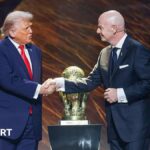
In a stunning intersection of global sport and high-stakes geopolitics, FIFA President Gianni Infantino has declared that former U.S. President Donald Trump has provided assurances that Iran’s national football team will be permitted to travel to the United States to compete in the 2026 FIFA World Cup. This revelation, coming directly from a meeting between Infantino and Trump, aims to quell a brewing storm of uncertainty surrounding Iran’s participation in the tournament, which will be co-hosted by the USA, Canada, and Mexico. With Iran’s group stage matches all scheduled on American soil, the statement attempts to firewall the world’s largest sporting event from the escalating tensions that define U.S.-Iran relations. But can a political promise, especially one from a former president eyeing a return to power, truly guarantee a geopolitical détente on the football pitch?
The Assurance: A Political Pass for Team Melli
The core of Infantino’s announcement is both simple and profoundly complex. Following their meeting, Infantino stated that Trump “reiterated that the Iranian team is, of course, welcome to compete in the tournament in the United States.” This assurance is critical because the 2026 World Cup draw has placed Iran in a position where their entire group stage journey will unfold in U.S. cities. Without explicit guarantees, the specter of visa denials, travel restrictions, or diplomatic incidents could have derailed their participation, undermining the integrity of the tournament and inflaming international tensions.
Key elements of the situation include:
- Geographic Necessity: Iran cannot participate in the 2026 World Cup without entering the United States.
- Timing of the Assurance: The promise comes from a former president, not the current administration, adding a layer of political uncertainty.
- FIFA’s Diplomatic Role: Infantino’s move is a classic example of sports diplomacy, attempting to preempt a crisis by securing top-level political backing.
This isn’t merely about athlete visas; it’s a high-profile test of whether the unifying spirit of the World Cup can temporarily suspend decades of mutual hostility. For the players of Team Melli, it represents a fragile hope that their sporting dreams won’t be casualties of a political landscape they do not control.
Expert Analysis: Navigating a Minefield of Politics and Protocol
Sports analysts and geopolitical experts are parsing Infantino’s statement with a mix of cautious optimism and deep skepticism. The central question is one of authority and follow-through.
“The promise from President Trump is significant, but it is not operational,” notes Dr. Sarah Jenkins, a professor of sport and geopolitics. “It signals a potential pathway, but the actual implementation of visa approvals, security protocols, and on-the-ground logistics will fall to the State Department and Homeland Security apparatus of the sitting president in 2026. This is where the real challenge lies.”
Furthermore, the analysis reveals several critical layers:
- The 2024 Wild Card: Trump’s potential re-election in November 2024 would transform his assurance from a political comment into a likely policy directive, simplifying the process immensely.
- A Biden Administration Scenario: If President Joe Biden remains in office, his administration would be tasked with honoring a pledge made by his political rival. While the Biden White House would likely support FIFA’s apolitical stance, any fresh geopolitical crisis could complicate matters.
- The Iranian Response: Tehran has yet to officially comment. Domestic hardliners may frame the requirement to seek U.S. visas as a humiliation, while football authorities and fans will push for participation. The regime will weigh the propaganda value of competing on the world’s biggest stage against any perceived concession.
Infantino, in this view, has effectively kicked the can down the road, using Trump’s assurance to manage the narrative today while the actual resolution remains years away.
Predictions for 2026: Scenarios on the Road to Kick-Off
As the 2026 World Cup approaches, several distinct scenarios could unfold, each with dramatic implications for the tournament and international relations.
Scenario 1: The Smooth Passage (Most Likely)
Despite the noise, the most probable outcome is that Iran competes. The financial and reputational cost to FIFA and the host nations of a no-show would be catastrophic. Behind-the-scenes diplomacy, likely involving neutral third parties and strict security agreements, will ensure visas are granted. The teams and fans will be subject to unprecedented security, but the games will go on.
Scenario 2: The Diplomatic Crisis
A geopolitical flashpoint—such as a nuclear advancement, regional proxy attack, or internal unrest in Iran—occurs in the months leading up to the tournament. This could lead to renewed U.S. sanctions or travel bans, putting the assurance under immense strain. FIFA could be forced into a last-minute, controversial venue change to Mexico or Canada, a logistical nightmare.
Scenario 3: The Iranian Withdrawal
Pressure from hardline factions within Iran leads the government to voluntarily withdraw, citing the “hostile environment” of the United States. This would be framed domestically as an act of defiance. While damaging to the competition, it would allow Iran to control the narrative and avoid potential protests or incidents involving its players on U.S. soil.
The wildcard in all predictions is the American political climate in mid-2026. The World Cup will unfold in a nation possibly gripped by a renewed presidential campaign or early in a new administration. The tournament will be a global stage not just for football, but for America’s political mood, with Iran’s presence serving as a live case study.
Conclusion: Football’s Ultimate Stress Test
Gianni Infantino’s announcement is less a final solution and more a high-profile opening gambit in a delicate diplomatic game that will play out over the next two years. By publicly securing Donald Trump’s “green light,” he has placed a powerful marker down, attempting to establish a principle of sporting inclusion that future U.S. administrations will find difficult to publicly overturn. He has shifted the burden of potential disruption onto political actors, positioning FIFA as the guardian of the game’s unity.
Ultimately, the saga of Iran’s 2026 World Cup participation will be the ultimate stress test for the idea that football exists separate from politics. The beautiful game has often been a conduit for diplomacy, but rarely under such a glaring, pre-meditated spotlight. The world will watch to see if a 90-minute match on a field in New York, Los Angeles, or Dallas can accomplish what decades of statecraft have failed to do: create a temporary, but genuine, zone of neutral ground. The final whistle on this issue is still years away, but the first, most crucial political pass has now been played.
Source: Based on news from India Today Sport.
Image: CC licensed via www.rawpixel.com