Michael Owen’s Verdict: Why Michael Carrick is the Man to Lead Manchester United
The search for a permanent Manchester United manager is the Premier League’s most captivating saga, a high-stakes drama filled with big-name contenders and intense public debate. Yet, according to a former teammate who shared the pitch with him during Sir Alex Ferguson’s final glory years, the answer has been in the dugout all along. Michael Owen, the former United and England striker, has delivered a powerful endorsement of caretaker boss Michael Carrick, stating he “can’t believe people are questioning” his suitability for the role. In an era of flashy appointments and philosophical overhauls, Owen’s argument cuts through the noise: the solution is a figure of calm, competence, and deep-rooted club DNA.
From Teammate to Tactician: Owen’s Inside Track on Carrick’s Meteoric Rise
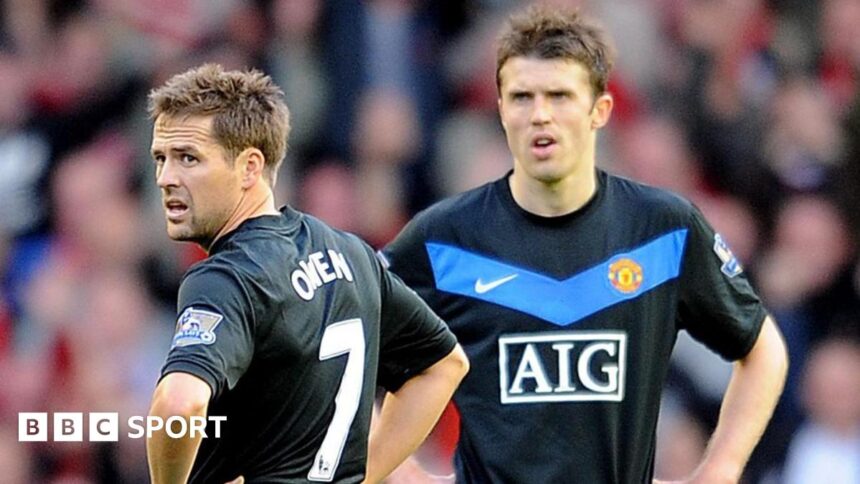
Michael Owen and Michael Carrick’s paths converged at Old Trafford between 2009 and 2012, a period that included a Premier League title and a Champions League final. Owen witnessed firsthand the qualities that defined Carrick as a player: intelligence, composure, and an unflappable temperament. Now, Owen sees those same attributes translating seamlessly into management. “When you play with someone, you get a real sense of their football brain and their character,” Owen’s insight suggests. “Michael was never the loudest, but he was always the most influential. He saw pictures on the pitch before anyone else. It’s no surprise to me that he’s brought a calm back to the club.”
This calm authority has been the cornerstone of Carrick’s impressive interim tenure. Appointed caretaker in January following the abrupt dismissal of Ruben Amorim, the 44-year-old inherited a squad low on confidence and languishing in sixth place. The transformation has been stark. With six wins from eight matches, United have surged to third in the table, playing with a structure and purpose that had been missing.
By the Numbers: The Compelling Case for Carrick’s Continuity
The statistical evidence supporting Carrick’s appointment is formidable. Moving beyond the raw win-loss record, the underlying metrics and the atmosphere around the club reveal a significant shift. The narrative of a “caretaker bounce” doesn’t fully capture the sustained improvement he has engineered.
- Immediate Impact: Six wins from eight Premier League games, including crucial victories over top-four rivals.
- Defensive Solidity: A marked reduction in costly individual errors and a more organized defensive unit.
- Midfield Balance: A clear return to the United principle of controlling games through the center of the park.
- Player Response: Public and private endorsements from senior squad members, highlighting improved communication and clarity.
Perhaps most tellingly, Owen’s claim that “everyone at Man Utd loves him” speaks to a cultural reset. In the post-Ferguson era, the club has often felt divided—between players and managers, between the terraces and the boardroom. Carrick, with his 464 appearances for the club, bridges those gaps. He is not an outsider imposing a philosophy; he is a club legend reminding the team of its core identity.
Expert Analysis: Carrick vs. The “Marquee Name” Dilemma
The modern football boardroom often operates with a checklist: a proven winner, a distinct tactical “brand,” and global marketability. Names like Zinedine Zidane, Julian Nagelsmann, or Roberto De Zerbi naturally excite fans and commercial departments. However, Owen’s backing of Carrick challenges this orthodoxy. It asks a fundamental question: does Manchester United need another revolutionary, or a restorer?
Carrick’s approach is not a nostalgic retreat. It is a modern application of United’s traditional virtues—pace on the wings, midfield control, and attacking football—executed with a tactical acumen honed under Jose Mourinho and Ole Gunnar Solskjaer. His success underscores a truth often forgotten: man-management and cultural fit can be as critical as a complex pressing scheme. He understands the weight of the shirt, the expectation of the Stretford End, and the standards set by the Class of ’92, a generation he played alongside and now seeks to emulate from the technical area.
Furthermore, the gamble on a “proven” manager has repeatedly backfired at Old Trafford. Carrick represents a different kind of risk—one on potential, understanding, and long-term vision. In an environment where patience is scarce, his appointment would be a bold statement of faith in continuity and internal development.
Prediction: What a “Carrick Era” Could Look Like at Old Trafford
If handed the permanent role, what can United expect? Based on his brief tenure and Owen’s testimony, the blueprint is clear. The Carrick era would likely be defined by pragmatic evolution rather than radical revolution. We would see a continued emphasis on youth development, with the academy pipeline feeding a first-team squad playing a 4-3-3 or 4-2-3-1 system built on control.
Expect a focus on intelligent, technically-gifted midfielders—players in his own image—and wingers encouraged to express themselves. The transfer strategy would likely shift from chasing superstar names to identifying characters who fit a specific system and the club’s culture. Most importantly, the club would regain a sense of stable identity. No longer a revolving door for philosophies, United would be building a project with a man who embodies the club’s past and present at its helm.
The ultimate prediction is one of restored stability. Top-four consistency would become the baseline, with a genuine title challenge the target within two to three seasons, backed by a football structure that finally aligns from the boardroom to the pitch.
Conclusion: The Case for the Quiet Man
In the loud, opinionated world of football punditry, Michael Owen’s endorsement of Michael Carrick is a powerful intervention. It is not based on fleeting form but on deep personal knowledge of the man’s character and football intellect. Carrick’s record—six wins from eight games and a rise to third—provides the tangible proof. But it is the intangible that Owen highlights: the restored calm, the universal respect, the reconnection with the club’s soul.
Manchester United’s next managerial decision is pivotal. They can once again chase the glittering external name, hoping for a quick fix, or they can look inward to a figure who has already begun the repair job. Michael Carrick may not be the loudest candidate, but as his former teammate attests, he might just be the right one. In backing the quiet man from the academy of hard knocks, United would not be taking a step back, but a decisive step forward into a future built on the very foundations that made them great.
Source: Based on news from BBC Sport.