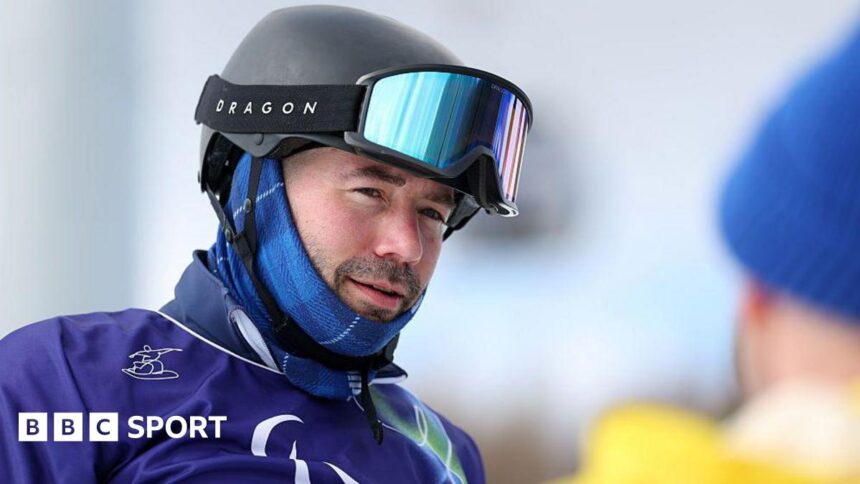
Davy Zyw: How Paralympic Defiance Redefines Life with MND
In the crisp, thin air of the Italian Dolomites, a man in a tartan snood stared down a mountain. The world saw a Paralympic snowboarder in the start gate. Medicine once saw a statistic. Davy Zyw, diagnosed with Motor Neurone Disease (MND) in 2018 and given 18 months to live, did not just stare down the snowboard cross course in Cortina. He stared down mortality itself. His historic appearance as the first athlete with MND at a Winter Paralympics was more than a sporting milestone; it was a seismic statement of human spirit, a lesson in rewriting narratives, and a profound source of joy that he says will fortify the rest of his life.
A Diagnosis of Limits, A Response of Defiance
The story of Davy Zyw is a masterclass in the inversion of expectation. At 30, the diagnosis of MND – a progressive, terminal illness that attacks the nerves controlling movement – arrived like a sentence. The prognosis was brutally clear: a rapid decline. For many, the focus shifts immediately to palliative care and managing an unforgiving timeline. Zyw’s psychology, however, was wired differently. The initial shock gave way not to surrender, but to a fierce, questioning defiance.
“Why not?” became a powerful mantra. Why not seek a second opinion? Why not explore every possible therapy? Why not, crucially, hold onto the things that bring joy and purpose? For Zyw, an avid snowboarder, that meant holding onto his board. His journey to Cortina was not a sudden decision but the culmination of years of stubborn, daily rebellion against the disease’s projected path. He adapted his equipment, refined his technique to work with his changing body, and targeted the Paralympics not as a fantastical dream, but as a tangible goal. This defiance in the face of adversity became his core therapy.
The Cortina Crucible: More Than a Race
As Zyw took his place on Sunday, the sporting outcome was almost secondary. His presence in the start gate was the victory. Surrounded by the rugged beauty of Cortina, a landscape as formidable and enduring as his own spirit, he embodied a truth that transcends sport: quality of life is defined by depth of experience, not by medical charts.
Expert analysis in psychoneuroimmunology suggests that profound positive psychological states can have tangible impacts on well-being. The intense focus, the adrenaline, the community, and the sheer Paralympic joy Zyw experienced are not mere ephemeral feelings. They are potent neurological events. Dr. Anya Petrova, a sports psychologist specializing in adaptive athletes, explains: “Achieving a pinnacle goal under such circumstances creates a powerful feedback loop. The sense of agency, accomplishment, and global recognition floods the system with positive neurochemicals. This doesn’t cure a disease like MND, but it can fortify the mind and body’s resilience, potentially influencing pain perception, stress response, and overall life satisfaction in meaningful ways.”
For Zyw, the race was a physical manifesto. Every turn executed was a point proven. Every finish line crossed (he competed valiantly, though not for a medal) was a boundary erased. The key elements of his achievement include:
- Unprecedented Representation: Shifting the global perception of what is possible with MND.
- The Power of Purpose: Demonstrating that a forward-looking goal can be a critical component of living with a terminal illness.
- Adaptive Innovation: Pioneering new techniques and equipment for athletes with degenerative conditions.
- Community Impact: Providing immense hope and a new blueprint for the global MND community.
Predictions: The Zyw Legacy and the Future of Adaptive Sport
Davy Zyw’s Paralympic journey will ripple far beyond Cortina. His legacy is poised to catalyze change in several key areas. Firstly, within adaptive sports science, his case will be studied for insights into training regimens for degenerative conditions, focusing on maintaining core function and maximizing current ability rather than traditional progression models.
Secondly, we predict a significant impact on MND advocacy and funding. His visible, triumphant defiance brings a new, powerful face to the cause, likely energizing research initiatives and support networks. He has redefined “living with MND” from a narrative of waiting to one of active, passionate engagement.
Finally, Zyw has set a precedent. He has shown that classification systems in Paralympic sport must remain dynamic and inclusive, capable of accommodating athletes with progressive conditions. Future games may see more athletes with similar diagnoses, inspired by his trailblazing path, advocating for categories that recognize their unique challenges and strengths.
Fortifying a Future, One Turn at a Time
As the world moves on from the Cortina Games, Davy Zyw continues his most important race. The finish line he seeks is not made of snow, but of life lived entirely on his own terms. The joy forged in the mountains – the camaraderie, the competition, the sheer act of flying down a mountain on a board – is not a memory he will simply look back on. It is a resource.
That joy is a psychological fortress. It is a reservoir of strength he can draw from on the more difficult days that MND will inevitably bring. It is proof, etched into his very being, that he can still define his days with awe and achievement. The Paralympics did not just give him a platform; it gave him a profound and personal tool for resilience.
Davy Zyw’s story is the ultimate rebuttal to a countdown clock. He stands, in his tartan snood and on his snowboard, as a permanent testament to a simple, revolutionary idea: a life, however challenged, directed by passion and purpose is a life truly won. The mountains of Cortina witnessed history, but they also witnessed a man gathering an unshakeable fortitude. That joy, that defiance, will indeed light and fortify the rest of his life, inspiring countless others to stare down their own mountains and ask, with quiet courage, “Why not?”
Source: Based on news from BBC Sport.