Glasner’s Diagnosis: Crystal Palace’s “Nervous” Rush for Goal Costly in Leeds Stalemate
Selhurst Park, a fortress known for its cacophonous support and moments of attacking flair, fell into a familiar, frustrated silence on Saturday. A 0-0 draw with Leeds United, a result that does little for either side’s distinct ambitions, was dissected not through moments of magic, but through a telling admission from the home dugout. Crystal Palace manager Oliver Glasner pinpointed a critical psychological flaw in his team’s performance: a palpable, goal-hungry anxiety that saw them “lose our structure” and ultimately, two precious points.
A Tale of Two Halves and a Singular Problem
The match itself followed a pattern long-time Palace observers know well. The Eagles started with positive intent, with the dynamic Eberechi Eze probing and Michael Olise, returning from injury, showing flashes of his incisive brilliance. There were half-chances, moments where the final pass just lacked precision. Yet, as the clock ticked and the expected breakthrough didn’t arrive, a visible tension gripped the home side.
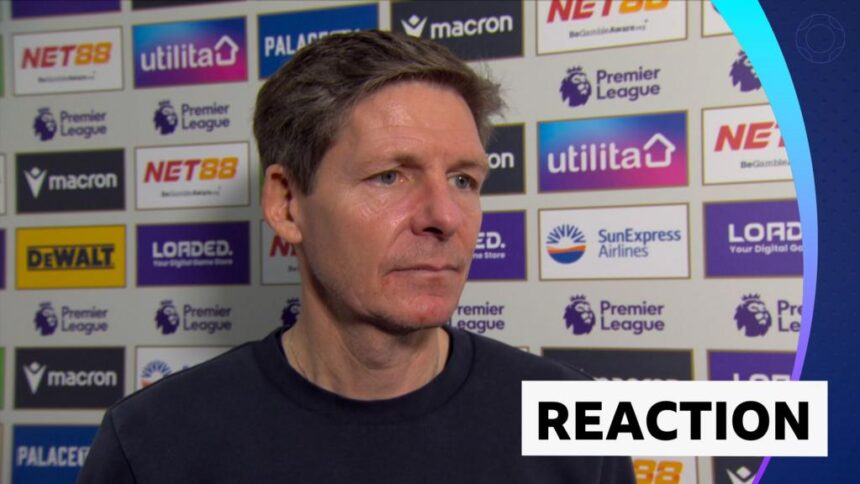
Glasner’s post-match analysis was strikingly candid. “In the second half, we were a bit nervous,” he conceded. “We were rushing. We were losing our structure when we were attacking.” This wasn’t just a coach bemoaning missed chances; this was a diagnosis of a systemic breakdown. The composure and coordinated pressing that defines Glasner’s philosophy evaporated, replaced by a desperate, individualistic surge for a winner. The result was a disjointed attack, easily marshaled by a resolute Leeds defense, and a vulnerability on the counter that a more clinical opponent would have punished.
Deconstructing the “Nervous Rush”: Where Palace Went Wrong
Glasner’s call for his team to stay “calm” in pursuit of a goal speaks to a deeper tactical and mental challenge at Selhurst Park. The “nervous rush” manifests in several key, damaging ways:
- Midfield Abandonment: In the quest to overload the Leeds box, Palace’s midfielders, particularly the deeper-lying players, were often caught too far forward. This left gaping channels for Leeds to exploit in transition, breaking the team’s shape.
- Forced Final Balls: Instead of working the ball patiently to carve out a clear opportunity, players opted for low-percentage crosses into crowded areas or speculative long-range efforts, handing possession back to the opponent.
- Isolation of Key Men: The frantic pace disconnected Eze and Olise from the midfield. They were forced to drop deeper to collect the ball, nullifying their threat in the final third where they are most dangerous.
- Defensive Uncertainty: The anxiety wasn’t confined to the attack. The defensive line, sensing the pressure to keep a clean sheet to salvage a point, became deeper and more reactive, inviting pressure rather than controlling the game’s tempo.
This pattern is not unique to this game. It highlights a psychological hurdle for a squad often embroiled in mid-table security but lacking the consistent killer instinct to challenge higher. The weight of expectation at home, against a team they are “expected” to beat, becomes a burden, not a catalyst.
Glasner’s Prescription: Calmness, Structure, and Patience
The Austrian manager’s task is now clear: to instill a steely, process-driven mentality. His philosophy is built on control, aggressive but organized pressing, and quick, vertical transitions. The “nervous rush” is its antithesis. His post-match comments are the first step—publicly identifying the issue holds the players accountable to the standard he demands.
Moving forward, expect Glasner to drill two core principles:
1. Structural Discipline Over Individual Heroism: The message will be that winning the game is a collective, structural endeavor. Players must trust the system and their teammates’ movements, even in the dying minutes. Maintaining shape ensures defensive security while creating sustainable attacking waves, not one-off gambles.
2. The “Next Action” Mentality: Instead of players dwelling on a missed chance or a poor pass, the focus will be on immediately resetting, recovering the correct position, and winning the ball back. This calms the game down and prevents the snowball effect of frustration that leads to tactical chaos.
The return of Michael Olise is a massive positive, but his integration must be within the team structure, not as a lone hope. Similarly, the role of a central striker—whether Jean-Philippe Mateta or another—becomes crucial as a focal point to calm play and link the frantic midfield with the attack.
Predictions: A Pivotal Moment in Palace’s Season
This goalless draw could be a pivotal teaching moment for the Glasner era. How the team responds will define their end to the season. The immediate fixtures will test their newfound “calm.”
- Short-Term: We will likely see a more controlled, perhaps even slightly more patient Palace in their next home outing. The risk is that the crowd’s impatience could feed the old anxiety. Glasner must manage the stadium’s energy as much as his team’s.
- Long-Term: This is a fundamental culture shift. If successful, Glasner will not only have built a tactically adept side but a mentally resilient one. This is what separates comfortable mid-table teams from those that can consistently challenge for European spots. Failure to address it will mean more frustrating stalemates like the Leeds game, where two points are willingly surrendered.
The draw itself is not a disaster. A point and a clean sheet is a platform. But Glasner’s sharp critique reveals he is aiming for much more. He isn’t just evaluating results; he’s evaluating performances and mental fortitude.
Conclusion: The Quest for Composure
Oliver Glasner’s frank assessment of Crystal Palace’s “nervous” performance against Leeds United was more revealing than the 0-0 scoreline. It exposed the critical bridge the club must cross to evolve from a sporadically thrilling side into a consistently effective one. The technical quality, embodied by Eze and Olise, is undeniable. The defensive foundations, led by the impressive Joachim Andersen, are solid.
However, the final ingredient—the composure to dominate games and clinically seize victories—remains elusive. The “rush” Glasner identified is the symptom of a team not yet fully convinced by its own process under pressure. His mission is now as much psychological as it is tactical. For the Eagles to truly soar under their new manager, they must first learn to breathe, to trust, and to resist the desperate rush. The path to a higher Premier League perch is paved not with frantic leaps, but with calm, deliberate steps.
Source: Based on news from BBC Sport.