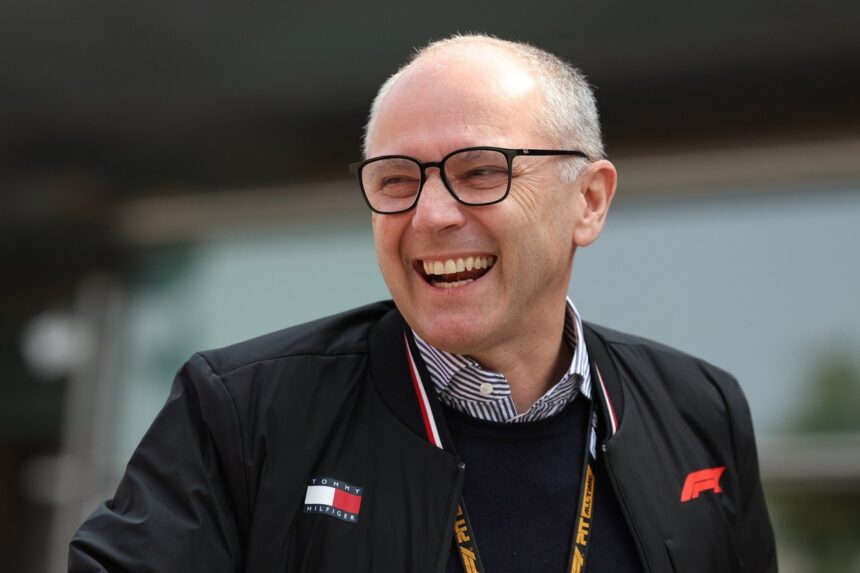
Who Slept Best Last Night? For F1’s Stefano Domenicali, Shanghai Brought Sweet Dreams
The dawn after the Chinese Grand Prix broke over a world where one Italian, in particular, could greet it with a deep, restorative sense of calm. While the tifosi celebrated a new national hero in Carlos Sainz, and the Scuderia reveled in a one-two finish, the man with the weight of a global sport on his shoulders finally had proof of concept. For Stefano Domenicali, the CEO of Formula 1, Sunday in Shanghai wasn’t just a race; it was a profound relief, a validation, and perhaps the best night’s sleep he’s had in months.
The Imola Native’s Divided Heart: Fan vs. CEO
Do not be fooled by the impeccable suit and corporate title. Stefano Domenicali is, at his core, a fan forged in the crucible of Italian motorsport. Born in Imola, a town whose identity is etched in racing asphalt, his childhood stories of scaling fences to watch cars roar by are the stuff of legend. That fan’s heart undoubtedly swelled seeing Ferrari’s resurgence, the fierce yet fair duel between Charles Leclerc and the victorious Sainz, and the coronation of Italy’s brightest hope since the era of Alberto Ascari.
But the CEO’s mind is tasked with a broader calculus. His sleep is measured not in podiums for a single team, but in global engagement, spectacle, and the health of the sport’s commercial ecosystem. Recent weeks have been dominated by a discordant chorus: driver complaints about the “unnatural” handling of the 2026 cars, concerns over racing quality, and murmurs about the sport’s direction. The Chinese Grand Prix, therefore, arrived as a critical stress test. The question wasn’t just who would win, but whether F1 itself could deliver.
Shanghai’s Symphony: Why This Race Was a CEO’s Dream
The answer was a resounding yes. From lights out to the checkered flag, the 2026 Chinese Grand Prix was a narrative masterpiece, ticking every box on a league executive’s wishlist.
- Fierce, Clean Wheel-to-Wheel Battles: The lead changed hands multiple times, not in the pits but on track. The Sainz-Leclerc-Max Verstappen triangle provided a high-speed chess match of strategy and skill.
- Strategic Variance: Teams diverged on tire strategy, creating moving trains of cars and unpredictable swings in race order, keeping viewers glued until the final laps.
- The Rise of a Marketable Star: Carlos Sainz’s dominant yet hard-fought win solidifies his status as a charismatic, elite talent—a perfect protagonist for the F1 story.
- Unpredictability: For the first time in years, the winner wasn’t a foregone conclusion at the start. This inherent uncertainty is the lifeblood of sports entertainment.
The relief for Domenicali was palpable. The race was a spectacle that argued eloquently against the recent criticism. The cars, quirks and all, produced a show. The new regulations, designed to promote closer racing, seemed to bear fruit in Shanghai’s long braking zones and sweeping corners. The CEO could point to the broadcast and say, “This. This is what we’re building.”
Five Quick Takeaways from F1’s 2026 Chinese GP
Beyond Domenicali’s restful night, the race laid down significant markers for the season ahead.
1. Ferrari is Truly Back in the Fight: This wasn’t a fluke. The SF-26 is a machine capable of winning on merit. The intra-team battle adds a delicious layer of intrigue.
2. The Verstappen Challenge is Met: Red Bull and the reigning champion are far from beaten, but they are now being consistently pressured. Verstappen’s second place was hard-fought, a sign he is no longer in a league of his own.
3. The Midfield Maelstrom is Fiercer Than Ever: Points were fought for with tooth and nail. Teams like McLaren, Aston Martin, and the surprising VCARB squad provided relentless action throughout the top ten.
4. Driver Skill is Amplified: The “unnatural” car quirks drivers bemoaned may have actually heightened the display of talent. Controlling these machines while racing inches apart made the performances even more impressive.
5. Sprint Format Refinement Worked: The revised weekend schedule provided clear, digestible segments of action, building a coherent narrative towards the Grand Prix itself.
The Road Ahead: Predictions After a Paradigm-Shifting Weekend
The Chinese Grand Prix has reset the season’s trajectory. We can now anticipate a sustained title fight, likely a three-way duel between Ferrari’s two drivers and Verstappen. The psychological blow to Red Bull is significant, and the response at Imola will be telling. For the sport’s management, the challenge shifts from defending the product to capitalizing on this momentum.
Expect Domenicali’s F1 to aggressively market the “new era of competition” narrative. The focus will be on the human drama—the rivalries, the comebacks, the sheer will to win displayed in Shanghai. The driver concerns about the cars will not disappear, but they will be quieter against the backdrop of such compelling racing.
Conclusion: The Sound of Silence in London
So, who slept best last night? In a plush hotel in Shanghai, a victorious Carlos Sainz likely slept with a gold medal around his neck. In Maranello, Ferrari engineers slept with the satisfied exhaustion of proven genius. But in London, at the helm of Formula 1, Stefano Domenicali enjoyed a different kind of peace.
The silence he heard was the absence of criticism, the quieting of doubt. It was the sound of a global audience buzzing about a fantastic race, of headlines celebrating competition, and of a sport that delivered on its highest promise. For the fan from Imola, it was a perfect Italian result. For the CEO, it was the undeniable proof that his vision is working. After the storm of scrutiny, the Chinese Grand Prix was his calm. And that, for any leader, is the foundation for the most restful sleep of all.
Source: Based on news from Yahoo Sports.