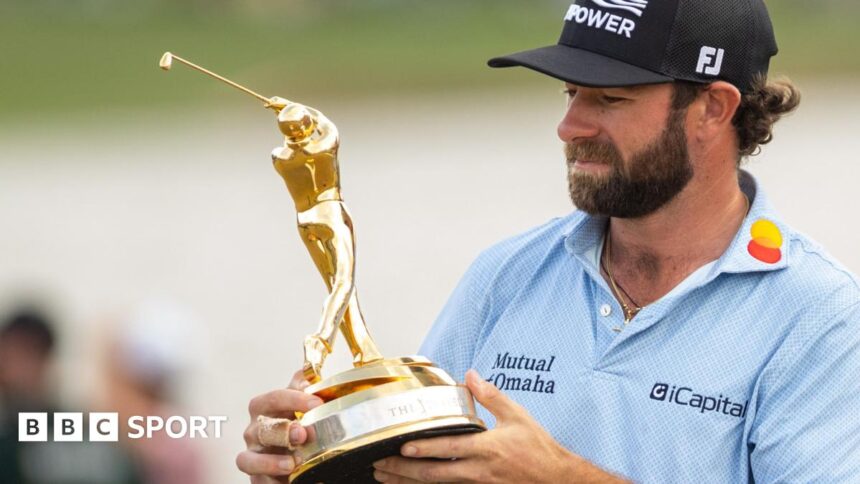
The Players Championship: A Colossal Event Forever in the Shadow of Golf’s Majors
The roar that echoed across the iconic 17th green at TPC Sawgrass last Sunday was as deafening as any in golf. Cameron Young, staring down a legacy-defining putt, and Matt Fitzpatrick, grappling with a gut-wrenching bogey on the 72nd hole, provided a drama-soaked finale that reminded us why we watch. The PGA Tour’s promotional machine had dubbed March “major” in the lead-up, a not-so-subtle nudge in the eternal debate. But let’s settle this once and for all: The Players Championship is not a major championship. It is, however, something equally fascinating—the greatest non-major in the history of the sport, a spectacular monument to modern golf that has carved its own indelible, yet distinct, legacy.
The Unbridgeable Chasm: History, Not Just a Purse
To understand why The Players can never cross the Rubicon into major status, one must look beyond the $25 million purse and the pristine conditioning. Golf’s four majors—The Masters, PGA Championship, U.S. Open, and The Open Championship—are steeped in a century of history. They are institutions defined by tradition, collective memory, and a global, almost mythical, significance. Their legends are the bedrock of the game: Nicklaus at Augusta, Hogan at Merion, Watson at Turnberry, Tiger’s “Tiger Slam.”
The Players Championship, inaugurated in 1974, is a creation of the PGA Tour itself, a deliberate and brilliant piece of corporate architecture. Its move to TPC Sawgrass in 1982 and the construction of the stadium concept were masterstrokes for fan engagement and television, but they underscore its nature as a manufactured, rather than an organic, landmark. Its identity is tied to a single, punishing course, not the varied and historic rota of the Opens. While the quality of the field is arguably the strongest top-to-bottom in golf, major status isn’t awarded on field strength or difficulty alone. It is conferred by time, weight, and the unshakeable consensus of the golfing world.
- The Masters (1934): A tradition unlike any other, born from Bobby Jones’ vision.
- The PGA Championship (1916): The pinnacle for touring professionals for over a century.
- The U.S. Open (1895) & The Open (1860): The ultimate tests of national and ancient championship golf.
- The Players (1974): The PGA Tour’s flagship, a modern spectacle.
The distinction is clear. You can’t anoint a major; it must evolve into one. That ship has sailed for The Players.
The Fitzpatrick Bogey and Young’s Breakthrough: A Microcosm of Its Value
Last Sunday’s finish perfectly encapsulated the event’s supreme worth. Matt Fitzpatrick, a U.S. Open champion, stood on the 18th tee with a one-shot lead. What followed was a cruel bogey, a product of Sawgrass’s relentless pressure. It was a “gift” only in the most brutal sense, a trophy lost as much as it was won. Cameron Young, arguably the best current player without a PGA Tour win, had to seize it with steely resolve over the terrifying final holes, which he did. This was not major championship gravity, but it was elite, stomach-churning, career-altering drama.
For Young, this victory does not place him in a major winner’s circle, but it does something perhaps more immediate: it exorcises the demons of close calls, validates his talent on the biggest non-major stage, and deposits a $4.5 million check. It proves he can win under the brightest lights the Tour can create. The Players Championship victory is a colossal achievement, a separator among the elite, and a cornerstone of any Hall of Fame resume. It just doesn’t come with a green jacket or claret jug.
Why the ‘Fifth Major’ Talk Persists (And Why It’s Useful)
The PGA Tour’s persistent teasing of major status is a strategic masterclass. By fueling the debate, they elevate their product. Calling it “the fifth major” or, as this year, labeling March “major,” generates headlines, discussion, and a perceived stakes-raising that benefits sponsors, broadcasters, and players. It’s a self-fulfilling prophecy of prestige. This marketing genius ensures that while The Players may never officially join the quartet, it is forever discussed in the same breath, occupying a unique tier of its own creation. The conversation itself is the victory.
The Future: A Permanent and Powerful Pillar
So, what is the future of The Players Championship? It is not one of evolution into a major, but of consolidation as the undisputed king of everything else. Its predictions are clear:
- It will remain the PGA Tour’s financial and strategic crown jewel, its purse and points allocation setting the standard for the regular season.
- Its identity will become even more tied to TPC Sawgrass and the stadium golf experience, a contrast to the rotating classics of the major rota.
- Winners will be seen as “major-ready”, with the victory serving as the ultimate proof of concept that a player can handle the most intense pressure the Tour can manufacture.
- In an era of fractured golf, it will stand as the unifying centerpiece of the PGA Tour’s annual calendar, a must-win for members seeking to define their legacy within the Tour ecosystem.
The tournament’s destiny is not to join an old order, but to be the foundational event of the modern golf order.
Conclusion: Embracing Its Own Greatness
The quest to label The Players a major is a disservice to its true achievement. It is the Everest of non-majors, a masterpiece of presentation and competition that demands and deserves its own category of acclaim. Cameron Young’s thrilling victory over Matt Fitzpatrick wasn’t a major win, but it was a monumental one. It provided the kind of heart-in-throat climax that only the very best sporting events can.
Let us stop the futile debate. The Players Championship is not a major, never has been, and never likely to be. And that’s perfectly okay. In accepting that truth, we can fully appreciate it for what it is: a spectacular, self-made titan of the game, a $25 million drama played out on a stadium stage where fortunes and reputations are made, and where the only thing missing is the history it is still too young to possess. Its glory is not borrowed; it is earned, every March, on the treacherous slopes of Pete Dye’s iconic creation.
Source: Based on news from BBC Sport.