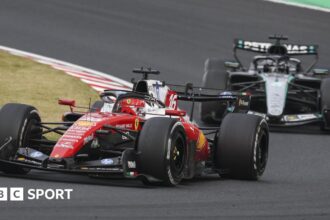
Enough is Enough: Ferrari’s Vasseur Calls for Stability in F1 Start Rules
The roar of engines at idle, the frantic radio chatter, the agonizing wait for five red lights to illuminate and then vanish. The race start is the single most electrifying, chaotic, and consequential moment in a Formula 1 Grand Prix. It’s a high-stakes ballet of reaction times, clutch bite, and nerve, where championships can be won or lost in a heartbeat. Yet, in recent years, the foundational procedure governing this critical moment has felt less like a bedrock of the sport and more like a shifting sand dune. Now, a powerful voice from Maranello has drawn a line in the asphalt. Ferrari Team Principal Frédéric Vasseur has declared, in no uncertain terms, that when it comes to further tinkering with F1’s start rules, “enough is enough.”
The Moving Target: A History of Start Procedure Tinkering
To understand Vasseur’s firm stance, one must look at the evolutionary—some might say reactionary—path the start procedure has taken. For decades, the process was sacrosanct: drivers controlled their own clutch paddles, relying on muscle memory and feel to launch their machines. The drama was pure and unadulterated. However, as technology advanced, so did the complexity and the potential for gamesmanship and error.
The modern era has seen a constant push-and-pull between the FIA’s desire for consistency and the teams’ relentless pursuit of competitive advantage. Major changes have included:
- The Clutch Bite Point Find Procedure: Mandating a specific, automated process for drivers to set their clutch bite point on the formation lap, removing some of the “art” to standardize the approach.
- Stricter Sensor Enforcement: Proliferation of sensors and software to monitor clutch engagement profiles, leading to a spike in penalties for minute, often imperceptible, transgressions.
- Reactive Rule Tweaks: Adjustments made in response to specific controversies, such as start-line positioning or penalty applications, creating a patchwork of clarifications.
This environment has created what Vasseur and others see as an unsustainable paradox: in striving for absolute fairness through hyper-regulation, the sport has introduced new layers of inconsistency and frustration. A driver can deliver a perfect launch in the eyes of millions, only to be handed a time penalty hours after the race for a clutch parameter deviation measured in milliseconds.
Vasseur’s Stand: The Case for Sporting Integrity Over Technicality
Frédéric Vasseur’s declaration is not merely a complaint from a team that may have suffered a bad weekend. It is a philosophical argument about the soul of competition. His core thesis is that the start must remain, first and foremost, a sporting challenge rather than a technical compliance exercise.
“We are at the point where we have so many rules and so many sensors that we are creating confusion,” Vasseur argued, implicitly pointing to recent races where post-race penalties for start procedure infringements have overshadowed on-track battles. The fear is that the narrative of a Grand Prix is no longer decided by daring overtakes or strategic genius, but by a stewards’ bulletin issued long after the champagne has dried.
Vasseur’s call is for stability. Engineers and drivers need a consistent framework to hone their craft. The current climate of frequent minor adjustments means resources are perpetually diverted from innovation to interpretation. “You need a stable regulation for the teams, for the drivers, to be able to practice and to improve,” he stated. This stability is fundamental to fair competition. When the goalposts move repeatedly, it penalizes those who have mastered the existing system and introduces an element of lottery that undermines pure performance.
The Ripple Effect: How Start Uncertainty Impacts the Entire Sport
The implications of an unstable start procedure extend far beyond the driver’s cockpit. The uncertainty creates a cascade of negative effects throughout the F1 ecosystem.
- For Fans: It breeds confusion and disillusionment. The visceral joy of a lightning start is neutered by the looming possibility it will be annulled by a penalty. It breaks the immediate connection between action and consequence.
- For Teams: It leads to conservative racing. If the risk of a penalty for an aggressive, borderline launch is too high, teams may instruct drivers to adopt safer, less dynamic starts, potentially dulling the spectacle at the very moment it should be most intense.
- For the FIA: It places the governing body in the role of constant referee, inviting criticism and accusations of inconsistency with every marginal call. It shifts their focus from policing dangerous driving to adjudicating technical minutiae.
In essence, over-regulation of the start threatens to sanitize one of the last truly human, instinctive elements of a sport increasingly dominated by data and simulation. Vasseur’s plea is to protect that element.
The Road Ahead: Predictions for the Start Rule Debate
Vasseur’s comments are a calculated shot across the bow, likely voiced in formal Technical Advisory Committee and Sporting Advisory Committee meetings. His stance will resonate with many drivers and senior engineers who share the fatigue with “trial by sensor.”
Predicting the outcome involves navigating F1’s complex political landscape. We can anticipate several potential developments:
1. A “Freeze” on Minor Changes: The most likely scenario is a push for a moratorium on tweaks to the clutch procedure and sensor thresholds for a defined period, perhaps two full seasons. This would allow the sport to settle into a known framework.
2. A Simplification Push: There may be a movement to roll back some of the complexity, potentially reducing the number of monitored parameters or widening the acceptable tolerance bands to only punish egregious violations, not microscopic ones.
3. Driver Advocacy Amplification: The Grand Prix Drivers’ Association (GPDA) is likely to back calls for stability. A unified front from the stars of the sport carries significant weight with both the FIA and Formula One Management (FOM).
However, resistance is inevitable. The FIA’s mandate is to ensure fairness, and its engineers will argue that precise measurement is the only tool to prevent cheating. Teams perpetually on the back foot may also see constant change as a chance to disrupt their rivals’ advantage.
The Checkered Flag: Why Stability is the Ultimate Win
Formula 1 stands at a crossroads between its technological pinnacle and its racing heart. The start procedure debate encapsulates this tension perfectly. Frédéric Vasseur’s “enough is enough” is more than a soundbite; it is a call to reaffirm a core principle. The race start must be a test of driver skill and team preparation, not a prelude to a courtroom drama.
Stable, clear, and durable rules are the foundation upon which true sporting greatness is built. They allow drivers to become heroes and engineers to become legends. They allow fans to cheer in the moment without a nagging fear of future asterisks. As the 2024 season progresses and the topic inevitably returns to the agenda, the FIA and the teams would be wise to heed the Scuderia’s warning. The pursuit of perfect, sterile fairness risks stripping the sport of its essential, beautiful imperfection—the human element that makes a great start so breathtaking to begin with. For the sake of the drivers, the teams, and the millions watching around the globe, it is indeed time to say enough.
Source: Based on news from Sky Sports.
Image: CC licensed via www.piqsels.com