Morocco Crowned Afcon 2025 Champions After Senegal Forfeits Final in Historic Ruling
In a decision that has sent seismic shockwaves through the world of football, the Confederation of African Football (CAF) has officially stripped Senegal of their 2025 Africa Cup of Nations title and crowned Morocco as the new continental champions. The unprecedented ruling comes after Senegal’s dramatic and controversial walk-off during the final, a protest act the CAF Appeal Board labeled “shameful.” This is not a story of a goal scored in extra time, but of a title decided in a boardroom, rewriting history and igniting fierce debate about sport, protest, and consequence.
The Final That Never Finished: A Timeline of Chaos
The 2025 Afcon final in Yaoundé was poised to be an instant classic. Defending champions Senegal, led by a golden generation, faced a resurgent Morocco, a team carrying the hopes of a continent after their historic World Cup run. For over 90 minutes, the two giants battled to a stalemate, a tense, tactical affair decided by fine margins. Then, in the 88th minute, chaos erupted.
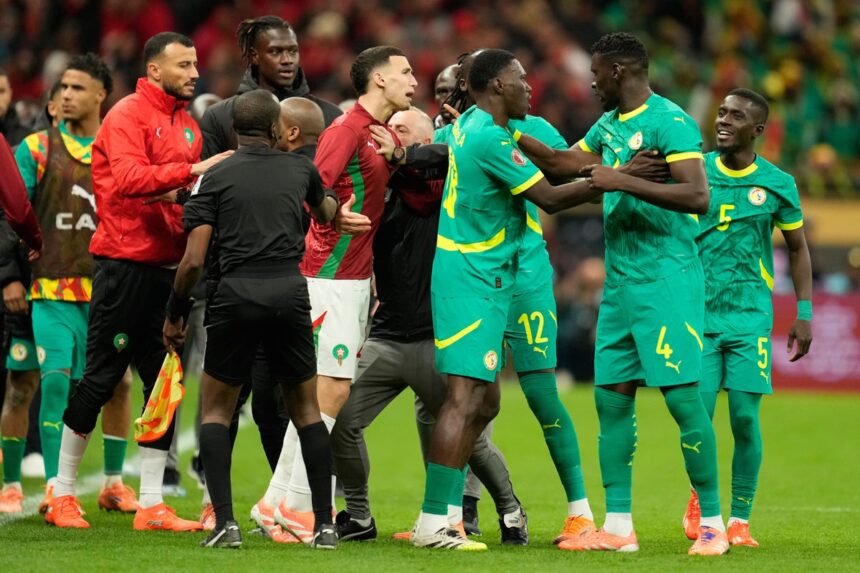
A Moroccan attack broke into the Senegalese box, resulting in a tangled challenge. After a lengthy VAR review, the referee pointed to the spot, awarding Morocco a penalty. What followed was a scene of pure bedlam. Incensed Senegalese players surrounded the official, with captain Kalidou Koulibaly at the forefront of the protests. After several minutes of heated debate, in an act of stunning defiance, the entire Senegalese squad, led by their coaching staff, turned and walked off the pitch and into the dressing room.
The stadium fell into a confused silence. The Moroccan players, initially celebrating the penalty award, were left bewildered on the turf. The referee waited, then officially suspended the match. Crucially, Senegal’s walk-off protest occurred before the penalty could be taken. Brahim Diaz, the designated taker, would eventually return to the empty pitch to mockingly chip a ‘Panenka’ into the arms of goalkeeper Edouard Mendy, but the game’s fate was already sealed by the forfeit.
- 88th Minute: Controversial penalty awarded to Morocco after VAR check.
- 90+ Minute: Senegal team and staff stage a full walk-off protest.
- Match Suspended: Referee officially halts play due to forfeit.
- Post-Forfeit: Diaz misses symbolic penalty; Senegal later wins 1-0 in an unofficial extra-time period played under protest.
The Rulebook Wins: CAF’s Landmark Decision Explained
While the emotional aftermath saw Senegal return to complete the match under extreme duress—and score to win 1-0 in extra time—the governing body’s focus was strictly on the act of abandonment. The CAF Appeal Board’s investigation was swift and unequivocal. Their ruling hinged on two clear-cut regulations within the competition’s statutes.
Article 82 and Article 84 of the Afcon regulations are unambiguous: if a team “refuses to play or leaves the ground before the regular end of the match without the authorisation of the referee,” they are deemed the loser. The forfeit scoreline is automatically recorded as a 3-0 victory for the opposing team. CAF emphasized that the integrity of the competition and respect for the match officials are non-negotiable pillars of the sport.
“The actions of the Senegalese Football Federation, in instructing its team to leave the pitch, were a direct assault on the laws of the game and the authority of the match official,” read part of the CAF statement. “Such conduct is shameful and cannot be tolerated, regardless of the perceived injustice of a single decision.” This hardline stance transforms the record books. Morocco, who last lifted the trophy in 1976, are now the official 2025 Afcon champions. The 1-0 extra-time victory celebrated by Senegal is erased, replaced by a 3-0 forfeit loss.
Expert Analysis: A Pyrrhic Victory and a Continent Divided
This ruling creates a complex legacy. For Morocco’s historic Afcon title, the victory is profoundly bittersweet. The Atlas Lions have been the continent’s most consistent side for nearly a decade, and their technical project is the envy of Africa. Yet, their second star will forever carry an asterisk in the public imagination. They were crowned not by a winning goal, but by a ruling. Coach Walid Regragui’s immediate post-match comments, praising his team’s resolve while expressing sympathy for the ugly circumstances, now seem prescient.
For Senegal, this is a catastrophic blow to their footballing legacy. The golden generation that finally delivered an Afcon in 2021 and defended it on the pitch in 2025 will now be remembered for an act of protest that cost them everything. The debate will rage: was this a principled stand against poor officiating, or a petulant act that betrayed their teammates and nation? The financial penalties, potential further suspensions, and reputational damage will be severe and lasting.
The fallout extends beyond the two finalists. CAF has drawn a line in the sand, asserting its authority in the most dramatic way possible. This decision signals a zero-tolerance policy towards teams challenging the referee’s ultimate authority, setting a precedent that will echo for generations. It raises critical questions for the future: How does football balance the need for respect with the raw emotion of the game? And what are the appropriate, proportional channels for protest?
The Road Ahead: Repercussions and a Fractured Legacy
The immediate future is fraught with tension. We can expect several key developments:
Senegal’s Appeal and Sanctions: While the CAF Appeal Board is the final internal arbiter, the Senegalese Federation could take the case to the Court of Arbitration for Sport (CAS). However, given the clear violation of black-and-white rules, an overturn seems unlikely. More probable are significant fines and potential suspensions for federation officials and possibly players involved in instigating the walk-off.
Morocco’s New Era: The Moroccan football federation must now navigate the celebration of a title won in the most unusual circumstances. Their challenge is to honor their team’s incredible journey—which was worthy of a final—while acknowledging the awkward reality. This title, however acquired, will fuel their ambition and could be the catalyst for a dominant period.
Afcon’s Integrity at a Crossroads: This incident will force a continent-wide conversation about refereeing standards, VAR implementation, and player conduct. CAF’s firm hand may deter future walk-offs, but it does not address the root causes of the frustration that led to it. Investment in officiating technology and training must be a priority to prevent such a crisis from ever recurring.
In conclusion, the 2025 Africa Cup of Nations will be remembered not for dazzling skills or last-minute winners, but for a moment of defiance that changed everything. Morocco ascends to the throne, their name etched onto the trophy, yet their triumph is shrouded in controversy. Senegal’s golden generation sees its crowning moment annulled, a heartbreaking lesson in the cold, unforgiving nature of the rulebook. This seismic ruling is a watershed moment for African football, a stark reminder that while passion is the sport’s lifeblood, its foundation must always be respect for the game itself. The beautiful game in Africa moves forward, but with a deep and lasting scar.
Source: Based on news from Yahoo Sports.