


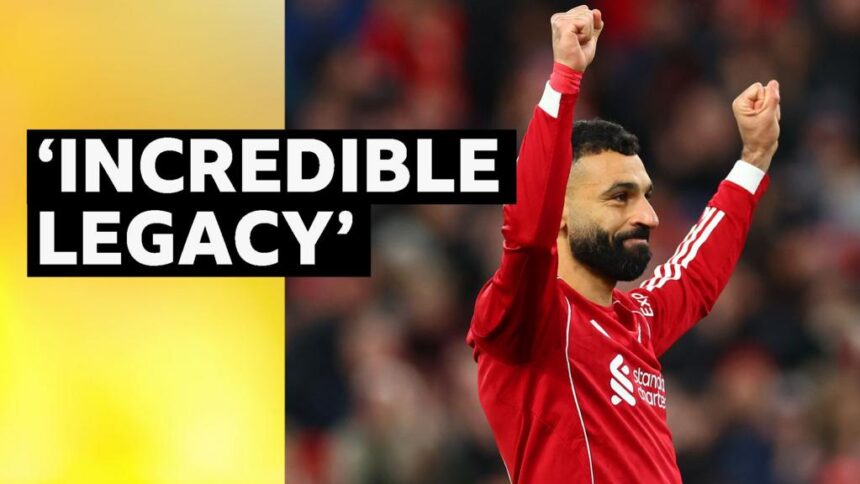
Liverpool’s Looming Void: Why Replacing Salah’s Numbers is the Ultimate Test
The news, though long-anticipated, still lands with the weight of an era ending. Mohamed Salah’s confirmation that he will depart Liverpool at the close of the 2025-26 season sends a definitive tremor through the foundations of Anfield. While the club and its global fanbase have two more seasons to savor his unique brilliance, the specter of his exit demands immediate and strategic foresight. As former Liverpool defender and BBC pundit Stephen Warnock starkly articulated, the mission is clear yet monumental: Liverpool must find someone to hit Salah numbers. This isn’t merely about replacing a player; it’s about replicating a phenomenon—a challenge that will define the club’s next decade.
The Unquantifiable Standard: Deconstructing “Salah Numbers”
To understand the scale of the task, one must first comprehend what “Salah numbers” truly represent. Since his arrival in 2017, Salah has transcended the label of a traditional winger. His output is a relentless, season-defining constant.
- Goal Machine: Averaging over 23 goals per Premier League season, he is the only player to score 20+ goals in five of his first six campaigns.
- Creative Force: Coupled with a consistent double-digit assist tally, making him the league’s most prolific goal contributor over his tenure.
- Durability & Consistency: A staggering availability rate, avoiding major injuries and delivering in the biggest moments—finals, derbies, title deciders.
- Global Icon: His impact extends beyond metrics, encompassing commercial reach, morale, and a winning mentality that has lifted an entire squad.
As Warnock implies, finding a player who can deliver 30-40 direct goal involvements season after season is the non-negotiable starting point. This production has been the engine of Liverpool’s success under Jürgen Klopp and will be for any successor.
The Blueprint for Succession: Strategy Over Sentiment
Liverpool’s recruitment team, led by the data-driven Michael Edwards and Julian Ward, now faces its most scrutinized assignment. The path to replacing Salah is unlikely to be a straight swap. The strategy may involve a multi-pronged approach.
The Marquee Signing: The most direct route is targeting a proven, world-class attacker already performing at an elite level. Names like Florian Wirtz or Khvicha Kvaratskhelia may emerge, but this market is fiercely competitive and astronomically expensive. The fee and wages would shatter the club’s structure, carrying immense risk.
The Evolutionary Approach: Liverpool may opt to sign a high-potential talent—a “next Salah”—who can grow into the role. This mirrors the strategy that brought Salah himself from Roma. The club’s scouts will be scouring Europe for a player with the raw materials: explosive pace, a ruthless left foot, and the capacity to handle pressure. This requires patience and a calculated gamble.
The Systemic Redistribution: Perhaps the most plausible solution is that no single player will be asked to bear the full burden. Instead, Liverpool could evolve their system, spreading the goal-scoring responsibility across a refreshed forward line. The development of Darwin Núñez, the creativity of Dominik Szoboszlai, and the integration of a new wide forward could collectively aim to match Salah’s output. This lessens dependency but requires tactical recalibration.
Beyond the Spreadsheet: The Intangible Legacy
Stephen Warnock’s analysis, rooted in his understanding of the club’s fabric, touches on a deeper truth. The numbers are a quantifiable target, but Salah’s intangibles are woven into the club’s identity. His mentality—a blend of fierce competitiveness and relentless professionalism—has set the standard at the AXA Training Centre.
Whoever is tasked with filling the void must possess not just technical quality, but the psychological fortitude to thrive under the Anfield spotlight. They must embrace the history, handle the inevitable comparisons, and deliver when the team needs a moment of magic. This leadership vacuum may be as critical as the goal vacuum. The new signing must be a character, not just a commodity.
A Two-Year Head Start: Liverpool’s Critical Window
The silver lining in Salah’s early announcement is the gift of time. Unlike sudden, traumatic departures, Liverpool now has a clear, two-season runway to plan. This allows for a phased transition.
- Season 2024/25: Identify and potentially secure the primary target, possibly integrating them into the squad alongside Salah for a mentorship period.
- Season 2025/26: Manage the farewell tour while ensuring the successor is bedded in, ready to assume the mantle fully upon Salah’s departure.
- Strategic Clarity: This timeline allows the club to align this monumental signing with the long-term vision of the post-Klopp era, ensuring footballing and financial resources are strategically deployed.
Failure to use this time effectively would be a catastrophic misstep. The planning starts now, in the shadows of Salah’s final chapters.
Conclusion: The Defining Transition of a Generation
Stephen Warnock has framed the challenge with the clarity of a former professional who understands what is at stake. Replacing Mohamed Salah is Liverpool’s single most important piece of business since perhaps his own signing. It is a puzzle that combines cold, hard data with the warm, emotional heartbeat of a community. Getting it wrong could plunge the club into a period of offensive uncertainty; getting it right could launch a thrilling new era.
The “Salah numbers”—those glittering, relentless statistics—are the benchmark. But the true task is finding a player who can also capture a fraction of his spirit. As the countdown to his exit begins, Liverpool’s recruitment machinery must operate with precision, ambition, and a profound awareness that some boots, no matter how expensive the replacement, are uniquely hard to fill. The post-Salah era will be defined by how well they heed Warnock’s warning.
Source: Based on news from BBC Sport.


