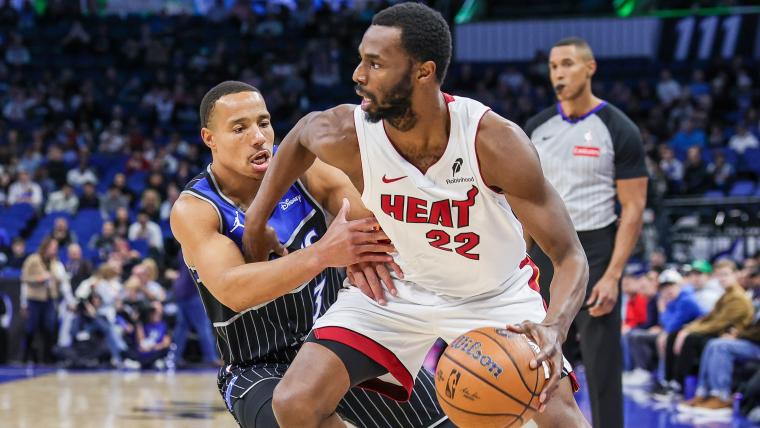
Heat, Andrew Wiggins: A Partnership Poised to Fizzle Without a Blockbuster Trade
The Miami Heat’s acquisition of Andrew Wiggins was a classic Pat Riley move: low-risk, high-reward, and dripping with the potential for a reclamation project. Wiggins, the former No. 1 overall pick, arrived not as a savior, but as a puzzle piece. Yet, as the Heat’s philosophy dictates, the fit must be perfect, and the timeline for contention is always now. The emerging reality, as first suggested by The Sporting News, is that Miami and Andrew Wiggins could very well part ways without the drama of a trade. This isn’t a story of failure, but one of divergent paths and cold, hard roster calculus.
Andrew Wiggins’s career arc is uniquely modern. He has never quite scaled the superstar heights expected of a top draft selection, yet he has carved out a vital, championship-proven role. He is the ultimate “3-and-D” wing with athleticism to spare, a box-score stuffer who can guard the opponent’s best player and drop 20 on any given night. But as multiple franchises have learned, Wiggins thrives as a complementary star, not the leading man. In Miami, he finds an organization built on culture, conditioning, and precise role definition. The marriage seems logical, but its longevity is far from guaranteed.
The Miami Heat’s Relentless Roster Churn
The Heat operate under a simple, relentless mantra: constant evolution. Jimmy Butler isn’t getting younger, and Bam Adebayo’s prime is squarely in the window. The front office, led by Riley and Andy Elisburg, is perpetually in pursuit of the next edge, the next piece that transforms a contender into a champion. They are masters of the asset maneuver, often creating something from nothing.
Wiggins was acquired as such an asset. His contract, once considered burdensome, now looks more manageable in a rising salary cap environment, especially for a player of his two-way pedigree. However, his fit is situational. He is not a primary ball-handler or a consistent offensive initiator—needs that have plagued Miami in recent postseason runs. The Heat’s system demands maximum effort, precise spacing, and, above all, availability. Any deviation from that standard, for any reason, can make a player expendable in their relentless pursuit of an upgrade.
Why a Trade Isn’t the Only Exit Route
The conventional thinking is that to move on from a player of Wiggins’s caliber, a trade must be engineered. But Miami’s situation and the NBA’s collective bargaining agreement provide alternative avenues. The most plausible scenario for a split involves the Heat’s financial strategy and Wiggins’s own contractual status.
- Contract as a Matching Salary: Wiggins’s salary is most valuable as a massive matching piece in a trade for a higher-tier star. If a disgruntled All-Star becomes available, Wiggins’s contract is the key that unlocks the deal. A split occurs not because Miami soured on Wiggins, but because he was the necessary vehicle to land a true game-changer.
- The Non-Guaranteed Final Year: Crucially, the final year of Wiggins’s contract (2026-27) is non-guaranteed. This is a powerful tool. It makes him exponentially more tradable next offseason as essentially an expiring contract. Alternatively, it gives Miami the option to simply waive him before that guarantee date, freeing up significant cap space without a trade partner. This is the ultimate “split without a trade” mechanism.
- Roster Crowding and Youth Movement: The Heat have invested heavily in younger wings like Jaime Jaquez Jr. and Nikola Jović, who represent the future core and require development minutes. If Wiggins’s presence stunts that growth or if the coaching staff believes the future is better served by allocating his minutes and shots internally, the rationale for a costly veteran diminishes.
Wiggins’s Fit in the Heat Culture Crucible
The “Heat Culture” fit is a double-edged sword. On one hand, Wiggins’s defensive versatility and improved shooting are tailor-made for Erik Spoelstra’s system. On the other, his occasionally passive offensive demeanor and fluctuating motor have been career-long critiques—traits that are anathema in Miami. The question isn’t about Wiggins’s talent; it’s about his sustainable intensity.
In Golden State, Wiggins found perfect synergy as a fourth option, excelling in a role that asked for specific, concentrated bursts of excellence. In Miami, the ask might be different. With Butler’s load management and the team’s offensive inconsistencies, Wiggins may be needed to be a consistent second or third option night after night. His history suggests that is not his ideal niche. If the Heat determine he cannot reliably provide that secondary scoring punch in the playoffs, his value to their specific championship blueprint plummets, regardless of how “useful” he is in the abstract.
Predictions: The Most Likely Paths Forward
So, how does this partnership likely end? The path of least resistance points toward a transactional, rather than a dramatic, split.
1. The Bridge to a Bigger Star (Summer 2025): This is the most probable outcome. Wiggins plays the 2024-25 season in Miami, contributing as a high-level role player. Next offseason, his contract (with its non-guaranteed year looming) becomes one of the most flexible and attractive trade assets in the league. Miami packages him with picks and/or young talent to pursue the next available star, whether that’s a Donovan Mitchell or a surprise trade candidate. He splits from the Heat as a valued asset, not a cast-off.
2. The Cap-Space Pivot (2026): If no star trade materializes and Miami’s young core makes a significant leap, the franchise could decide to fully reset around a new timeline. Exercising the option to waive Wiggins before his 2026-27 salary guarantees would be a clean, if stark, financial reset, allowing them to pursue free agents or retain their own youth.
3. The Unexpected Rebirth: The wild card. Perhaps the Heat culture unlocks a new, sustained version of 2022 Finals Wiggins. If he embraces the grind and consistently performs as a true two-way force, he could become a long-term fixture alongside Butler and Adebayo. While compelling, this path requires Wiggins to rewrite his career narrative at age 29, a challenging proposition.
Conclusion: A Pragmatic Partnership with an Expiration Date
The union between the Miami Heat and Andrew Wiggins is built on pragmatism, not permanence. He is a talented player filling a present need, but also a flexible contract and a potential trade chip for a future ambition. The notion of a split without a trade is not a slight against Wiggins’s abilities; it is a testament to the cold, calculating nature of NBA roster construction at the highest level, especially as executed by the Miami Heat.
Wiggins will likely be a valuable contributor in Miami. He may even be a key to a deep playoff run. But his tenure should be viewed through a transactional lens. He is both a player and an asset, and the Heat are experts at maximizing both. When the time comes to cash in that asset for a bigger prize or to clear the deck for the next phase, the split will be executed with businesslike efficiency. No trade demand, no public fallout—just the relentless, forward-moving machinery of a franchise forever chasing a championship, with or without Andrew Wiggins.
Source: Based on news from Yahoo Sports.