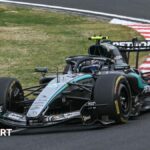
Ollie Bearman’s Suzuka Survival: A 50G Wake-Up Call for the 2026 Formula 1 Era
The ghost of Suzuka’s most fearsome corners was summoned once more on Sunday. In a blinding, brutal instant, the 2026 Japanese Grand Prix transformed from a strategic battle into a stark demonstration of survival. Haas driver Ollie Bearman, the promising Briton in his second full F1 season, became the central figure in a violent 50G crash that ripped the heart from his VF-26 challenger and sent a shockwave through the pinnacle of motorsport. The incident, a chilling consequence of the new regulatory era, has ignited urgent conversations about safety, technology, and the razor’s edge drivers walk in the hybrid age.
The Spoon Curve Incident: A Split-Second Catastrophe
On Lap 21, the race was settling into its strategic rhythm. Ollie Bearman, running a strong points-paying position, approached the legendary, high-speed sweeps of the Spoon Curve. Ahead, the Alpine of Franco Colapinto was navigating the complex corner. What happened next was a perfect and terrifying storm of modern Formula 1 variables.
Closing speeds in the current era of F1 are already astronomical, but the 2026 regulations have introduced a new and critical variable: aggressive and complex electrical energy harvesting. Colapinto’s car was deep in a harvesting phase, a mode where the car recovers significant electrical energy but at a drastic cost to internal combustion engine power output. To Bearman, cresting the curve at full tilt, the Alpine ahead would have appeared to suddenly decelerate violently.
The lethal speed differential created an impossible scenario. With milliseconds to react, Bearman faced a horrifying choice: a direct, high-speed rear-impact with Colapinto’s car or a desperate evasive maneuver. He chose the latter, jerking his Haas to the right. This sent him onto a perilous trajectory, clipping the curb and losing all aerodynamic downforce. The car became a passenger of physics, spearing across the runoff and making sickening, catastrophic contact with the unforgiving Tecpro barriers.
The aftermath was a scene of devastation. The Safety Car was instantly deployed as marshals rushed to a car that was little more than a monocoque surrounded by carbon fiber shards. The FIA’s official data later confirmed the peak impact force: a staggering 50G shunt.
Beyond the Impact: The 2026 Regulatory Tightrope
While the immediate focus is rightly on Bearman’s health, the root cause of the crash points directly at the evolving heart of Formula 1’s technical philosophy. The 2026 power unit regulations represent the most significant shift in a generation, placing a heavier emphasis than ever on electrical energy.
- Energy Harvesting Phases: Cars will enter periods of intense harvesting to meet strict energy deployment quotas. This can create sudden, dramatic drops in acceleration that are not immediately visible to a pursuing driver.
- The “Zombie Car” Effect: The term, whispered in paddocks, describes a car in full harvest mode: moving fast but not accelerating, creating a potentially deceptive and dangerous target for a driver approaching at race speed.
- Driver Awareness & Telemetry: Current driver aids and radio communication may be insufficient to warn of such acute speed deltas. The incident begs the question: does F1 need a standardized, real-time telemetry signal for cars in critical harvesting modes?
This was not a simple error of judgement; it was a driver being caught out by a fundamental and unpredictable characteristic of the new-generation machinery. The FIA and F1 have long prided themselves on pre-emptive safety, but Bearman’s crash reveals a new, digital-age blind spot that has emerged from the push for sustainability.
Bearman’s Resilience and the Road to Recovery
Miraculously, and a testament to the incredible safety standards built into modern F1 chassis, Ollie Bearman was able to extricate himself from the wreckage. He was seen limping away, a clear sign of the immense forces his body endured, and was immediately taken to the circuit medical centre before being airlifted to a nearby hospital for comprehensive checks.
Haas Team Principal, Ayao Komatsu, stated: “Ollie is alert and talking. The initial scans are encouraging, showing no major fractures. He is, however, battered and bruised, as you’d expect from an impact of that magnitude. His physical and mental recovery is our only priority now.”
Bearman’s sophomore season has been marked by flashes of brilliance, solidifying his reputation as a future star. This brutal interruption is a cruel twist, but his proven resilience—honed from a young age in the junior categories—will be his greatest asset. The coming weeks will involve rigorous physiotherapy and undoubtedly, psychological evaluation, as the mental fortitude required to climb back into an F1 cockpit after such an event cannot be overstated.
Predictions and Implications for the Future of F1
The ripples from this crash will extend far beyond Haas’s garage. We can expect several key developments in its wake:
Immediate Technical Directives: The FIA is likely to fast-track investigations into mandatory warning systems or adjusted harvesting protocols in high-speed sectors to mitigate the risk of such extreme closing speeds. Teams may be required to limit harvesting in designated danger zones like Spoon Curve or Eau Rouge.
Driver Advocacy: The Grand Prix Drivers’ Association (GPDA) will become a powerful voice. Drivers will demand greater clarity and predictability from the complex power units. Their feedback could directly shape mid-regulation tweaks to ensure the “zombie car” effect is minimized.
Long-Term Regulatory Review: While the 2026 regulations are set, this crash provides critical, real-world data. It will inform the 2030+ rulemaking process, emphasizing that safety and predictability must be engineered into the very DNA of the power unit, not just the chassis.
Bearman’s Comeback Trail: For Ollie, the path is clear: a meticulous, step-by-step recovery. His seat is secure, but his return will be a major story. When he does buckle back in, all eyes will be on his confidence through high-speed corners and in traffic—a psychological hurdle he must and will overcome.
Conclusion: A Harsh Lesson at Racing’s Most Demanding Temple
Suzuka, a circuit that rewards absolute commitment and punishes the slightest frailty, has delivered another sobering chapter in F1’s relentless pursuit of progress. Ollie Bearman’s violent 50G crash is a stark reminder that as the sport innovates towards a more technologically complex future, the human element—both in the cockpit and in the rulemakers’ offices—must remain the central focus.
This was more than a racing incident; it was a systemic warning. The crash at Spoon Curve will be analyzed not just for what it destroyed, but for what it must now help build: a safer, more intelligible formula where the bravery of drivers like Bearman is matched by an engineering philosophy that leaves no room for lethal surprises. The young Briton’s limp away from the wreckage may well be the stride that forces Formula 1 to take a crucial step forward.
Source: Based on news from Yahoo Sports.