Gary Woodland’s Victory Wasn’t About Golf. It Was a Declaration of War on Silence.
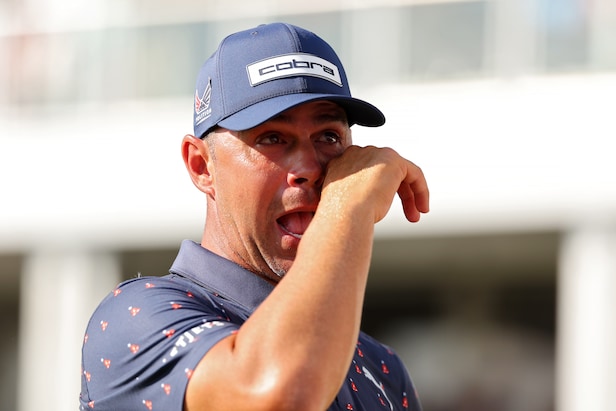
The putt was a formality. A four-foot tap-in on the 72nd hole of the Houston Open to seal a two-shot victory, the kind of moment professional golfers practice ten thousand times. But when the ball disappeared into the cup, Gary Woodland did not perform the classic, stoic champion’s fist pump. His body convulsed. His arms shot skyward, not in triumph, but in release. He crumpled into his wife’s embrace, both weeping, a public unraveling of a private war. This was not the celebration of a golfer who had won. This was the visceral, shuddering relief of a man who had survived. Seven years after his last win, and just months after revealing a secret battle with post-traumatic stress disorder, Woodland’s victory was a scoreboard fact that paled next to the human truth it represented: he refused to let the story end the way the darkness wanted it to.
The Exhaustion of Pretending: A Champion Dying Inside
For over a year, Gary Woodland lived a double life. Publicly, he was the inspiring comeback story: the 2019 U.S. Open champion who had bravely undergone brain surgery to remove a lesion, returning to the fairways to the warm applause of galleries. Privately, he was in a state of perpetual, terrifying crisis. The official diagnosis, received about a year ago, was post-traumatic stress disorder—a condition he, like many, associated solely with combat. His trauma was different, a complex storm likely rooted in the fear and vulnerability of his health scare, but the neurological impact was identical.
“I was dying inside,” Woodland would later confess. The cruelty was in the disconnect. Every week, fans and fellow players would greet him with heartfelt encouragement: “So good to see you doing well!” He would smile, nod, and absorb the kindness that felt like a weight because it was meant for a version of himself that did not exist. The pressure to maintain that facade became unbearable.
His experience on the course was a nightmare of hypervigilance and dissociation:
- Panic in Plain Sight: A walking scorer accidentally startled him from behind during a tournament in Napa. Woodland’s eyesight went blurry, his mind blanked, and when it was his turn to hit, he physically could not. His caddie offered to withdraw. Woodland refused, playing through tears for the remainder of the round.
- Isolation Rituals: He would cry in portable bathrooms between holes. He would sprint to his car after rounds to hide, avoiding any human interaction that might fracture his fragile composure.
- The Ultimate Fight: The decision to finish that round in Napa, and every round after, was critical. It was no longer about golf. It was about committing to the fight itself. Walking off felt like surrendering a piece of his identity he might never get back.
The Turning Point: Rejecting the “Feel-Good” Narrative
The breaking point wasn’t a crash; it was a specific kind of exhaustion—the exhaustion of pretending. Three weeks before his Houston win, Woodland sat down with Golf Channel and deliberately dismantled the public narrative. He replaced the tidy “brain surgery survivor” headline with the messy, terrifying reality of PTSD. He spoke of the shame, the fear, and the profound loneliness of suffering in a spotlight.
This was not merely an act of advocacy, though it certainly was that. It was a tactical and personal necessity. “I could no longer be what people had decided I was,” he implied. By speaking his truth, he robbed the illness of its power to isolate him. He connected with veterans and first responders who recognized the symptoms: the brain rewired around trauma, stuck in a fight-or-flight loop. Their message was the one he needed: You cannot do this alone. No amount of Tour wealth or physical strength is armor against a rewired nervous system.
Coming forward was his first true act of control. He stopped absorbing misplaced warmth and returning a fraudulent smile. He traded the burden of a lie for the heavy, but solid, ground of truth.
Houston: The Physical Manifestation of a Mental Victory
This context is what transformed the Houston Open from a golf tournament into a profound spectacle. Woodland’s performance was technically masterful—his ball-striking was commanding, and he led for much of the weekend. But to watch him was to see a man playing with a different kind of focus. The weight was gone. The swing was free. The outcome, for once, felt secondary to the process.
When the final putt fell, the raw emotion wasn’t about the trophy. It was the culmination of a longer, harder journey. As he said through tears afterward: “We tell an individual sport, but I wasn’t alone today. I got a lot of people behind me. Anyone who is struggling with something, I hope they don’t give up. Just keep fighting.” His “we” wasn’t his team. It was everyone who had shared their story, everyone who had listened to his, and the part of himself he had finally learned to not abandon.
This is where sports transcend score. The victory was in the vulnerability that preceded it. The win was sealed not on the 18th green, but in the decision to stop fighting alone.
What Woodland’s Win Means for the Future of Sports and Mental Health
Gary Woodland’s journey creates a new, more complex blueprint for the athlete’s comeback narrative. It moves beyond the physical—the repaired knee, the rehabbed shoulder—and into the neurological and psychological. His victory offers several critical predictions and implications:
- The End of the “Strong Silent” Archetype: Woodland, a famously tough, athletic golfer, proves that mental health is not a weakness. His strength was in seeking help and speaking out, redefining resilience for the next generation of athletes.
- A Ripple Effect in the Locker Room: Just as Michael Phelps and Naomi Osaka opened conversations, Woodland’s PTSD revelation speaks directly to athletes who may be suffering from trauma—whether from injury, personal loss, or the immense pressure of performance. His win proves that addressing it can be part of a winning strategy.
- Redefining the “Comeback”: The most important comeback wasn’t to the winner’s circle. It was a comeback to himself. His performance in Houston was the first public evidence of a private reconciliation, showing that healing is not linear but can coexist with, and even fuel, elite performance.
Gary Woodland did not “beat” PTSD. That’s not how these things work. Trauma rewires the brain; it becomes a part of the landscape you learn to navigate. What he did was far more powerful: he refused to let it win. He refused to let it silence him, isolate him, or force him from the arena of his life. His victory in Houston was a punctuation mark in a longer sentence of survival. It screamed to anyone listening in their own darkness that the fight is the whole point, that showing up—terrified and tearful—is itself a victory. The score was a footnote. The real story was the man, finally whole enough to hold the trophy, who used his platform to turn his personal pain into a public lighthouse. That’s a legacy no leaderboard can ever capture.
Source: Based on news from Yahoo Sports.