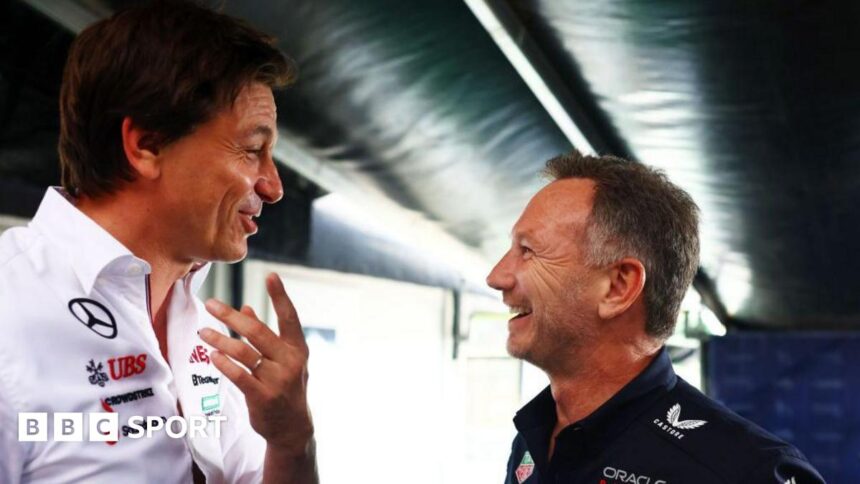
Broken Glass Makes Horner F1 Return Difficult, Says Rival Wolff
The world of Formula 1 is a crucible of high-speed competition, where rivalries forged on the track often simmer long after the checkered flag falls. Few were as intense as the battle between Mercedes and Red Bull during the 2021 season, a year that culminated in a controversial finale and left scars between team principals Toto Wolff and Christian Horner. Now, with Horner out of a job, his former rival has delivered a stark assessment of his future, using a vivid metaphor that speaks volumes about the lasting impact of scandal in the pinnacle of motorsport.
A Legacy Forged in Fire and Controversy
To understand the weight of Toto Wolff’s words, one must first revisit the incendiary 2021 championship duel. Lewis Hamilton, the stately king of the hybrid era for Mercedes, versus Max Verstappen, the fiery young challenger from Red Bull. The title fight was a season-long war of attrition, with team principals Wolff and Horner acting as generals, trading barbs in the media as frequently as their drivers traded positions on track.
The tension reached its zenith at the Abu Dhabi Grand Prix, where a controversial late safety car decision by race director Michael Masi handed Verstappen the title on the final lap. The fallout was nuclear. Mercedes’ fury was palpable, and the professional rivalry between Wolff and Horner hardened into something more personal. This history is the essential backdrop against which Wolff now comments on Horner’s predicament, lending his perspective a unique blend of insider knowledge and historic antagonism.
“Broken Glass”: Wolff’s Metaphor for Scandal
Christian Horner’s two-decade reign at Red Bull, a period of incredible success with 13 championships, ended abruptly in July. The official reason cited declining form and internal disputes, but it was the shadow of scandal that truly defined his exit. Earlier in the year, Horner had been accused of sexual harassment and coercive behaviour by a female employee, allegations that triggered an internal investigation.
While Horner was cleared of the claims twice—first by an initial investigation and then upon the dismissal of an appeal—the damage to his reputation was severe. The controversy dominated the opening race weekend in Bahrain, overshadowing the sport itself. It is in this context that Toto Wolff offered his blunt analysis. “A return to Formula 1 will be difficult for Christian because he has ‘broken quite a lot of glass’,” Wolff stated. In the high-stakes, image-conscious world of F1, this metaphor cuts deep.
- Reputational Damage: The public nature of the allegations, regardless of the legal outcome, creates a permanent stain.
- Sponsor Aversion: Major global brands are intensely sensitive to association with controversy.
- Team Dynamics: Installing a figure with such recent baggage could disrupt the delicate chemistry of a team.
- Governing Body Scrutiny: The FIA and F1 Group, keen to promote a clean image, may quietly discourage a swift return.
“Breaking glass” implies a shattering of trust, a creation of hazardous fragments that are difficult and dangerous to clean up entirely. For Wolff, the issue isn’t the legal verdict, but the irreversible reputational fallout that makes Horner a risky proposition for any potential employer.
The Unforgiving Landscape of Modern Formula 1
Wolff’s commentary touches on a fundamental shift in Formula 1’s corporate culture. The sport, under Liberty Media’s stewardship, has aggressively pursued global growth, tapping into new markets like the United States. This expansion demands a polished, mainstream-friendly product. The drama is meant to be on the track, not in the principal’s office.
Teams are now billion-dollar entities with complex ownership structures and deep ties to multinational corporations. The role of a team principal has evolved from a purely sporting figurehead to a CEO-like role, representing the team’s brand at all times. In this environment, a figure associated with a high-profile scandal—even if exonerated—represents a significant commercial and PR risk.
Where might Horner fit? A return to a top team like Ferrari, McLaren, or Aston Martin seems implausible given the immediate scrutiny it would attract. A mid-field team desperate for his technical and strategic acumen might be tempted, but would likely baulk at the media firestorm his appointment would ignite. This leaves roles in management further from the spotlight, perhaps with a manufacturer or in a consultancy capacity, as more probable, if less glamorous, avenues.
Expert Analysis: The Path Back and Wolff’s Calculated Words
From a journalistic standpoint, Wolff’s statement is a masterclass in pointed commentary. It is not an overt attack, but a cold, analytical prediction that carries the authority of a seasoned insider. By using the “broken glass” metaphor, he frames the situation in terms of irreversible consequence, not legal guilt. He positions himself above the fray, commenting on the state of the sport’s ecosystem rather than the individual.
However, the path to redemption in sports, while narrow, does exist. Time is a critical factor. A period of silence and distance from the F1 paddock could allow the immediate controversy to fade. Horner’s undeniable record of success—six constructors’ and seven drivers’ titles—remains his strongest currency. If he can demonstrate that his sporting genius outweighs the perceived reputational risk, a door may eventually crack open.
Potential scenarios for a Horner return include:
- A leadership role with a new manufacturer entry (e.g., Audi) seeking instant credibility and operational expertise.
- A move to a different racing series, such as the WEC or Formula E, to rebuild his profile away from the F1 media glare.
- A return in a non-team principal capacity, such as a strategic advisor to a team owner or a senior management role within a parent company.
Yet, Wolff’s core argument stands: the glass, once broken, cannot be unbroken. The memory of the 2021 Bahrain weekend, with Horner simultaneously celebrating on track while battling allegations off it, is now part of F1’s permanent record.
Conclusion: A Cautionary Tale in the Paddock’s Goldfish Bowl
Toto Wolff’s assessment of Christian Horner’s future is more than just a rival’s parting shot. It is a stark reflection of the new realities of Formula 1. The sport now exists at the intersection of cutting-edge technology, vast financial investment, and intense societal scrutiny. In this arena, winning is everything, but reputation is the currency that buys you the chance to compete.
The Horner saga serves as a cautionary tale for every figure in the paddock. The speed and intensity of modern media can amplify allegations to a point where legal exoneration does not equate to public or commercial rehabilitation. For Christian Horner, a man who lived and breathed Formula 1 for 20 years, the road back is fraught with the very shards of glass Wolff describes. His unparalleled success may one day compel a team to brave the cleanup, but as his old rival so succinctly noted, the difficulty of that task cannot be underestimated. In the end, Wolff’s metaphor endures because it perfectly captures the permanent, hazardous, and visible nature of reputational damage in the world’s most visible sport.
Source: Based on news from BBC Sport.