Max Verstappen’s Media Standoff: Inside the Suzuka Ejection and the Unending Tension
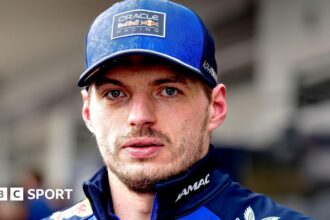
The serene paddock of the Suzuka Circuit, a temple of speed and precision, was abruptly transformed into a theater of tension on Thursday. Max Verstappen, the reigning and four-time Formula 1 World Champion, stood before the assembled media not to discuss his favorite corner or his strategy for the Japanese Grand Prix, but to issue an ultimatum. Pointing directly at English journalist Giles Richards of The Guardian, Verstappen declared, “I’m not speaking before he leaves.” In a stunning re-run of a previous clash, the Red Bull star had a reporter ejected from his pre-race media session, reigniting a fierce debate about driver-media relations, personal grudges, and the pressurized world of modern F1.
A Flashback to Abu Dhabi: The Root of the Rift
To understand the electric moment in Suzuka, one must rewind to the 2023 season finale in Abu Dhabi. There, Giles Richards posed a question to Verstappen that, in the champion’s view, crossed a line. While the exact wording has been debated, the query centered on the intense scrutiny faced by Red Bull team principal Christian Horner amid internal team dynamics and Verstappen’s own public loyalty. Verstappen perceived it as an attempt to stir controversy and destabilize the team, responding with visible irritation. The incident clearly left a deep mark.
Fast forward to Japan, and Verstappen’s memory proved long. His refusal to even begin the session until Richards departed was a calculated power move. The brief, tense exchange—”Seriously?” from a bewildered Richards, met with a terse “Yes” and a final “Get out!” from Verstappen—was not a spontaneous outburst. It was a premeditated statement. This was Verstappen drawing a boundary, enforcing a consequence, and sending a clear message to the entire press corps about what he considers unacceptable.
Expert Analysis: The Psychology of a Champion Under Siege
From a sporting psychology perspective, Verstappen’s actions are a multifaceted defense mechanism. He operates in a unique ecosystem of extreme pressure, where every word is dissected and narratives are constantly spun. His entire career has been shaped by a tight-knit inner circle—his father Jos, manager Raymond Vermeulen, and the Red Bull racing family. Perceived attacks on that circle are treated as direct personal affronts.
“Verstappen views the world through a lens of absolute loyalty and competition,” explains a veteran F1 analyst. “The team is his fortress. A question he interprets as attempting to breach those walls, to create division, is an act of aggression. His response in Suzuka wasn’t just about a journalist; it was about protecting his ecosystem. He controls the car with ruthless precision, and he seeks to control his narrative with the same intensity.”
This incident also highlights the evolving, often fraught, relationship between superstar athletes and the media. While mandatory FIA press conferences ensure a baseline of access, these more informal team-run sessions are a privilege. Verstappen leveraged that distinction powerfully. His message was clear: access is not a right if it breaches his personal code.
- Boundary Enforcement: A direct consequence for a past transgression, establishing rules of engagement.
- Loyalty Signaling: A public demonstration of his protective stance towards his Red Bull inner circle.
- Psychological Fortressing: Creating a media environment he deems “safe” from perceived hostile lines of questioning.
- Control Narrative: Taking command of the session’s tone from the very first second, on his terms.
The Ripple Effect: Predictions for the Season and Beyond
This standoff will have consequences that extend far beyond a tense Thursday in Japan. We can anticipate several key developments:
1. A Chilling Effect on the Press Corps: Journalists will now weigh the risk of asking Verstappen hard-hitting questions about team dynamics or controversies. Will this lead to more anodyne interviews, or will it embolden others to test his boundaries further? The dynamic is permanently altered.
2. Intensified Scrutiny on Verstappen’s Leadership: While his driving genius is unquestioned, his role as a team leader and a global sporting ambassador will be critically examined. Rivals like the meticulously media-trained Lewis Hamilton or the affable Lando Norris offer a stark contrast in style. Verstappen’s approach may galvanize his team but could alienate segments of the broader F1 audience.
3. Red Bull’s Delicate Balancing Act: The team will privately support their star asset—his performance is their success. Publicly, however, they must manage partnerships and the sport’s broader image. Expect behind-the-scenes mediation, but no public reprimand for the champion who delivers them championships.
4. The “Verstappen Rule”: Could the FIA or Formula 1 management step in to clarify protocols for team-run media sessions? While they cannot force a driver to answer a question, they have an interest in maintaining professional standards of access. This incident may prompt quiet discussions about the limits of a driver’s veto power.
Conclusion: Raw Principle or Petty Grudge?
Max Verstappen’s ejection of Giles Richards is a defining snapshot of the champion’s character. It can be framed as a principled stand against what he sees as malicious, divisive journalism—a fierce protection of his team’s sanctity in a hyper-competitive environment. Alternatively, it can be viewed as a champion holding a petty grudge, wielding his immense power to silence a critic and avoid uncomfortable topics.
The truth likely resides in the intense, uncompromising space Verstappen occupies. He is not a politician or a corporate spokesman; he is a pure racer who demands that the world engage with him on his terms. In Suzuka, he made those terms brutally clear. As the 2024 season accelerates, this incident ensures that the spotlight will remain fixed not only on Verstappen’s peerless racing, but also on the formidable, unyielding fortress he builds around himself and his quest for a fifth title. The battle lines with the media are now as sharply defined as the racing lines at 130R.
Source: Based on news from India Today Sport.
Image: CC licensed via www.wallpaperflare.com