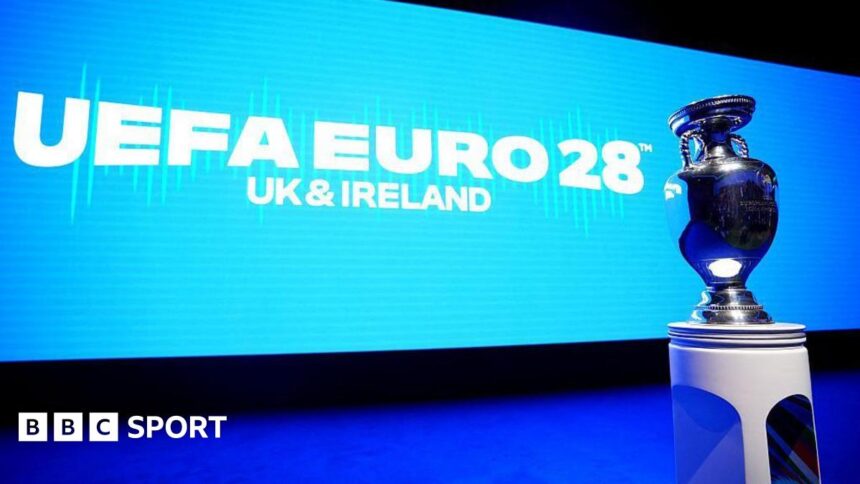
Euro 2028’s Fan-First Promise: Five Tickets for the Price of a World Cup Parking Spot
In the ever-escalating financial arms race of global sports, where the cost of fandom often feels like a secondary concern, a startling comparison has emerged. As the football world turns its gaze to the 2026 World Cup in North America, with its sprawling distances and premium price tags, the blueprint for Euro 2028 offers a stark and refreshing contrast. According to UEFA’s pricing strategy, supporters will be able to purchase five Euro 2028 tickets for roughly the same cost as a single World Cup parking space at a stadium in the United States this summer. This isn’t just a catchy headline; it’s a deliberate manifesto for a more accessible, fan-centric major tournament. With the event hosted across nine stadiums in the UK and the Republic of Ireland, UEFA is making a bold claim: the soul of the game can be preserved, even at its highest level.
The Stark Economics of Modern Fandom
To understand the significance of UEFA’s move, one must first look at the current landscape. The 2026 World Cup, while promising a festival of football across three nations, also brings with it the formidable commercial weight of the American sports market. Early reports and projections based on existing major event pricing in the US suggest that ancillary costs like parking can reach astonishing heights. It’s not uncommon for premium parking at NFL or major college football games to exceed $200. When scaled to a once-in-a-generation World Cup event, a parking space cost of $250-$300 (£200-£240) is a plausible, if eye-watering, estimate.
Against this backdrop, UEFA’s pledge to broadly freeze ticket prices for Euro 2028 is revolutionary. By anchoring the cheapest group stage tickets below £30 and £60—mirroring the 2024 prices in Germany—the governing body is creating a tangible financial sanctuary for supporters. The math is simple and powerful: five of those £60 tickets equal £300, directly comparable to that single World Cup parking spot. This conscious pricing is a direct response to a growing global concern: that live elite sport is pricing out the very people who give it meaning.
Deconstructing the Euro 2028 Ticket Strategy
UEFA’s plan is not a vague promise; it’s a structured, multi-category system designed with clear priorities. The core of the strategy rests on two pillars: volume for the many, and premium exclusivity for the few to subsidize the rest.
- Fans First Categories (40% Allocation): This is the heart of the policy. Two entire ticket categories, comprising 40% of all tickets, are dedicated to the most affordable prices. This ensures a significant portion of every stadium will be filled with supporters whose primary qualification is passion, not wealth.
- Four-Tier Plus VIP+ Structure: The system will feature four general public categories, with the “Fans First” tiers at the bottom. A small sliver of VIP+ tickets will sit at the very top. These ultra-premium experiences are the crucial economic engine.
- Cross-Subsidy Model: The revenue generated from the high-end corporate and VIP+ tickets is explicitly intended to fund price freezes for the general fan. This model acknowledges commercial realities while deliberately redirecting profits to safeguard accessibility.
This approach recognizes a diverse fanbase. The young family, the student, the lifelong supporter of a smaller nation—all have a protected pathway to attend. Meanwhile, the market for luxury hospitality, which exists at every event, is harnessed to benefit the wider crowd.
The Home Advantage: Logistics and Legacy
Hosting across five nations (England, Scotland, Wales, Northern Ireland, and the Republic of Ireland) provides a unique logistical advantage that complements the pricing strategy. Unlike a transcontinental World Cup or even a single-nation Euros with extensive travel, the UK and Ireland host venues are relatively close-knit.
This geography drastically reduces two other major cost burdens for fans: internal travel and accommodation. Supporters may be able to attend multiple matches without ever boarding a flight. The dense rail and road networks, combined with the possibility of day trips for many, stand in stark contrast to the thousands of miles and multiple internal flights required for a World Cup in the US, Canada, and Mexico. This holistic affordability—tickets, travel, and lodging—could make Euro 2028 the most accessible major tournament in a generation for European fans.
Furthermore, the tournament leaves behind a legacy of modernized, right-sized stadiums. From Dublin’s Aviva Stadium to Cardiff’s Principality Stadium and Glasgow’s Hampden Park, these are venues with deep community roots and existing public transport links, not white elephants built in isolation. This sustainable model avoids the crippling debt and underuse that has plagued other mega-events.
Expert Analysis: A Calculated Gamble with High Rewards
From a sporting business perspective, UEFA’s strategy is a calculated gamble, but one with potentially monumental rewards. “This is a masterclass in brand protection and long-term thinking,” says Dr. Sarah Elwood, a sports economist. “UEFA is trading maximum short-term per-ticket revenue for immense goodwill, packed stadiums with authentic atmospheres, and a powerful narrative. They are selling the ‘product’ of an unforgettable, inclusive festival of football, which in turn enhances the value of their broadcast and sponsorship deals.”
The risk, of course, is leaving money on the table. The demand for a Euros in these football-mad nations will be astronomical, and they could likely charge far more for the cheapest tickets. However, the cost of doing so—sterile atmospheres, a homogenized wealthy crowd, and a furious public backlash—is deemed higher. The VIP+ tickets funding model is the savvy compromise, ensuring revenue streams are maintained without betraying the core support.
This also sets a formidable precedent. It creates a public expectation for future tournaments and puts pressure on other governing bodies, notably FIFA, to justify their own pricing structures. The “five tickets for a parking space” soundbite is a potent piece of PR that UEFA will wield for years.
Predictions and The Road to 2028
Looking ahead, the success of this policy will hinge on execution. The primary challenge will be combating the inevitable black market. With such high demand and relatively low face-value prices, touts and speculative resale will be a major threat. UEFA must invest in a robust, nominative ticketing system and strict resale controls to ensure tickets reach genuine fans.
We can also predict:
- Unparalleled Atmospheres: With stadiums filled by those for whom the ticket was a sacrifice but not an impossibility, the noise and passion will be electric, creating a virtuous cycle of memorable TV moments.
- A Blueprint for Others: If successful, this model could become the standard for continental tournaments globally, forcing a re-evaluation of pure profit-maximization.
- Increased Scrutiny on FIFA: The contrast with 2026 will be a constant point of discussion, pressuring FIFA to introduce more accessible ticket quotas for the World Cup.
Conclusion: More Than a Price Freeze, A Statement of Values
UEFA’s pricing strategy for Euro 2028 is far more than a clever marketing point or a temporary price freeze. It is a profound statement of values in an era of sporting commercialism. By ensuring that five Euro 2028 tickets cost the same as a single World Cup parking space, they are making a deliberate choice about what kind of event they want to host and what kind of sport they want to govern. It is a commitment to the cacophonous, passionate, and diverse crowds that define European football culture.
In the UK and Ireland, they have found willing partners—nations with existing infrastructure and a deep, often tribal, football heritage. By leveraging this and a smart cross-subsidy ticketing model, Euro 2028 has the potential to be a landmark tournament: a celebration that is spectacular not in its opulence, but in its accessibility. It promises a simple yet increasingly rare outcome: the chance for real fans to be at the heart of the story, not just spectators to a corporate show. In the end, they are betting that the roar of a truly full, truly passionate crowd is worth more than any parking fee in the world.
Source: Based on news from BBC Sport.