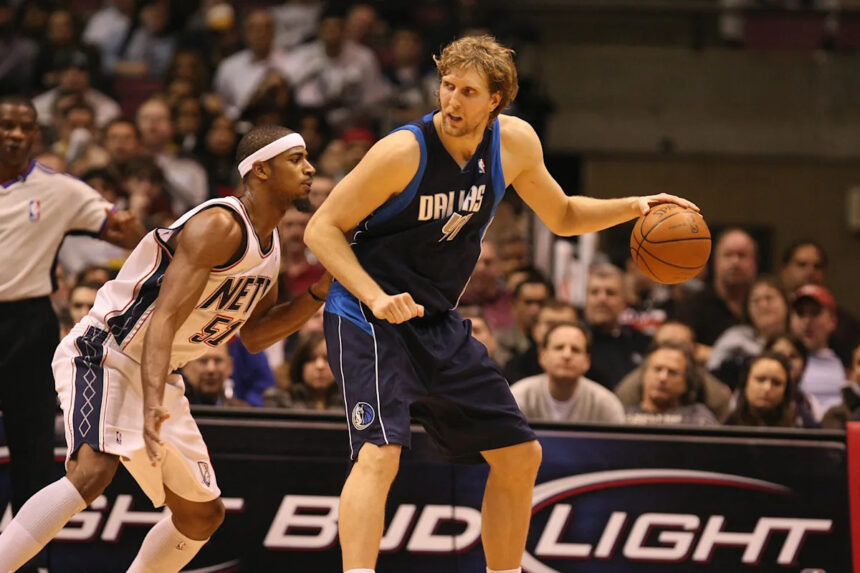
The No. 51 in Brooklyn Nets History: The Unfulfilled Promise of Sean Williams
In the sprawling tapestry of the Brooklyn Nets franchise—a history woven from ABA championships, NBA Finals appearances, and over 600 players across 52 jersey numbers—some threads are defined by stardom, others by longevity, and a few by tantalizing, unfulfilled potential. The story of jersey No. 51 falls squarely into the latter category. While the number itself has been worn sparingly, its most notable occupant, Sean Williams, remains a fascinating “what-if” in the annals of the team. Drafted in an era of transition for the then-New Jersey Nets, Williams embodied a raw, breathtaking athleticism that promised to reshape the team’s interior identity. His tenure, from 2007 to 2010, serves as a compelling case study in how sheer physical talent alone cannot cement an NBA legacy, leaving behind a legacy of spectacular blocks and unanswered questions.
A Draft Night Gamble: The Nets Bet on Athleticism
By the summer of 2007, the New Jersey Nets were at a crossroads. The glory days of back-to-back NBA Finals appearances were receding, and the franchise was navigating the final years of the Jason Kidd-Vince Carter-Richard Jefferson era. With the 17th overall pick in the 2007 NBA Draft, the Nets front office, led by Rod Thorn, looked not for a polished scorer, but for a defensive game-changer. They selected Sean Williams, a 6’10” forward/center from Boston College, whose college career was as notable for its interruptions as its flashes of dominance.
Williams’s pre-draft profile was a study in contrasts. At his best, he was a defensive phenom:
- Elite shot-blocking instinct: He averaged a staggering 5.0 blocks per game as a college sophomore.
- Freakish athleticism: He possessed a vertical leap and quick-twitch reflexes rarely seen in a player of his size.
- Transition finishing ability: He could run the floor like a guard and finish with authority.
However, significant red flags followed him to the pros. Disciplinary issues led to a dismissal from the Boston College team, and his offensive game was considered rudimentary at best. The Nets’ selection was a quintessential high-risk, high-reward gamble, betting that their structure and veteran leadership could harness his immense physical gifts.
Flights of Fancy and Grounded Reality: The On-Court Rollercoaster
Sean Williams’s rookie season immediately validated the “high-reward” side of the draft equation. Thrust into meaningful minutes due to injuries, he became an instant fan favorite at the Izod Center. His shot-blocking was not just effective; it was theatrical. He would seemingly come from nowhere to pin shots against the backboard, igniting fast breaks and energizing the crowd. For a brief period, he looked like the defensive anchor the team desperately needed, averaging 1.5 blocks in just 17.5 minutes per game as a rookie.
Analytically, Williams’s impact was clear in short bursts. He provided a defensive spark off the bench that the plodding Nets’ frontcourt otherwise lacked. His presence in the paint altered opponents’ driving strategies. However, the “high-risk” elements of his profile proved equally valid. His offensive limitations were stark; beyond dunking, he had little reliable scoring touch. More critically, the disciplinary and consistency issues that plagued him in college resurfaced. He struggled with foul trouble, often negating his defensive value by taking himself out of games. Off-court incidents, including a well-publicized marijuana possession arrest, began to overshadow his on-court exploits.
As his tenure progressed, Williams failed to develop the basketball IQ or the off-court maturity to complement his athleticism. The coaching staff, first under Lawrence Frank and later others, found his minutes harder to justify. The arrival of new head coach Avery Johnson in 2010 signaled a definitive end; Williams was waived before the 2010-11 season, his potential largely untapped.
No. 51 in Context: A Jersey of Transitional Figures
To fully understand Sean Williams’s place in franchise lore, one must look at the other occupants of jersey No. 51. The number has been one of the least worn in team history, typically reserved for big men during specific, transitional periods:
- Jimmy Collins (1974-75): The original Net to wear No. 51, playing a single season for the New York Nets in the final ABA championship year.
- Eddie Lee Wilkins (1990-91): A journeyman center who played one season for the New Jersey Nets during a forgettable early-90s period.
- Sean Williams (2007-10): The most recent and most physically gifted player to wear the number, representing the end of the New Jersey era.
This lineage positions Williams not as a franchise cornerstone, but as a symbol of a specific draft philosophy and a particular moment in time. He was selected as the Nets were trying to extend a competitive window, and his departure coincided with the franchise’s plunge into a rebuild that would eventually lead to the move to Brooklyn. The No. 51, in this light, is a jersey of projects and brief tenures, with Williams standing as its most athletically spectacular project.
Legacy and The Lasting “What If?”
So, what is the lasting legacy of Sean Williams in Brooklyn Nets jersey history? He does not reside in the pantheon of franchise greats, nor is he a notorious bust. Instead, he occupies a unique space as a cautionary tale of unrefined talent. In today’s NBA, a player with his athletic profile and shot-blocking prowess would be nurtured with specialized developmental coaches, placed in analytical systems that maximize his strengths, and managed by player development teams attuned to off-court support. The early 21st-century NBA was less equipped for such projects.
For the modern Nets fan, Williams’s story is a reminder of the franchise’s complex path. His highlights—those gravity-defying blocks—remain a visceral thrill on YouTube, glimpses of a player who could, for a single possession, dominate a game physically. Yet, his career trajectory underscores a fundamental basketball truth: sustainable NBA success is built on a combination of skill, mentality, and opportunity.
As the Brooklyn Nets continue to build their future, chasing stars and crafting cohesive rosters, the history of jersey No. 51 serves as a footnote of fascinating imperfection. Sean Williams’s three-season tenure was a fleeting, explosive, and ultimately unfinished symphony of athleticism. He remains the human highlight film who never found a consistent narrative, a player whose legacy is forever defined not by what he was, but by what he so spectacularly could have been.
Source: Based on news from Yahoo Sports.