Projecting the Eagles’ 2026 Offensive Starters: A New Era Under Sean Mannion
The Philadelphia Eagles’ offseason is humming with a distinct sound—not just the clatter of weights during voluntary workouts, but the palpable buzz of a franchise in transition. As the 2026 NFL Draft looms, the Eagles’ offense stands at a pivotal crossroads, shaped by significant coaching turnover and strategic roster evolution. With new play-caller Sean Mannion at the helm and a retooled skill-position group, predicting the starting lineup is an exercise in forecasting the dawn of a new offensive philosophy. We dive deep into the film, the acquisitions, and the scheme fits to project the 11 men who will take the first snap for the Eagles’ offense this fall.
A Revolution in the Coaching Booth
Gone are the foundational pillars of Kevin Patullo and the legendary Jeff Stoutland. In their place, Head Coach Nick Sirianni has orchestrated a fascinating, quarterback-centric staff overhaul. The promotion of Sean Mannion to offensive coordinator is the headline move. A former NFL quarterback known for his cerebral approach, Mannion’s vision will be filtered through the lenses of passing game coordinator Josh Grizzard and senior offensive assistant Jerrod Johnson, another ex-QB. This trio suggests a heavy emphasis on schematic nuance, pre-snap diagnostics, and maximizing Jalen Hurts’ growth as a pocket passer. Up front, Chris Kuper takes over the Herculean task of maintaining the “Brotherly Shove” standard, while Ryan Mahaffey will look to synergize the run game with a talented tight end room.
This collective brain trust indicates a potential shift. Expect less reliance on pure RPO brutality and more layered, pro-style concepts that use motion and formation to create mismatches. The offense will still run through Hurts’ unique talents, but the surrounding cast will be deployed with more precision.
Quarterback and Backfield: Stability Meets Thunder
This area offers the least suspense but the most excitement. Jalen Hurts enters his prime, coming off a 25-touchdown, six-interception season that underscored his improved efficiency. His offseason work with Mannion and Johnson will be crucial in mastering the new system’s intricacies. The acquisition of veteran Andy Dalton provides a stable, experienced backup, a clear upgrade that allows the coaching staff to focus fully on Hurts’ development.
The backfield, however, is a potent two-headed monster. Saquon Barkley returns after consecutive 1,000-yard seasons, a testament to his durability and elite playmaking. His role as a receiver will be heavily featured in Mannion’s offense. The fascinating complement is Tank Bigsby, acquired via trade. His explosive 5.7 yards per carry in a limited role last season showcased a devastating, downhill style.
- Projected Starter: Jalen Hurts (QB1)
- Projected Starter: Saquon Barkley (RB1)
- Key Role: Tank Bigsby (Change-of-Pace Back)
This duo allows for a dynamic, game-script-proof approach. Barkley can win on all three downs, while Bigsby provides the fresh-legged hammer to close out games.
The Pass-Catching Corps: A Speed-First Metamorphosis
The most dramatic overhaul occurs here, with the expected post-June 1 departure of A.J. Brown signaling a philosophical pivot. The Eagles have aggressively pursued vertical speed and separation ability, moving away from pure power.
Hollywood Brown is the new WR1. His elite deep speed and experience in sophisticated passing games make him the primary X-receiver and a perfect match for Hurts’ improved deep ball. The trade for Elijah Moore provides a dynamic, versatile weapon in the slot and as a motion piece, capable of creating easy throws and YAC opportunities. The wild card is Dontayvion Wicks, whose crisp route-running and strong hands will be counted on to win on intermediate and contested catches.
At tight end, the reliable Dallas Goedert remains a foundational piece, especially critical as the young wideouts build chemistry with Hurts. His blocking and prowess in the middle of the field will be a security blanket.
- Projected Starters: Hollywood Brown (X), Elijah Moore (Slot), Dontayvion Wicks (Z)
- Projected Starter: Dallas Goedert (TE1)
- Key Battle: Watch for a potential Day 2 draft pick to push Wicks immediately for the Z-receiver role.
The Offensive Line: Kuper’s First Test
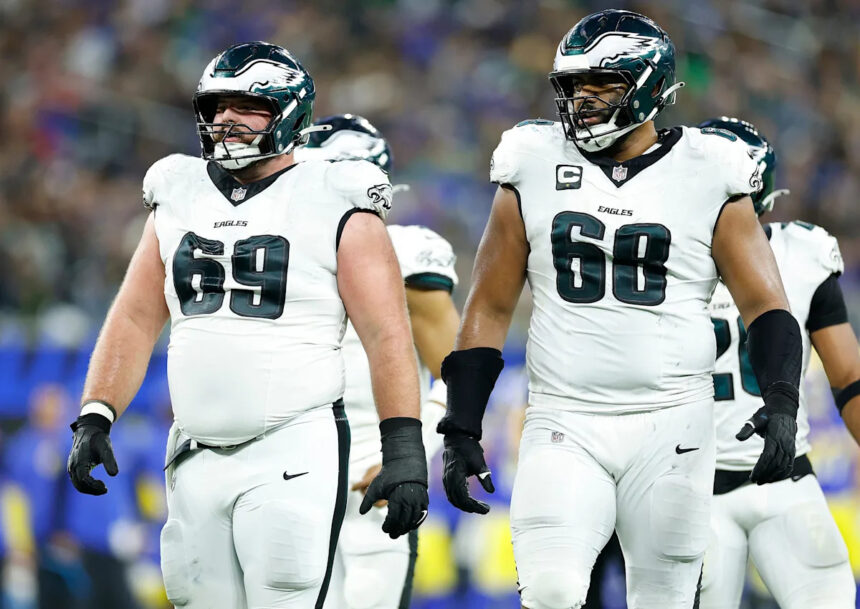
Chris Kuper inherits a still-formidable unit, but one with key questions. The tackle spots are locked down by future Hall of Famer Lane Johnson and the steadily improving Jordan Mailata. The interior, however, is in flux. Landon Dickerson is a Pro Bowl rock at left guard, and Jason Kelce’s successor at center, Cam Jurgens, must take the next step in his third year as the starter. The real competition lies at right guard.
While Tyler Steen has held the role, the Eagles are likely to seek an upgrade through the draft or internal competition. The line’s success hinges on Kuper’s ability to instill Stoutland’s technical excellence while integrating his own zone-running principles to optimize the Barkley-Bigsby duo.
- Projected Starters: Jordan Mailata (LT), Landon Dickerson (LG), Cam Jurgens (C), Tyler Steen (RG)*, Lane Johnson (RT)
- *Major Question Mark: Right Guard. This position is the most likely to be filled by a high draft pick or a veteran free agent signing post-June 1.
Final 2026 Starting Offense Projection & Draft Impact
Based on the current roster and the new coaching staff’s likely preferences, here is our early prediction for the Eagles’ Week 1 offensive starters:
- QB: Jalen Hurts
- RB: Saquon Barkley
- WR: Hollywood Brown
- WR: Elijah Moore
- WR: Dontayvion Wicks
- TE: Dallas Goedert
- LT: Jordan Mailata
- LG: Landon Dickerson
- C: Cam Jurgens
- RG: [Rookie Draft Pick / Competition Winner]
- RT: Lane Johnson
The 2026 NFL Draft will be decisive. Philadelphia is almost certain to target the offensive line, particularly a guard who can start immediately. Furthermore, don’t rule out another wide receiver selection to add depth and competition for Wicks. The Eagles have built a faster, more versatile weaponry for Hurts, betting that Sean Mannion’s schematic guidance can unlock a more efficient, explosive attack.
In conclusion, the 2026 Eagles’ offense represents a calculated evolution. It transitions from a bully-ball unit to a more multifaceted, speed-oriented attack, all while maintaining its core identity of a powerful run game. The success of this projection hinges on two factors: Jalen Hurts’ seamless adaptation to a more complex passing system, and Chris Kuper’s ability to keep the offensive line performing at an elite level. If those boxes are checked, this new-look Eagles offense has the potential to be less predictable, more dynamic, and just as devastating as its predecessors.
Source: Based on news from Yahoo Sports.