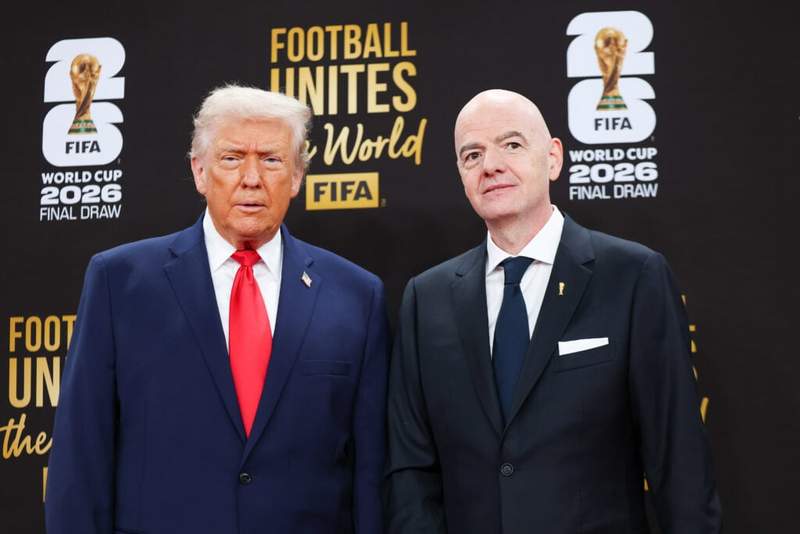
Why Donald Trump’s envoy wants Italy back on the World Cup stage
Italy’s absence from the FIFA World Cup has become one of the most painful recurring stories in modern football. The four-time champions have now missed three consecutive tournaments, a staggering reality for a nation that once defined the sport’s defensive artistry. But a bizarre, high-stakes geopolitical proposal involving Donald Trump’s envoy has now thrown a controversial lifeline onto the table. Could the Azzurri actually return to the World Cup stage through a political backdoor?
The suggestion, first reported by the Financial Times, comes from Paolo Zampolli, a New York-based Italian businessman and close associate of former President Donald Trump. Zampolli, who served as a diplomatic envoy during the Trump administration, has publicly floated the idea of replacing Iran with Italy in the upcoming World Cup. His reasoning? The ongoing war between the United States, Israel, and Iran has created an unprecedented scenario where Iran’s participation may become untenable—and Italy, a footballing giant, should be ready to step in.
This is not a rumor from a tabloid. It is a real, documented political intervention that has shocked the football world. But before we dissect the feasibility of such a move, we must first understand how Italy ended up in this humiliating position in the first place.
The playoff disaster that broke Italian hearts
Italy’s latest World Cup elimination was arguably the most painful of the three. The Azzurri entered their playoff against Bosnia and Herzegovina as heavy favorites. The match was tense, physical, and ultimately decided by the cruelest margin: a penalty shootout. But the story of that night was written long before the spot kicks.
Alessandro Bastoni, Italy’s world-class defender and a key pillar of Inter Milan’s backline, was sent off before half-time. The red card—a harsh but correct decision for a last-man foul—forced the Azzurri into a defensive shell. Despite playing with ten men for over 45 minutes, Italy managed to hold a 1-0 lead deep into stoppage time. Then came the sucker punch. A late equaliser from Bosnia silenced the Stadio Olimpico, pushing the match into extra time. Italy, exhausted and demoralized, could not find a winner. The shootout was a lottery, and Italy lost.
That defeat meant Italy missed their third straight World Cup. For context, no other nation with four or more World Cup titles has ever missed three in a row. Brazil, Germany, Argentina—all have managed to qualify even during transitional periods. Italy, however, has become a cautionary tale of managerial instability, tactical stagnation, and a shocking inability to score goals when it matters most.
The fallout was immediate. Head coach Roberto Mancini resigned within weeks, citing a lack of support from the federation. Star players like Gianluigi Donnarumma and Federico Chiesa publicly expressed their devastation. The Italian media, once proud of the nation’s footballing pedigree, turned its wrath on the entire system. But while fans mourned, a different kind of drama was brewing in the corridors of power.
Enter Paolo Zampolli: The envoy with a radical idea
Paolo Zampolli is not a football executive. He is a businessman, a diplomat, and a long-time associate of Donald Trump. During Trump’s presidency, Zampolli was appointed as an honorary consul and served as a bridge between Italian and American interests. He is known for his blunt style and his ability to navigate the murky waters of international politics.
In an exclusive interview with the Financial Times, Zampolli revealed that he had directly suggested to FIFA and U.S. State Department officials that Italy could replace Iran in the World Cup. His argument is grounded in the escalating conflict between the United States, Israel, and Iran. With a full-scale war now a realistic possibility, Zampolli believes that Iran’s participation in the tournament—especially if matches are held in the United States or allied nations—would be logistically impossible and politically explosive.
“Italy is a football superpower,” Zampolli said. “They should not be sitting at home watching the World Cup on television. If Iran cannot participate due to war, then the most logical replacement is Italy. It’s not about politics—it’s about the integrity of the competition.”
The proposal has already sparked fierce debate. Critics call it a cynical, opportunistic move that undermines the sporting meritocracy. Supporters argue that if war prevents a nation from competing, FIFA has a responsibility to maintain the tournament’s quality by inviting a top-tier replacement. But is this even possible under current FIFA rules?
Could Italy actually replace Iran? The legal and practical hurdles
The short answer is: it is highly unlikely, but not impossible. FIFA’s regulations for World Cup qualification are rigid. Once a team qualifies through the confederation pathway, replacement is only allowed under extreme circumstances—such as a nation being banned by FIFA or a government collapse. War, however, is not explicitly covered in the replacement protocols.
Here are the key obstacles Italy would face:
- FIFA’s qualification structure: Iran qualified through the Asian Football Confederation (AFC). Italy is a member of UEFA. Replacing one with the other would require a complete overhaul of the tournament’s regional balance.
- Political backlash: Other AFC nations, particularly Saudi Arabia and Qatar, would likely protest any move that removes an Asian team for a European one. The optics of replacing a Middle Eastern nation with a Western European power would be disastrous for FIFA’s image.
- Timing: The World Cup draw is already complete. Iran is placed in Group B alongside England, the United States, and a playoff winner. Changing the group composition now would create logistical chaos for broadcasters, sponsors, and participating teams.
- FIFA’s neutrality clause: FIFA statutes explicitly forbid political interference in football. Even if Zampolli’s suggestion gains traction, FIFA president Gianni Infantino has repeatedly stated that the organization will not be used as a tool for geopolitical agendas.
However, there is a precedent for last-minute replacements. In 1994, Yugoslavia was banned from the World Cup due to UN sanctions, and Denmark—who had not qualified—was invited as a replacement. Denmark went on to win the European Championship in 1992, but that was a different era, and the circumstances were driven by a global sanctions regime, not a single envoy’s suggestion.
So while Zampolli’s proposal is bold, it faces almost insurmountable odds. But the fact that it is being discussed at all reveals something deeper: the world misses Italy at the World Cup.
Expert analysis: Why Italy’s absence hurts the tournament
From a purely sporting perspective, Italy’s absence is a loss for the World Cup’s brand. The Azzurri bring tactical sophistication, defensive mastery, and a passionate global fanbase. Without them, the tournament loses a layer of historical weight. Think of the iconic moments: Paolo Rossi’s hat-trick in 1982, Fabio Cannavaro’s defensive masterclass in 2006, Mario Balotelli’s iconic celebration in 2012. These are moments that define World Cup lore.
Moreover, Italy’s current generation is not weak. Players like Nicolò Barella, Federico Dimarco, and Gianluca Scamacca have proven themselves in Europe’s top leagues. The problem is not talent—it is a systemic failure in youth development and tactical adaptability. Italy’s obsession with defensive pragmatism has left them unable to break down low-block defenses, a fatal flaw in modern international football.
My prediction: Even if Zampolli’s proposal fails—and it almost certainly will—the conversation itself may pressure FIFA and UEFA to revisit the qualification process. A potential solution could be expanding the World Cup to 48 teams earlier than planned, which would give Italy a guaranteed path back. Alternatively, a play-in tournament between the best non-qualified teams from different confederations could be introduced.
But for now, Italy must focus on what they can control: winning. The next UEFA Nations League campaign and the 2026 World Cup qualifiers are their only realistic routes back. The political shortcut is a fantasy—albeit a fascinating one.
A strong conclusion: Football must remain above politics
Paolo Zampolli’s suggestion to replace Iran with Italy is a testament to the desperation felt by Italian football fans and officials. It is also a reminder of how deeply geopolitics can intrude into sport. But football’s beauty lies in its meritocracy. The World Cup is not a charity event; it is a reward for qualification earned on the pitch.
Italy’s absence is self-inflicted. They lost to Bosnia and Herzegovina because they could not score with ten men. They missed the 2018 and 2022 tournaments because they failed to convert chances against Sweden and North Macedonia. Politics should not be a safety net for poor performance.
That said, the World Cup is poorer without Italy. Their iconic blue jerseys, their tactical battles, their emotional rollercoasters—these are part of the tournament’s soul. If Zampolli’s proposal does nothing else, it should serve as a wake-up call to the Italian Football Federation. The solution is not a political intervention. It is a long-term plan to rebuild the national team’s identity, invest in youth academies, and rediscover the attacking flair that once made the Azzurri champions of the world.
Until then, Italy will remain on the outside looking in. And the World Cup will feel just a little bit smaller.
Source: Based on news from Yahoo Sports.