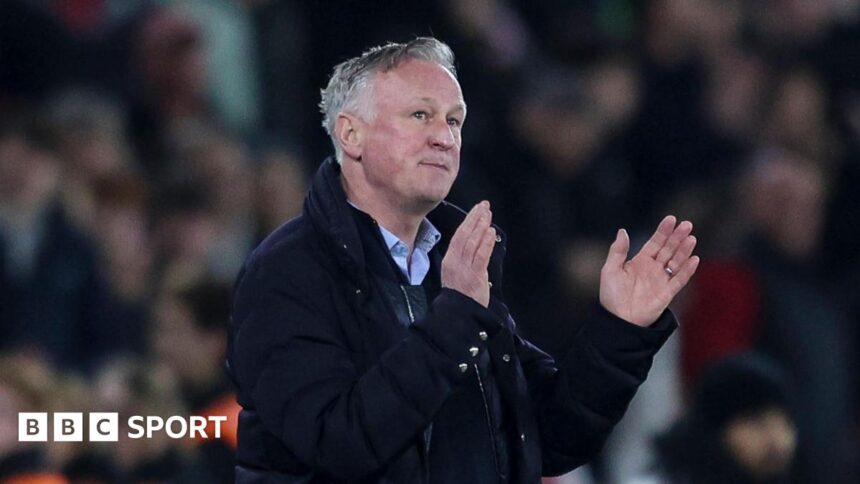
Can’t Do Both: Michael O’Neill Rules Out Extending Northern Ireland-Blackburn Rovers Job Share
The romantic notion of a dual-manager role in modern football has officially been laid to rest. After a whirlwind few months that saw him rescue Blackburn Rovers from the brink of relegation while simultaneously steering Northern Ireland to a World Cup playoff heartbreak, Michael O’Neill has admitted the unthinkable: he cannot continue to juggle both jobs.
Speaking in the aftermath of Blackburn’s emphatic 1-0 victory over Sheffield United on Wednesday night—a result that mathematically secured Rovers’ Championship status for another season—O’Neill dropped the bombshell that has been brewing since February. “I maybe underestimated the demands,” he confessed. The statement was not an admission of failure, but a stark reality check for a manager who has become synonymous with overachievement on both fronts.
O’Neill took interim charge of Blackburn in February with the club languishing in 22nd place in the Championship table. At that point, the idea of a playoff push seemed delusional; survival was the only currency. Fast forward to May, and Ewood Park is breathing a collective sigh of relief. But the cost of that survival, both mentally and logistically, has been immense.
Let’s break down the impossible equation O’Neill has been trying to solve. On one side, you have a national team on the cusp of a World Cup—Northern Ireland pushed Italy all the way in a tense playoff in Bergamo last month, losing 2-0 but earning plaudits for their resilience. On the other, you have a club side in a relegation dogfight requiring daily hands-on management, tactical tweaks, and recruitment planning. The math simply doesn’t add up.
The Impossible Balancing Act: From Bergamo to Blackburn
When O’Neill accepted the Blackburn role on an interim deal until the end of the season, many questioned the wisdom of the move. Here was a manager who had transformed Northern Ireland from rank outsiders into a side that could compete with Europe’s elite. His stock was sky-high. Why risk it all on a relegation battle in Lancashire?
The answer, as O’Neill has always been pragmatic, was simple: he loves the day-to-day intensity of club football. But the reality of managing two high-pressure environments simultaneously has been a brutal education. “I’ve been doing this for three months, and it’s been relentless,” O’Neill admitted after the Sheffield United win. “You’re constantly switching between two worlds, two sets of players, two sets of expectations. It’s not sustainable.”
The numbers tell the story. In his 14 league games in charge of Blackburn, O’Neill oversaw a remarkable turnaround. The club won six, drew five, and lost just three, climbing from the relegation zone to a comfortable 14th-place finish. But the emotional toll was visible. After the Italy defeat, O’Neill had to immediately switch focus to a midweek Championship fixture against Coventry City. There was no time to process the heartbreak of Bergamo.
- Blackburn’s turnaround under O’Neill: 14 games, 6 wins, 5 draws, 3 losses. From 22nd to 14th.
- Northern Ireland’s playoff run: Lost 2-0 to Italy in Bergamo, but qualified for the playoff via a group stage that included Switzerland and Bulgaria.
- Key moment: The win over Sheffield United on Wednesday night, which mathematically secured Championship safety.
The dual role has also created a logistical nightmare. O’Neill has been commuting between Belfast, Manchester, and Blackburn, often attending Northern Ireland training camps during international breaks and then rushing back to Ewood Park for midweek matches. “I’ve lived out of a suitcase for three months,” he joked. But the laughter masks a deeper concern: the quality of his work has been stretched thin.
Expert Analysis: Why O’Neill’s Decision is Inevitable
From a tactical perspective, the dual role was always a ticking time bomb. Club football demands a granular level of detail that international football simply does not. At Blackburn, O’Neill had to assess squad depth, manage injuries, implement a new tactical system, and build relationships with players who were strangers to him. At Northern Ireland, he had to maintain a distinct identity and prepare for one-off playoff matches with limited preparation time.
The result? A manager who was running on fumes. “You can’t do both,” O’Neill stated bluntly. “It’s not fair to either group of players. They deserve 100% of my attention, and I’ve been giving them 80% at best.”
This is not a criticism of O’Neill’s ability—far from it. The fact that he succeeded in both roles is a testament to his managerial genius. But the modern game is unforgiving. Club football requires a full-time presence. Recruitment meetings, training sessions, press conferences, and tactical analysis are non-negotiable. International football, by contrast, is a part-time gig that demands intense bursts of focus during windows. Trying to merge the two is like trying to drive a car with two steering wheels.
What does this mean for Blackburn Rovers? The club now faces a pivotal summer. O’Neill’s contract expires at the end of the season, and he has already indicated that a decision will be made in the coming weeks. The board at Ewood Park will be desperate to keep him. He has proven he can stabilize a sinking ship and instill a winning mentality. But they must also accept that O’Neill will not commit to a long-term deal unless he can focus solely on Rovers.
What about Northern Ireland? The Irish FA will be equally anxious. O’Neill is the most successful manager in the nation’s history, having led them to Euro 2016 and within touching distance of a World Cup. Losing him would be a massive blow. However, there is a sense that O’Neill’s heart remains with the Green and White Army. He has often spoken of his emotional connection to the role. The question is whether he can walk away from a club project that he has only just begun.
Predictions: O’Neill’s Next Move and the Fallout
Based on O’Neill’s comments and the trajectory of his career, I predict the following outcome: Michael O’Neill will step down from his Northern Ireland role to become the permanent manager of Blackburn Rovers. Here’s why.
First, the club job offers stability. Blackburn is a sleeping giant with a rich history, a passionate fanbase, and a solid infrastructure. O’Neill has already demonstrated his ability to work miracles on a budget. With a full summer transfer window and a pre-season to implement his philosophy, he could transform Rovers into genuine playoff contenders.
Second, the Northern Ireland role, while emotionally fulfilling, is a part-time position that offers limited long-term growth. O’Neill has taken the team as far as he can given the talent pool. A younger manager, perhaps someone like Ian Baraclough or Jim Magilton, could bring fresh energy to the setup.
Third, O’Neill’s own words reveal his mindset. “I’ve got a decision to make,” he said. “But I know I can’t keep doing both. It’s not good for anyone.” That is the language of a man who has already made up his mind. He is simply waiting for the right moment to announce it.
The fallout for Northern Ireland: The IFA will need to act quickly. The next international window is in June, with Nations League fixtures looming. Finding a replacement of O’Neill’s caliber will be difficult, but not impossible. The pool of candidates is limited, but names like Stephen Kenny (currently out of work after his Republic of Ireland stint) or Derek McInnes could be realistic options.
The fallout for Blackburn: If O’Neill commits, the club must back him in the transfer market. He has proven he can get the best out of a limited squad, but Championship survival is not a long-term ambition. Rovers need to invest in a goalscorer and a creative midfielder if they want to challenge for the top six.
Conclusion: The End of an Era, The Start of a New One
Michael O’Neill’s admission that he “can’t do both” is not a sign of weakness—it is a sign of wisdom. The man who defied the odds to save Northern Ireland and Blackburn Rovers in the same season has finally recognized his own limits. And in doing so, he has given both parties the clarity they need to move forward.
For Blackburn Rovers, the next few weeks will define their trajectory for years to come. If they secure O’Neill on a permanent basis, they will have a manager who has already proven he can deliver under pressure. If they fail, they risk losing the best candidate on the market.
For Northern Ireland, the search for a new leader begins. The legacy O’Neill leaves behind is one of hope, resilience, and a belief that anything is possible. But as he himself has shown, sometimes the hardest decision is the one that benefits everyone in the long run.
As the final whistle blew on Wednesday night at Ewood Park, the fans chanted O’Neill’s name. They know what he has done for their club. But they also know that his greatest challenge now lies ahead: choosing between two loves, and doing it with the same integrity that has defined his entire career.
Prediction: Michael O’Neill will sign a three-year deal with Blackburn Rovers by the end of June. Northern Ireland will appoint a new manager by August. And both will be better for it.
Source: Based on news from BBC Sport.