Super Bowl Champion Reveals the Overlooked Mental Shift in the College-to-NFL Transition
The jump from college football to the National Football League is often framed as a test of physical strength, speed, and endurance. Every year, NFL Draft prospects are measured, timed, and weighed ad nauseam. They run 40-yard dashes, bench press 225 pounds, and perform agility drills designed to showcase their athletic prowess. But according to Super Bowl champion and 14-year NFL veteran Steve Beuerlein, the most daunting hurdle a rookie faces isn’t the 300-pound defensive end chasing him down—it’s the silent, crushing weight of mental overload.
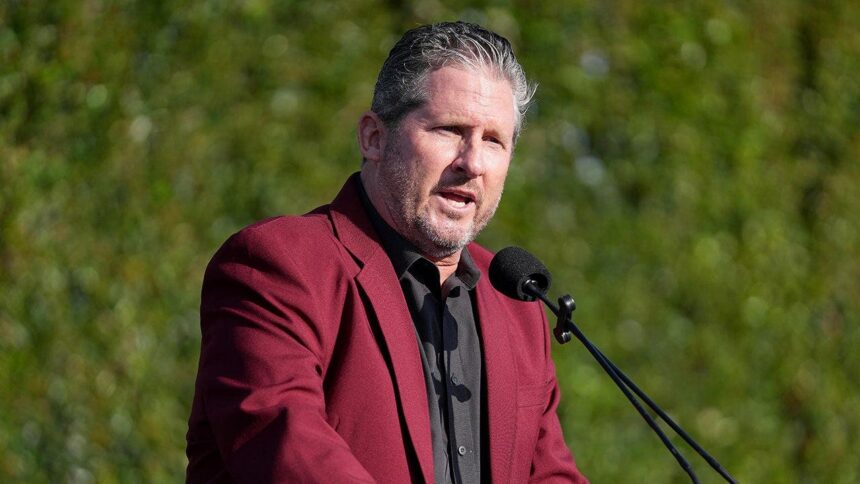
In an exclusive interview with Fox News Digital, Beuerlein—who won Super Bowl XXXVII with the Tampa Bay Buccaneers—peeled back the curtain on draft day anxiety and the unspoken truth about leaving the collegiate ranks. “I think a lot of players anticipate the physical side of it,” Beuerlein, now 61, told Fox News Digital. “Understanding that things just happen a lot faster. The guys are a lot stronger. The mistakes are a lot fewer. The margin for error is much less.” But what he revealed next is the part of the transition that rarely makes the highlight reel.
Beuerlein’s insight is a masterclass for anyone looking to understand why so many first-round picks fail to launch. It’s not about whether a player can bench press a car. It’s about whether his brain can process a playbook that reads like a foreign language while 70,000 fans scream for his blood.
The Myth of the “Ready-Made” Rookie
Every spring, analysts and fans anoint certain players as “NFL-ready.” They point to a powerful arm, a lightning-fast first step, or a knack for breaking tackles. Beuerlein, who was drafted by the Los Angeles Raiders in the fourth round of the 1987 NFL Draft, argues that this label is dangerously misleading. The physical tools are a prerequisite—not a guarantee.
“When you get to the NFL, the game slows down for veterans because their mind has caught up to the speed,” Beuerlein explained. “But for a rookie, the game speeds up. And that’s the part nobody talks about. You can’t simulate that in college.”
In college, a quarterback might face one or two complex defensive schemes per game. In the NFL, defensive coordinators spend the week designing looks they’ve never shown on film. A rookie’s pre-snap checklist expands from reading a safety to diagnosing a blitz package, a coverage shell, and a disguised stunt—all in under 15 seconds.
- Mental fatigue is the hidden injury: Rookies often hit a wall by Week 8, not because of a torn hamstring, but because their brain is exhausted from processing new information daily.
- Playbook volume: An NFL playbook can be 700 pages. College playbooks are often a fraction of that size.
- Practice speed vs. game speed: Even training camp reps don’t fully prepare a player for the live-fire chaos of a regular-season Sunday.
Beuerlein’s point is stark: the margin for error shrinks from a canyon to a razor’s edge. One missed read, one hesitation, and a play that worked in the Rose Bowl results in a sack, a turnover, or a career-altering hit.
The Draft Day Emotional Whiplash
Beuerlein didn’t just talk about the on-field transition. He also opened up about the psychological rollercoaster of draft day itself—a moment that millions of young athletes dream about, but few are prepared for emotionally. “The draft is a circus,” he said. “You have no control over where you go, who picks you, or what system you’re thrown into. One minute you’re the king of your campus, and the next you’re a rookie again, starting from zero.”
This emotional whiplash, Beuerlein argues, is a critical part of the transition that is often glossed over. A player like Caleb Williams or Drake Maye might walk into a facility as a top-three pick, but he immediately loses the social capital he built over four years in college. Veteran players don’t care about your Heisman Trophy. They care if you can hold a blitz pickup on third down.
Key psychological hurdles rookies face:
- Ego deflation: The star player who was never benched in college suddenly becomes a backup or a special teams contributor.
- Isolation: Moving to a new city, away from college friends and family, with no established support system.
- Financial pressure: Even with a signing bonus, the sudden influx of money can create family tension and poor decision-making.
- Media scrutiny: Every mistake is magnified. A bad game in college was a footnote. A bad game in the NFL is a segment on SportsCenter.
Beuerlein’s own journey is a testament to this grind. He didn’t become a full-time starter until his sixth season in the league. “I had to learn how to learn again,” he admitted. “I had to strip away everything I thought I knew and rebuild my process from the ground up.”
Why the “Physical Only” Narrative Hurts Prospects
The prevailing draft narrative—that the NFL is simply a “faster, stronger” version of college—does a disservice to incoming rookies. Beuerlein believes this oversimplification leads to unrealistic expectations and premature burnout. “You see these guys come in and they think, ‘I’m just going to out-athlete everybody.’ And it works for about two weeks. Then the veterans figure out your tells, the coaches expose your weaknesses, and suddenly you’re lost,” he said.
The Super Bowl champion pointed to the rise of sophisticated defensive schemes as the primary culprit. In the modern NFL, defenses use “simulated pressure” and “pattern-matching” coverages that require a quarterback to process multiple variables in a split second. A linebacker might drop into a deep zone, or a safety might blitz. The disguise is the weapon.
Three mental skills that separate NFL players from college stars:
- Anticipation: Throwing to a spot before the receiver breaks, trusting the route timing.
- Post-snap processing: Reading the defense in real-time after the snap, not just before it.
- Error recovery: Forgetting a bad play immediately and executing the next one with clarity.
Beuerlein emphasized that these skills are not innate. They are drilled, studied, and refined over years. “The best players I played with—guys like John Elway and Troy Aikman—they didn’t just have great arms. They had great brains. They saw the game two plays ahead,” he said.
Expert Analysis: The Future of the Transition
As the 2025 NFL Draft approaches, Beuerlein’s warning is more relevant than ever. The college game has shifted dramatically with the rise of the transfer portal, NIL deals, and spread offenses. Many college quarterbacks now operate out of shotgun, rarely take snaps under center, and face defenses that are simpler than what they’ll see on Sundays.
My prediction: The mental transition will only become more brutal in the next five years. As NFL defenses continue to evolve with hybrid players and AI-assisted film study, rookies will need to arrive with a higher baseline of football IQ. Teams that invest in “mental training” coaches—specialists who teach processing speed and situational awareness—will gain a competitive edge.
Beuerlein agrees. “I think we’re going to see more teams hire cognitive coaches. The physical talent is everywhere. The mental edge is what separates the legends from the one-and-dones.”
For general managers, this means looking beyond the combine numbers. A player who can explain a defensive coverage adjustment in a classroom interview might be more valuable than one who runs a 4.3 40-yard dash but struggles to read a blitz.
Conclusion: The Real Battle is Invisible
Steve Beuerlein’s revelation is a gut check for the football world. The college-to-NFL transition is not a physics problem—it’s a psychology exam. While fans obsess over hand size, vertical jumps, and shuttle times, the real battle is happening inside the helmet. It’s the rookie who stays up until 2 a.m. memorizing audibles. It’s the first-round pick who gets benched in Week 4 and has to rebuild his confidence from scratch. It’s the silent struggle that never makes the front page.
“You can’t prepare for the noise,” Beuerlein said. “But you can prepare your mind to handle it.” For every prospect dreaming of a Super Bowl ring, that advice is worth more than any draft grade. The physical side will get you in the door. The mental side will determine if you stay.
For more insights from NFL legends and the latest draft analysis, stay tuned to Fox News Digital. CLICK HERE FOR MORE SPORTS COVERAGE ON FOXNEWS.COM.
Source: Based on news from Fox Sports.