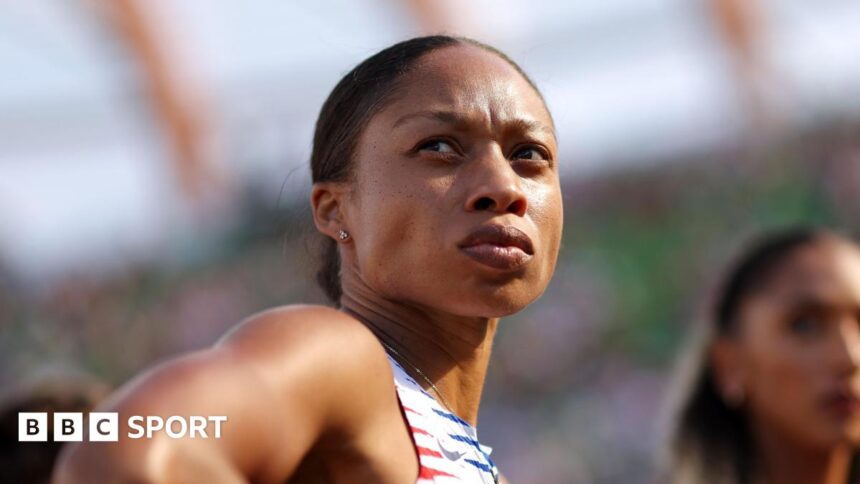
Allyson Felix: The 42-Year-Old GOAT Targets LA 2028 in a Comeback for the Ages
Allyson Felix, the undisputed queen of American track and field, is planning to rewrite the rulebook once again. At 40 years old, with a body that has given her 11 Olympic medals and a legacy that transcends sport, Felix has announced a comeback targeting the 2028 Los Angeles Olympics. This is not a nostalgic jog down memory lane. This is a calculated, audacious assault on the limits of athletic longevity. When the starting gun fires in LA, Felix will be 42 years old—an age at which most sprinters are long retired, coaching, or commentating. But Allyson Felix is not most sprinters.
The announcement, made exclusively to select media outlets, sent shockwaves through the athletics world. “This is a once-in-a-lifetime homecoming,” Felix said. “And it is the only thing powerful enough to pull me back.” The pull is undeniable. Born and raised in Los Angeles, Felix has the chance to compete in a home Olympics, a feat that has eluded many legends. But the path is treacherous, the timeline brutal, and the competition younger and faster than ever. Let’s break down what this comeback really means.
Why LA 2028? The Emotional and Competitive Calculus
Felix last competed at the 2022 World Championships in Eugene, where she anchored the mixed 4x400m relay to a gold medal. She then stepped away, gave birth to her second child, a son, in 2024, and focused on her family and her advocacy work for maternal health in sports. For most athletes, that would be a perfect ending. But the Los Angeles 2028 Games are a siren call that even the most decorated Olympian cannot ignore.
“The idea of running in my hometown, in front of my kids, at a stadium I grew up watching—it’s a story I want to finish,” Felix explained. The emotional weight is immense. But make no mistake: this is not a ceremonial appearance. Felix is a competitor, and she will not step on the track unless she believes she can contribute to a medal-contending relay team or even challenge for an individual spot.
The competitive calculus is fascinating. At 42, Felix will be the oldest female sprinter in Olympic history by a wide margin. But her event specialization—the 4x400m relay and potentially the open 400m—plays to her strengths. The 400m is a grueling event that rewards tactical intelligence, efficient pacing, and raw endurance. These are attributes that can, in theory, age better than pure speed. Felix’s personal best of 49.26 seconds (set in 2015) is still world-class, but she will need to get back under 50 seconds consistently to be competitive.
Breaking Down the Comeback: The Three Critical Hurdles
This comeback is not without massive risk. To understand whether Felix can actually make the US team, we have to examine three distinct phases: physical recovery, technical adaptation, and the brutal selection process.
- Physical Recovery: Felix gave birth in 2024. The postpartum timeline for elite sprinters is notoriously difficult. She will have approximately three years to rebuild her core strength, explosive power, and lactate threshold. At 42, muscle recovery is slower, and injury risk is higher. However, Felix has a secret weapon: she has already proven she can return to elite form after childbirth, winning a bronze medal in the 400m at the 2021 Tokyo Olympics (age 35) after giving birth to her daughter in 2018.
- Technical Adaptation: Felix’s stride mechanics and start have always been her hallmark. At 42, she may lose a fraction of a second off her start, which is critical in the 400m. She will likely need to shift her race strategy to a negative split—running the second half faster than the first—to conserve energy and use her veteran race IQ to outmaneuver younger, faster starters.
- The US Trials: This is the most brutal hurdle. The US Olympic Trials in track and field are arguably the toughest selection meet on the planet. To make the 4x400m relay pool, Felix must finish in the top six in the 400m at Trials. Given the depth of American women’s sprinting—with stars like Sydney McLaughlin-Levrone, Athing Mu (800m, but could move up), and rising talents like Kaylyn Brown and Britton Wilson—Felix will need to run a time in the low 50-second range just to make the final. Making the individual 400m team (top three) is an even taller order.
Expert Analysis: Can She Actually Win a Medal?
Let’s be honest: an individual medal in the 400m at age 42 is a near-impossible dream. The world record is 47.60 seconds, and the Olympic gold medal in Paris 2024 was won in 48.17 seconds. Felix’s best time in the last five years is 50.20 seconds. The gap is significant. However, her path to a medal lies in the 4x400m relay.
If Felix can run a 49.8-second split in the relay, she is a valuable asset. The US women’s relay team has historically dominated, but they need depth. With McLaughlin-Levrone potentially focusing on the 400m hurdles and the flat 400m, the relay pool needs experienced legs. Felix’s ability to handle pressure, run a perfect curve, and hand off cleanly makes her an invaluable third-leg or anchor option. I predict Felix will make the US relay pool but will not run in the individual 400m final. Her medal—if she gets one—will be gold in the 4x400m, likely as a heat runner or a final-leg substitute. That would give her a 12th Olympic medal, extending her record as the most decorated woman in Olympic athletics history.
“Allyson Felix is the ultimate competitor,” says former Olympic gold medalist and NBC analyst Ato Boldon. “She has a metronome-like consistency. If she can stay healthy, she will be on that relay team. The question is whether she can handle the speed of the new generation. But if anyone can, it’s her.”
Predictions and Legacy: More Than Medals
Beyond the medals, Felix’s comeback is a statement about women in sports, motherhood, and defying ageism. She has already redefined what is possible for mothers in elite athletics. Her advocacy for maternity protections for female athletes—through her partnership with Athleta and her own brand, Saysh—has changed sponsorship contracts across the industry. A successful comeback at 42 would shatter the ceiling for what female athletes can achieve later in their careers.
Here are my three bold predictions for the Felix comeback:
- Prediction 1: Felix will make the US Olympic team in the 4x400m relay pool. She will not make the individual 400m team, but she will be within 0.5 seconds of the qualifying time.
- Prediction 2: She will run a season’s best of 50.1 seconds in 2028, a time that would have placed her 6th in the 2024 Olympic final. It will be enough to secure a relay spot.
- Prediction 3: Felix will win a gold medal in the 4x400m relay, becoming the oldest American woman to win an Olympic track and field medal. She will also break the record for most Olympic medals by an American track and field athlete (male or female) with 12.
A Strong Conclusion: The Homecoming Queen
Allyson Felix’s comeback is not just about adding to a tally. It is about completing a circle. She started her Olympic journey in 2004 as a precocious 18-year-old in Athens. Twenty-four years later, she will walk into the Los Angeles Memorial Coliseum as a 42-year-old mother of two, a businesswoman, an activist, and a living legend. The roar of the home crowd will be deafening. Every step she takes on that track will be a victory against time, against doubt, and against every statistic that says she should be done.
Will she be the fastest woman on the track? No. But she will be the most significant. The LA 2028 Olympics will be her victory lap—a lap that took 24 years, 11 medals, and an unbreakable will to complete. Felix once said, “I want to leave the sport better than I found it.” By returning, she is showing the next generation that the finish line is not a number on a bib. It is a choice. And for Allyson Felix, the choice is clear: she will run home.
Source: Based on news from BBC Sport.