Is 15-Year-Old IPL Wonderkid Vaibhav Sooryavanshi Ready to Play for India?
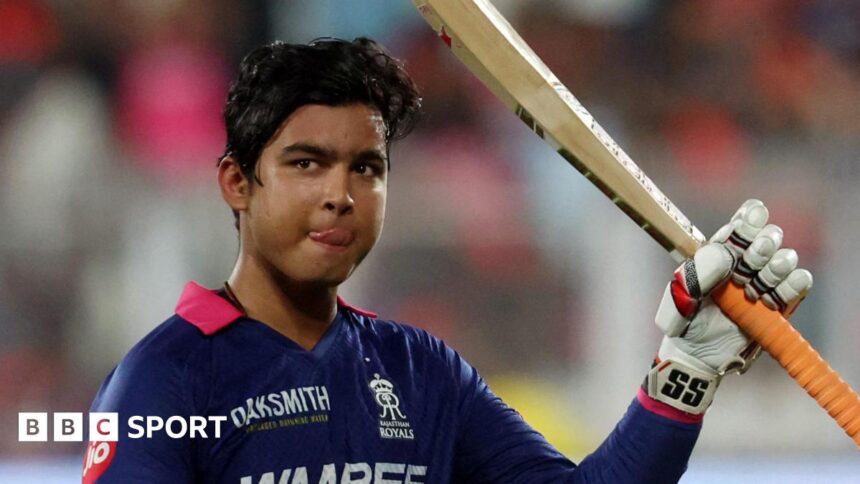
The Indian Premier League (IPL) has a storied history of unearthing generational talents. From a teenage Virat Kohli to a baby-faced Rishabh Pant, the tournament has always been the ultimate proving ground for raw potential. But this season, a phenomenon has emerged that has shattered every preconceived notion about age and readiness. His name is Vaibhav Sooryavanshi. He is 15 years old. And his numbers are not just impressive; they are borderline absurd.
With 404 runs at a staggering strike-rate of 237.64 in this year’s IPL, Sooryavanshi has turned the cricketing world on its head. The question is no longer about his talent—it is about his timeline. Is the young left-hander ready to trade the bubble of the IPL for the cauldron of international cricket? To answer that, we must look beyond the highlight reels and consult the man who has had a front-row seat to his entire ascent.
The Yardy Verdict: A Coach’s Perspective on Sooryavanshi’s Rise
Few have had a better view of the development of cricket’s 15-year-old sensation than former England all-rounder Mike Yardy. Yardy has been an unwilling witness to Sooryavanshi’s genius. He was in the opposing dugout when Sooryavanshi, then aged 12, played for India against England in an under-19 series. He was coach once more when the precocious left-hander toured England last summer—where Sooryavanshi scored 143 in the fourth 50-over match in Worcester—and again when the teenager hammered an incredible 175 from 80 balls against England in the Under-19 World Cup final in February.
When asked directly if the 15-year-old is ready for the senior Indian team, Yardy’s response is a blunt, emphatic: “Not really, no.”
This is not a dismissal of talent. Yardy is perhaps the most qualified non-Indian to assess this player. His reluctance is rooted in the chasm between domestic T20 leagues and the unique pressures of international cricket. “He is playing against a mix of internationals and domestic journeymen in the IPL,” Yardy explains. “But facing Jasprit Bumrah in a World Cup semi-final, with 90,000 people screaming, is a different beast. The mental load is exponentially higher.”
Yardy’s caution is a vital counterweight to the hype. While Sooryavanshi is dismantling bowling attacks with 237.64 strike-rate, he is doing so without the burden of expectation that comes with the national crest. His raw power and audacity are undeniable, but readiness for India is about more than runs.
The Technical Marvel: What Makes Sooryavanshi So Special?
To understand the debate, one must first appreciate the weapon. Sooryavanshi is not a fluke. His technique against pace is almost preternatural. He possesses a high backlift and a ferocious bottom-hand grip that allows him to hit through the line with devastating power. In the IPL, he has consistently dismantled bowlers clocking 140+ kph, often slogging them over deep mid-wicket for six with minimal foot movement.
- Unorthodox Genius: He often clears his front leg early, daring bowlers to bowl short. When they do, he has the hand-speed to pull them into the stands.
- Spin Destruction: Against slow bowling, his strike-rate is even higher. He uses his wrists to manipulate the ball into gaps, but his primary mode is brute force over the top.
- Clutch Performances: His knock of 175 in the U19 World Cup final was not against weak opposition. It was against a strong England attack, under the pressure of a final.
These are not the traits of a normal 15-year-old. This is a player who has been fast-tracked physically. He is tall, strong, and hits the ball harder than many seasoned internationals. The question is not whether he has the *tools* to play for India—he clearly does. The question is whether he has the *armor*.
The Case for Patience: Why Yardy Might Be Right
The history of cricket is littered with prodigies who burned out. The most famous example is Sachin Tendulkar, who debuted at 16. But Tendulkar was a rare outlier. For every Sachin, there are dozens of players who were rushed into the senior side only to be chewed up by the relentless pace of international cricket.
Sooryavanshi’s situation is unique because of the IPL. He is earning crores and playing against world-class players every night. This is a double-edged sword.
The Risks of Fast-Tracking:
- Physical Toll: At 15, his body is still developing. The rigors of a five-match Test series or a multi-format tour could lead to stress fractures or burnout.
- Mental Pressure: International cricket comes with relentless scrutiny. A few failures in an India shirt could shatter the confidence of a teenager.
- Bowling Adjustments: In the IPL, he faces bowlers who are often predictable in their lengths. International bowlers like Pat Cummins or Shaheen Afridi will have 12-month scouting reports on his weaknesses.
Yardy’s “Not really, no” is a warning. He has seen Sooryavanshi dominate age-group cricket, but he has also seen the gap between U19 and senior cricket. “The best thing for him is to play another full season of IPL, maybe two,” Yardy suggests. “Let him face 100 more balls from world-class bowlers. Let him fail a few times. That is where growth happens.”
The Counter-Argument: When Talent Defies Age
Yet, the opposing argument is equally compelling. Cricket is a sport where talent often trumps experience. If a player is good enough, they are old enough. The current Indian team is in a transition phase. The next T20 World Cup is less than two years away. Why not blood a player who can be a game-changer in the middle order?
Consider the data: Sooryavanshi’s strike-rate of 237.64 is the highest in this IPL season for any player with more than 200 runs. He is not just scoring runs; he is dominating. He is changing the momentum of games single-handedly. In a format where one over can decide a match, having a player who can hit sixes from ball one is invaluable.
Moreover, the Indian team has a history of successfully integrating young talent. Rishabh Pant debuted at 20 and was initially erratic, but the team backed him. Jasprit Bumrah was fast-tracked despite an unorthodox action. The Board of Control for Cricket in India (BCCI) has the support system—sports psychologists, physios, and senior mentors—to protect a young player.
The argument for his inclusion is simple: He is the best domestic player in the country right now. Age is just a number.
Predictions: What Will Happen Next?
Predicting the future of a 15-year-old is a fool’s errand, but the tea leaves are clear. Here is the most likely timeline:
- Immediate Future (Next 6 months): Sooryavanshi will not be selected for the senior Indian team. The selectors will resist the pressure. He will likely play for India A or in the Duleep Trophy to test his skills against first-class bowlers.
- Short Term (Next 12 months): If he dominates in domestic cricket and has another stellar IPL season, the calls will become deafening. He could be included in a T20I series against a weaker opponent (like Zimbabwe or Ireland) to ease him in.
- Long Term (World Cup 2026): This is the realistic target. By then, he will be 17 or 18. He will have three IPL seasons under his belt. He will be physically and mentally ready to be a mainstay in the Indian T20I squad.
The BCCI is notoriously conservative with young players. They will likely follow the “Prasidh Krishna model”—groom him in the domestic circuit, give him India A tours, and only then promote him to the senior team.
Conclusion: The Verdict on Sooryavanshi’s Readiness
Is Vaibhav Sooryavanshi ready to play for India? The honest answer, as Mike Yardy suggests, is not yet. But that is not a criticism. It is a reflection of the immense gap between dominating the IPL and conquering the world stage. The 15-year-old has the technique, the power, and the temperament of a future legend. But he lacks the scar tissue, the physical maturity, and the mental resilience that only time can provide.
For now, cricket fans should savor his genius in the IPL. Let him learn. Let him fail. Let him grow. The Indian team is not going anywhere. And when he is finally ready—perhaps in 2026, perhaps sooner—he will arrive not as a wonderkid, but as a fully-formed superstar.
The hype is real. The talent is undeniable. But patience, for once, might be the wisest play. The best is yet to come.
Source: Based on news from BBC Sport.