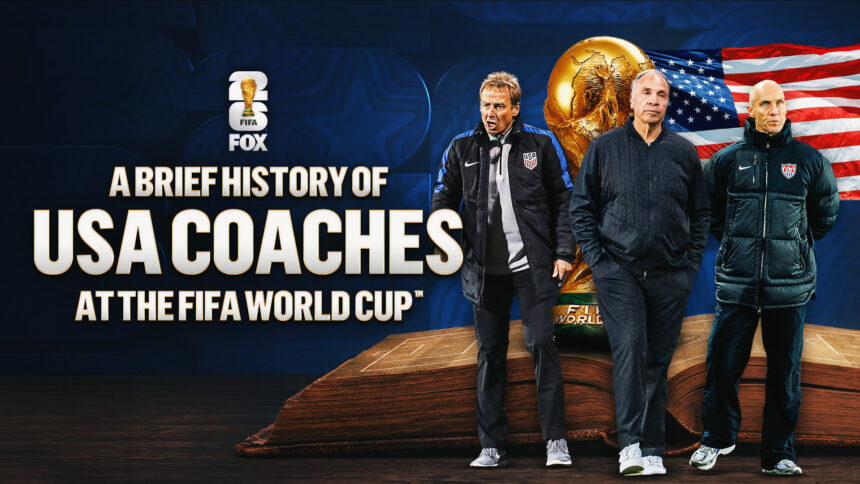
From Uruguay to Qatar: The Full History of USA Coaches at the Men’s World Cup
For the casual fan flipping on a World Cup match in 2026, the sight of the U.S. men’s national team on the pitch might feel like a modern inevitability. But the journey of the American program—and the men who have managed it on the sport’s grandest stage—is a story of long droughts, stunning breakthroughs, and a relentless chase for relevance. It may surprise some of the newer fans of the U.S. men’s national team that its history with the World Cup actually stretches back to the very first edition of soccer’s most prestigious tournament. The U.S. was one of 13 teams who participated in the inaugural event in 1930 in Uruguay. A second appearance occurred in 1950, but then a 40-year drought saw the U.S. not return to soccer’s biggest stage until 1990. Leading these World Cup squads were managers who made their mark on American soccer. From a surprise semifinal run to breaking a decades-long drought, to reaching quarterfinals and building golden generations, the men who have stood on the USA sideline have written the story of a program still chasing its ceiling. Let’s look at the managers who have led the U.S. men’s team at the World Cup.
- The Pioneer: Jack Millar and the 1930 Semifinal Miracle
- The Long Wait: From 1950 to 1990 and the Return of the Yanks
- The Modern Era: Bora, Arena, and Bradley
- Bora Milutinović (1994): The Showman
- Steve Sampson (1998): The Cautionary Tale
- Bruce Arena (2002, 2006): The Quarterfinal Breakthrough
- Bob Bradley (2010): The Tactical Pragmatist
- The Jurgen Klinsmann Era and the Modern Struggles
- The Present and Future: Gregg Berhalter and Beyond
- Conclusion: A Legacy Still Being Written
The Pioneer: Jack Millar and the 1930 Semifinal Miracle
The first coach to lead the U.S. men’s national team to a World Cup was the Scottish-born Millar, a man whose name deserves far more recognition in American soccer lore. Millar moved to the United States in 1911, a time when soccer was a patchwork of immigrant clubs and industrial leagues. He played with some of the earliest created soccer clubs in New York and Philadelphia and even played two matches for the national team in 1928 before retiring as a player. But Millar’s greatest contribution to the game was taking over as manager of the U.S. for the inaugural 1930 World Cup in Uruguay.
Traveling by steamship for two weeks, the American squad arrived in South America as massive underdogs. What happened next defied all expectations. Millar’s tactical approach was simple: physicality, direct play, and relentless pressing—a style that was decades ahead of its time. Two surprise wins in their group stage against Belgium and Paraguay led to a surprise appearance in the semifinals, where the Americans lost to Argentina. It’s still the best finish for the men’s team in history. Millar’s 1930 squad remains the gold standard for U.S. World Cup performances, a testament to his ability to organize a team of semi-professionals against the world’s best. His legacy is not just a third-place finish (officially, as there was no third-place match), but the proof that American soccer could compete on the global stage.
The Long Wait: From 1950 to 1990 and the Return of the Yanks
After Millar’s heroics, the U.S. returned to the World Cup in 1950 under manager William Jeffrey. Jeffrey, a Scottish-born coach like Millar, is best remembered for the “Miracle on Grass”—the stunning 1-0 victory over England in Belo Horizonte. That win remains one of the biggest upsets in World Cup history. However, the team failed to advance past the group stage, and the U.S. would not see another World Cup for 40 agonizing years.
That drought ended in 1990 under the guidance of Bob Gansler. A former player and a pioneer of the American college soccer system, Gansler took over a program that was essentially starting from scratch. The 1990 team qualified by winning the CONCACAF championship, but the World Cup itself was a harsh lesson. The U.S. lost all three group matches to Czechoslovakia, Italy, and Austria. Yet, Gansler’s true contribution was breaking the psychological barrier. He proved that the U.S. could qualify, setting the stage for the next generation. His tenure was about building the foundation, not winning trophies.
The Modern Era: Bora, Arena, and Bradley
The 1990s and 2000s saw the U.S. become a regular World Cup participant, and the coaching lineage reflects a shift from survival to ambition.
Bora Milutinović (1994): The Showman
As hosts of the 1994 World Cup, the U.S. needed a coach who could handle pressure. Enter Bora Milutinović, the Serbian globetrotter who had already led Mexico and Costa Rica to deep runs. Bora’s approach was psychological: he instilled belief in a team that lacked elite talent. The result was a 1-1 draw with Switzerland, a narrow 2-1 loss to Brazil, and a 1-0 victory over Colombia—a win that sent the U.S. to the Round of 16. They eventually fell to Brazil, but Bora had shown the world that American soccer was not a joke. His ability to rotate players and manage egos was critical in a tournament where the host nation’s expectations were sky-high.
Steve Sampson (1998): The Cautionary Tale
Steve Sampson took over after Bora and led the U.S. to a disastrous 1998 campaign. Despite a promising qualifying run, the team lost all three group matches, including a humiliating 2-1 defeat to Iran. Sampson’s tactical rigidity and failure to adapt to the tournament’s pace were heavily criticized. His tenure is a stark reminder that World Cup coaching is about in-game adjustments, not just preparation.
Bruce Arena (2002, 2006): The Quarterfinal Breakthrough
If any coach defined the U.S. men’s team’s rise in the 2000s, it was Bruce Arena. A no-nonsense, detail-oriented manager, Arena took the U.S. to the 2002 World Cup in South Korea and Japan. That team delivered the program’s best modern performance. A 3-2 win over Portugal, a 1-1 draw with South Korea, and a 2-0 victory over Mexico in the Round of 16 sent the U.S. to the quarterfinals. They lost 1-0 to Germany on a controversial goal, but the run was historic. Arena’s tactical flexibility—switching between a 4-4-2 and a 3-5-2—was key. The 2006 campaign, however, was a disappointment. The U.S. managed only a 1-1 draw with Italy and lost to Ghana and the Czech Republic, failing to advance. Arena’s legacy remains one of breaking the quarterfinal ceiling.
Bob Bradley (2010): The Tactical Pragmatist
Bob Bradley took over after Arena and brought a disciplined, defensive structure. The 2010 World Cup in South Africa saw the U.S. win its group for the first time since 1930, thanks to a dramatic 1-0 win over Algeria on a stoppage-time goal by Landon Donovan. Bradley’s team was resilient and organized, but they fell to Ghana in the Round of 16. His tenure was marked by solid qualifying campaigns but an inability to break into the quarterfinals again.
The Jurgen Klinsmann Era and the Modern Struggles
In 2011, the U.S. hired Jurgen Klinsmann, a German legend with a reputation for revolutionizing programs. Klinsmann’s 2014 World Cup team was a mixed bag. They lost 2-1 to Ghana, drew 2-2 with Portugal, and beat Ghana 2-1 (a thrilling match). A 1-0 loss to Belgium in the Round of 16 was a heartbreaker, but the team’s high-pressing style and belief in possession football represented a philosophical shift. Klinsmann’s biggest failure came in 2017 when the U.S. failed to qualify for the 2018 World Cup—a catastrophic blow that ended his tenure.
The Present and Future: Gregg Berhalter and Beyond
Gregg Berhalter took over in 2018 with a mandate to rebuild. The 2022 World Cup in Qatar was a test of his possession-based system. The U.S. drew 1-1 with Wales, beat Iran 1-0, and drew 0-0 with England—a performance that showed tactical discipline but lacked a cutting edge. They lost 3-1 to the Netherlands in the Round of 16. Berhalter’s system relies on youth and technical ability, but questions remain about his in-game adjustments and ability to unlock low-block defenses.
Predictions for 2026
With the U.S. set to co-host the 2026 World Cup, the next coach—whether Berhalter or a new hire—will face immense pressure. The golden generation of players like Christian Pulisic, Weston McKennie, and Gio Reyna will be in their prime. Expect a more aggressive, high-tempo style that leverages home-field advantage. The goal will be a quarterfinal appearance at minimum, with a semifinal run not out of the question if the group draw is favorable. The coach will need to be a master of rotation and psychology, managing a squad of players accustomed to top European leagues.
Conclusion: A Legacy Still Being Written
From Jack Millar’s surprise semifinal run in 1930 to Bruce Arena’s quarterfinal breakthrough in 2002, the history of USA coaches at the Men’s World Cup is a story of incremental progress. Each manager has added a layer to the foundation: Millar proved it was possible, Gansler ended the drought, Arena showed it could be done consistently, and Klinsmann modernized the philosophy. The 2026 World Cup on home soil represents the ultimate test. The coach who leads the U.S. into that tournament will not just be managing a team; they will be steering a program that has spent nearly a century chasing its ceiling. The next chapter is waiting to be written—and if history is any guide, it will be defined by resilience, adaptation, and the relentless pursuit of a dream.
Source: Based on news from Fox Sports.