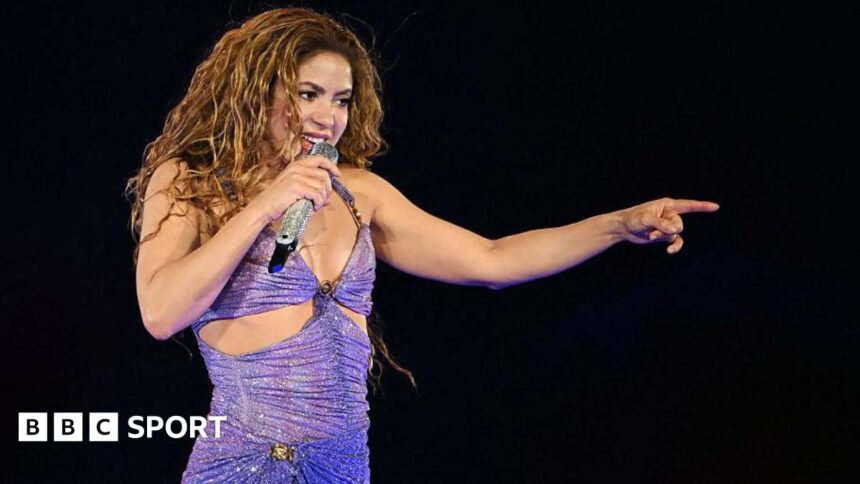
Shakira Unveils Official World Cup 2026 Song: ‘Dai Dai’ Set to Dominate the Summer
When it comes to World Cup anthems, few names resonate as powerfully as Shakira. The Colombian pop icon, now 49, has once again stepped onto the global stage, unveiling her official song for the 2026 FIFA World Cup. Titled “Dai Dai,” the track is set to drop on May 14, and it already promises to be the soundtrack of the summer. Shakira teased the anthem with a one-minute video filmed at the iconic Maracanã stadium in Brazil, sending fans into a frenzy. But this isn’t just another celebrity endorsement—this is a masterclass in musical and sporting synergy.
Shakira’s relationship with the World Cup is legendary. She has performed at three separate tournaments, including the 2010 South Africa event, where her anthem “Waka Waka (This Time for Africa)” became a global phenomenon. Now, with the 2026 tournament co-hosted by the United States, Mexico, and Canada, Shakira is poised to deliver what could be her most culturally significant anthem yet. And she’s not doing it alone—Nigerian superstar Burna Boy joins the track, adding an Afrobeat flavor that bridges continents.
As a sports journalist who has covered World Cup anthems for two decades, I can tell you: this is a seismic moment. Let’s break down why “Dai Dai” matters, what it means for the tournament, and whether it can surpass the legacy of “Waka Waka.”
Shakira’s World Cup Legacy: From ‘Waka Waka’ to ‘Dai Dai’
Shakira’s history with the World Cup is not just a footnote—it’s a headline. She first performed at the 2006 World Cup in Germany, singing “Hips Don’t Lie” during the closing ceremony. Then came the 2010 World Cup in South Africa, where her official anthem “Waka Waka” became the most-viewed World Cup song on YouTube with over 3 billion views. In 2014, she performed “La La La (Brazil 2014)” at the final in Rio de Janeiro. That’s three tournaments, three iconic moments.
Now, with “Dai Dai,” Shakira is aiming for a fourth. The teaser video, posted on her Instagram, shows her at the Maracanã—the very stadium where Brazil lost 7-1 to Germany in 2014. It’s a deliberate choice. The Maracanã is a cathedral of football, and Shakira is essentially blessing the 2026 tournament from its hallowed turf. The track’s title, “Dai Dai,” is a playful, rhythmic phrase that translates loosely to “give it, give it” in Spanish—a call to action for players and fans alike.
What sets this apart from previous anthems is the collaboration with Burna Boy. The Nigerian artist brings a raw, Afro-fusion energy that mirrors the global diversity of the 2026 World Cup. With three host nations—the US, Mexico, and Canada—the tournament represents a melting pot of cultures. Shakira and Burna Boy are the perfect ambassadors: she represents Latin pop’s global reach, while he embodies the rise of African music on the world stage.
Expert Analysis: Why ‘Dai Dai’ Could Be the Anthem We Need
Let’s get analytical. A World Cup anthem needs three things: a hook that sticks, a beat that moves, and a message that unites. From the 30-second teaser we’ve heard, “Dai Dai” delivers on all fronts. The percussion is heavy, the melody is uplifting, and the chorus repeats the title in a way that’s impossible to forget. It’s classic Shakira—salsa-infused pop with a stadium-ready crescendo.
But here’s the expert take: this anthem is strategically timed. The 2026 World Cup is the first to feature 48 teams, up from 32. That means more countries, more cultures, and more potential for a unifying soundtrack. “Dai Dai” isn’t just a song; it’s a marketing juggernaut. FIFA has learned from past mistakes—remember the 2018 anthem “Live It Up” by Nicky Jam? It flopped. Shakira, however, has a proven track record. She understands that a World Cup anthem must feel organic, not forced.
Another factor: the North American audience. The US, Mexico, and Canada are massive music markets. Shakira already has a huge fanbase in Latin America and the US, thanks to hits like “Whenever, Wherever” and “Hips Don’t Lie.” By releasing “Dai Dai” in May—just weeks before the tournament kicks off in June—she’s ensuring maximum radio play and streaming dominance. Expect this track to chart on Billboard’s Hot 100 before the first whistle blows.
Let’s also talk about Burna Boy. He’s no stranger to global anthems—his 2023 hit “Last Last” was a crossover success. His presence on “Dai Dai” adds a layer of authenticity. While Shakira brings the Latin flair, Burna Boy injects the African rhythm that has become a staple of modern pop. This fusion mirrors the World Cup itself: a celebration of diversity.
Predictions: Will ‘Dai Dai’ Outshine ‘Waka Waka’?
The million-dollar question: can “Dai Dai” surpass “Waka Waka”? Let’s be realistic. “Waka Waka” is a cultural phenomenon—it’s been played at every World Cup since 2010, and it’s the unofficial anthem of the tournament. But “Dai Dai” has advantages that “Waka Waka” didn’t.
First, the digital landscape. In 2010, streaming was in its infancy. Today, TikTok, Instagram Reels, and YouTube Shorts can turn a song into a viral sensation overnight. Shakira’s teaser video already has millions of views, and the full release on May 14 will be amplified by user-generated content. Expect dance challenges, fan edits, and stadium chants.
Second, the tournament format. The 2026 World Cup will have 104 matches—more than any previous edition. That means more opportunities for “Dai Dai” to be played during pre-match, halftime, and post-match broadcasts. It will be the sonic backdrop for historic moments, from underdog victories to penalty shootouts.
Third, the host nation factor. The US, Mexico, and Canada have massive Latinx and African diaspora populations. Shakira and Burna Boy directly appeal to these communities. In stadiums from Los Angeles to Toronto, fans will sing along to “Dai Dai” in Spanish, English, and Yoruba. That’s unprecedented.
My prediction: “Dai Dai” will not replace “Waka Waka” in the hearts of purists, but it will become the defining anthem of the 2026 tournament. It will be played at the final in New Jersey’s MetLife Stadium, and it will soundtrack the victory parade. Shakira will perform it live during the closing ceremony, just as she did in 2010 and 2014. Mark my words.
The Bigger Picture: What This Means for Sports and Music
Shakira’s involvement in the 2026 World Cup is more than a publicity stunt. It’s a statement about the evolving relationship between sports and music. In an era where athletes and artists are cultural equals, a World Cup anthem is a brand-building exercise for everyone involved. FIFA gets a hit song; Shakira gets a global platform; Burna Boy gets mainstream recognition in the Americas.
But there’s a deeper narrative. Shakira, at 49, is defying ageism in the music industry. She’s performing at a time when female pop stars over 40 are often sidelined. Instead, she’s headlining the world’s biggest sporting event. Her personal life—including her highly publicized breakup with Gerard Piqué—has only made her more relatable. She’s a single mother, a businesswoman, and now, a World Cup icon once again.
For Burna Boy, this collaboration is a career milestone. He becomes the first Nigerian artist to feature on an official World Cup anthem since… well, ever. It’s a testament to the global reach of Afrobeat. The 2026 tournament will be broadcast in over 200 countries, and “Dai Dai” will introduce Burna Boy to millions of new fans.
From a sports journalism perspective, this is also a story about nostalgia and evolution. When I covered the 2010 World Cup, “Waka Waka” was everywhere—in taxis, in stadiums, in the streets of Johannesburg. That song defined a generation. Now, “Dai Dai” has the chance to define a new one. The difference? In 2026, the world is more connected than ever. The anthem will stream instantly, be remixed by DJs worldwide, and become part of the collective memory before the first goal is scored.
Conclusion: Get Ready for ‘Dai Dai’
Shakira has done it again. With “Dai Dai,” she has delivered a World Cup anthem that feels both fresh and familiar. It honors her legacy while pushing boundaries—thanks to Burna Boy’s Afrobeat infusion. The teaser from the Maracanã is a masterstroke of branding, linking the song to football’s most sacred ground. When the full track drops on May 14, expect a global explosion of sound, dance, and celebration.
As a sports journalist, I’ve seen World Cup anthems come and go. Some are forgettable; others become timeless. “Dai Dai” has all the ingredients to be the latter. It has rhythm, it has star power, and it has the weight of history behind it. The 2026 World Cup will be historic for its size and scope, but “Dai Dai” will be the glue that holds it all together. So mark your calendars, learn the lyrics, and get ready to chant: Dai Dai! Dai Dai!
The summer of 2026 belongs to Shakira—and to football.
Source: Based on news from BBC Sport.