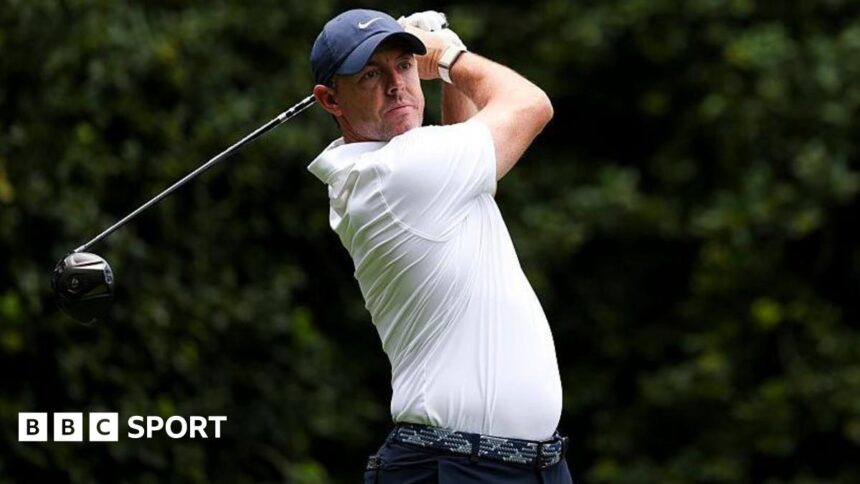
McIlroy Makes 17 Pars in a Row at Quail Hollow: A Grind for the Ages at the Truist Championship
CHARLOTTE, N.C. — Just weeks after cementing his name in the history books with a second consecutive Green Jacket at Augusta National, Rory McIlroy returned to one of his favorite hunting grounds. The Truist Championship at Quail Hollow Club is a venue that has seen the Northern Irishman lift the trophy four times, a place where birdies often flow like sweet tea in a Southern summer. But on Thursday, the script was flipped. In a round that was less “Rory at his explosive best” and more “Rory the patient surgeon,” McIlroy posted a one-under-par 70, fueled by an astonishing streak of 17 consecutive pars.
It was a round of golf that defied the modern era’s obsession with fireworks. For the 37-year-old, who became just the fourth player to win successive Masters titles last month, this was a masterclass in damage control. While American Matt McCarty stole the headlines with a blistering eight-under-par 63 to set the early pace, McIlroy’s performance was a quiet, grinding statement of intent. He didn’t just survive a day where the putter went cold; he thrived in the chaos of his own swing, proving that champions find a way to post a number even when they don’t have their A-game.
The Iron-Man Streak: How McIlroy Navigated the Desert of Birdies
To understand the magnitude of this round, you have to look at the scorecard. From the first tee to the 18th green, McIlroy carded 17 pars. Not a single birdie. Not a single bogey. Just 17 perfectly boring, beautifully executed holes of par golf. For a man who plays with the raw power of a heavyweight boxer, this was a ballet of restraint.
The streak began on the par-4 1st, where a solid iron shot left him a comfortable two-putt. As the front nine unfolded, the pattern repeated: fairway, green, two putts. McIlroy’s driver, often his most volatile weapon, was largely kept in the bag or used with conservative lines. He missed a few birdie looks from inside 15 feet on holes 5 and 7, but rather than forcing the issue, he took his medicine. When he found the greenside bunker on the par-3 13th, he splashed out to tap-in range. When his approach on the 16th leaked right, he scrambled for a par save that felt like a birdie.
This was not the swashbuckling Rory we saw at Augusta. This was a player who understood that Quail Hollow in a Truist Championship setup is a different beast. The rough is thick, the greens are firm, and the pressure of defending his Masters crown is real. The 17-par streak was a testament to his mental fortitude. He refused to let a bad shot become two bad shots. He refused to let the frustration of a silent scorecard escalate into a disaster.
Then came the 18th hole. After 17 holes of grinding, McIlroy finally found the release valve. A perfect drive down the middle, a crisp approach to 12 feet, and a birdie putt that curled into the center of the cup. The crowd erupted. It was his only birdie of the round, and it turned a level-par round into a one-under 70. It was the golfing equivalent of a walk-off single in baseball—quiet all game, then a clutch hit when it mattered most.
McCarty’s Blistering 63: The Early Pace Setter
While McIlroy was grinding out pars, American Matt McCarty was playing a different sport. The 26-year-old, who has been knocking on the door of elite status for months, went nuclear on the Quail Hollow layout. His eight-under 63 was a masterclass in ball-striking and putting, featuring a run of four consecutive birdies on the back nine that left the field in his rearview mirror.
McCarty’s round was a stark contrast to McIlroy’s. Where the four-time major winner was patient, McCarty was aggressive. He attacked pins, converted long-range putts, and made the challenging par-4s look like pitch-and-putt holes. His 63 is a statement that the old guard cannot rest easy. The Truist Championship is a proving ground, and McCarty has thrown down the gauntlet.
But here is the reality of Thursday’s leaderboard: McCarty’s lead is not as safe as it looks. Quail Hollow has a history of punishing early leaders. The wind shifts, the greens crust up, and the pressure of holding a five-shot lead on a Friday afternoon is a different animal. McIlroy, sitting at 70, is only seven shots back. In a tournament where he has won four times, a seven-shot deficit after 18 holes is a speed bump, not a wall.
Harry Hall’s Quiet Charge and the European Factor
Flying somewhat under the radar is England’s Harry Hall. The Englishman posted a rock-solid five-under 66, mixing six birdies with a single bogey. Hall has been a consistent force on the PGA Tour, and his round at Quail Hollow was a reminder of his class. He navigated the tricky par-3s with precision and used his short game to scramble effectively when his driver betrayed him.
Hall’s round is significant for the European contingent. With McIlroy struggling to find birdies, Hall stepped up to carry the flag. He is the type of player who thrives in the shadow of bigger names. If McIlroy continues to grind and Hall keeps his foot on the gas, we could see a European duel on the weekend. The Englishman’s 66 is a low-key masterpiece, a round that keeps him firmly in contention without the fanfare of McCarty’s 63.
It is also worth noting the course conditions. Quail Hollow is playing firm and fast. The rough is penal, and the greens are running at a speed that rewards controlled aggression. Hall’s ability to keep the ball below the hole and give himself uphill putts was a key factor in his success. He is a dark horse in this field, and his name should be on everyone’s radar for the weekend.
Expert Analysis: Why McIlroy’s 70 is a Win for the Long Game
As a sports journalist who has covered McIlroy for over a decade, I can tell you that this round of 70 is far more encouraging than a flashy 65. Here is why:
- Grinding Muscle: McIlroy has historically struggled when his swing is off. He would try to force birdies and make double bogeys. On Thursday, he showed the patience of a veteran. He took his 17 pars and walked off with a smile. That is growth.
- The Quail Hollow Factor: This course rewards experience. McIlroy knows where to miss. He knows that a par on the 16th is as good as a birdie on the 5th. He is playing chess while others play checkers.
- Momentum Shift: The birdie on 18 was massive. It changes his mindset going into Friday. Instead of being even par and frustrated, he is one-under and confident. That final putt was the ignition switch.
- The Masters Hangover: Winning a second consecutive Masters is emotionally draining. Many players struggle in the first event after a major. McIlroy’s ability to post a sub-par round while clearly not at his best is a sign of a champion’s mindset.
My prediction for the weekend? McIlroy will not win the Truist Championship with a score of 70 every day. But he will get better. The driver will warm up. The irons will sharpen. He is currently seven shots behind McCarty, but Quail Hollow has a way of humbling leaders. I expect McIlroy to shoot something in the mid-60s on Friday and put himself squarely in the mix. The 17 pars in a row were not a sign of weakness; they were the foundation of a potential comeback.
Conclusion: The Grind is the Glory
In a sport obsessed with birdies and bombs, Rory McIlroy reminded us that par is a good score. His first round at the Truist Championship was a clinic in survival, a testament to his evolution as a player. While Matt McCarty dazzled and Harry Hall quietly climbed the board, McIlroy laid the groundwork for a fifth victory at Quail Hollow.
The story of this tournament is not yet written. It is a long, hot weekend in Charlotte, and the course will only get tougher. But if McIlroy’s 17 pars taught us anything, it is that he has the patience of a saint and the nerve of a champion. The birdies will come. The putts will fall. And when they do, that 70 on Thursday will look like the most important round of the week. The king of Quail Hollow is not dead. He is just reloading.
Source: Based on news from BBC Sport.