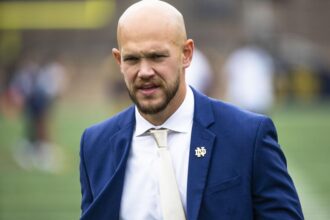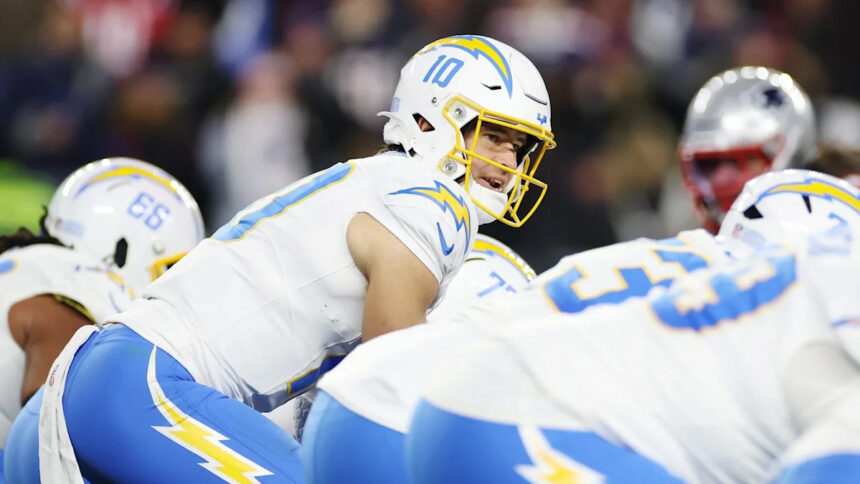
Mike McDaniel’s Mission: Unlocking the Final Gear of Justin Herbert’s Supercar Arm
There is a strange paradox surrounding Los Angeles Chargers quarterback Justin Herbert. Statistically, he is an alien. He has thrown for over 17,000 yards in his first four seasons, a feat matched only by Patrick Mahomes. He possesses a howitzer of an arm, ice-water in his veins, and the physical frame of a Greek god. Yet, as he enters his seventh NFL season in 2025, the most glaring data point on his resume remains a goose egg: zero playoff wins.
The Chargers have tried everything. They fired coaches, changed offensive coordinators, and hired the ultra-competitive Jim Harbaugh to instill a “mafia” mentality. But the piece that has remained stubbornly unpolished is the quarterback himself. Not broken, not bad—just unfulfilled potential. That is why the arrival of former Miami Dolphins head coach Mike McDaniel as a senior offensive assistant (or similar role, depending on the final title) is the most fascinating experiment in the NFL today.
On Friday, McDaniel offered a glimpse into his philosophy with a quote that should send shivers down the spine of every defensive coordinator in the AFC West. He spoke not about fixing Herbert, but about making him “own the position” in a way he never has. This is not a repair job. This is an evolution.
The “Toolbox” Metaphor: Why Herbert Hasn’t Maxed Out
McDaniel’s specific phrasing is telling. He said Herbert has “the capability of mastering every tool in the toolbox.” This implies that Herbert currently has a full box of wrenches, hammers, and screwdrivers, but he is still grabbing the wrong tool for the job at critical moments.
Let’s examine the evidence. Herbert’s arm talent is generational. He can throw a 60-yard bomb off his back foot, or zip a laser into a seam that physics says shouldn’t exist. But the NFL is a game of efficiency and rhythm, not just highlight reels. Too often, Herbert holds the ball waiting for the deep shot, absorbing sacks that cripple drives. According to Pro Football Focus, his time-to-throw has consistently ranked in the bottom third of the league. He relies on his cannon to overcome poor timing—a crutch that works in September but breaks down in January.
McDaniel’s background is the perfect antidote. In Miami, he turned Tua Tagovailoa into an MVP candidate by emphasizing pre-snap reads, quick processing, and layered throws. The Dolphins’ offense was a symphony of motion, spacing, and rapid-fire decisions. Herbert, by contrast, has often played like a heavy metal solo—impressive, loud, but sometimes out of tune with the band.
Consider these key areas where McDaniel will focus:
- Pre-snap mastery: Herbert must learn to diagnose coverages faster, using Mike Williams and Quentin Johnston’s alignments to dictate where the ball goes before the snap.
- RPO efficiency: The Chargers rarely used run-pass options effectively. McDaniel will install a system that forces Herbert to make split-second reads with a run threat.
- Pocket discipline: Instead of escaping to launch, Herbert will be taught to climb the pocket and deliver from a stable base.
The goal is not to make Herbert robotic. It is to make him unpredictable within structure. A quarterback who can be both a surgeon and a bomb-thrower is a nightmare. A quarterback who only throws bombs is a liability on third-and-4.
The “Quick Throw” Revolution: Fixing the Fatal Flaw
McDaniel was explicit about one specific target: improving Herbert’s efficiency when throwing the ball quickly. This is the single most important adjustment for the Chargers’ offense to take the next step.
Look at the numbers. In 2024, Herbert ranked near the bottom of the league in completion percentage on passes thrown in under 2.5 seconds. When he had time, he was elite. When he didn’t, he was average. In the playoffs, the pressure is relentless. Defenses will blitz, bracket Keenan Allen (if he stays), and force Herbert to beat them with rhythm throws to running backs and tight ends.
McDaniel’s solution is a detailed approach to the short game. This means:
- Footwork drills: Herbert’s lower body often gets lazy on quick throws, causing the ball to sail high. Expect a heavy emphasis on resetting his feet on three-step drops.
- Anticipation routes: Throwing to a spot before the receiver breaks, trusting the timing. This is how Tom Brady carved up defenses at age 45.
- Mesh concepts: Crossing routes that create natural picks and force the defense to communicate. Herbert has rarely used these in volume.
The beauty of this plan is that it does not negate Herbert’s greatest strength. As McDaniel noted, the quick game will exist “in conjunction with all the things you know he’s capable of doing—which is extend plays and launch it down the field.” The deep ball will always be a weapon. But now, it will be a counterpunch, not the opening jab.
Imagine a game where Herbert hits a tight end on a 7-yard out on first down. Then a screen to Austin Ekeler (or a similar back) for 12 yards. Then, on third-and-3, a quick slant to Johnston. Suddenly, the defense is back on its heels. Now, Herbert can look for the double move, the post route, the bomb. That is the ownership McDaniel is talking about: controlling the game, not just reacting to it.
Expert Analysis: Can McDaniel and Harbaugh Coexist?
The elephant in the room is the relationship between Mike McDaniel and head coach Jim Harbaugh. Harbaugh is a run-first, smash-mouth coach who wants to win with defense and a punishing ground game. McDaniel is a pass-happy, analytics-driven innovator. Oil and water?
Not necessarily. This is where the “own the position” concept becomes a power-sharing chess match. Harbaugh has publicly raved about Herbert, calling him a “once-in-a-generation talent.” But Harbaugh also knows that his style—running the ball 35 times a game—only works if the quarterback is efficient on the possessions he gets. McDaniel is the key to making that marriage work.
My prediction: The Chargers will run a hybrid offense in 2025. Early in games, they will lean on the run to set up play-action. But in critical moments—third-and-long, two-minute drills, fourth quarter—McDaniel will take the reins. Herbert will be given a “menu” of quick-game options that he can audible into based on the defensive look. This is what Mahomes does in Kansas City. It is what Herbert should have been doing for years.
The risk? Herbert might resist the change. He has been allowed to freelance for six years. Asking him to become a point guard instead of a power forward requires humility. But McDaniel is a master communicator, and Harbaugh’s rah-rah style will provide the emotional cover. If Herbert buys in, the ceiling is MVP-level production and a deep playoff run.
The Verdict: A Quarterback Reborn or Another False Dawn?
We have heard this story before. “The Chargers are going to finally unlock Justin Herbert.” It was said when they hired Joe Lombardi. It was said when they fired him and brought in Kellen Moore. It was said when they drafted Johnston. Each time, the result was the same: a talented team that finds new ways to lose close games.
But McDaniel represents something different. He is not just a play-caller; he is a systems architect. He understands that Herbert’s issue is not physical—it is psychological and technical. The “ownership” McDaniel speaks of is about confidence in the mundane. It is about trusting that a 5-yard completion on first down is just as valuable as a 50-yard bomb on third down.
For Herbert to truly own the position, he must stop trying to be a superhero on every snap. He must become a CEO of the offense. He must check into the right run, take the check-down, and live to fight another down. If McDaniel can teach him that, the Chargers will not just win a playoff game. They will become a perennial contender.
The bottom line: Justin Herbert has the arm of a god and the resume of a mortal. Mike McDaniel is the first coach to treat the problem as a craft, not a talent deficit. If the quarterback listens, the AFC will have a new sheriff. If he doesn’t, the Chargers will remain the league’s most frustrating tease. The 2025 season is not just about wins and losses. It is about whether the most gifted arm in football can finally learn to own the game between his ears.
Prediction: Herbert throws for 4,500 yards, 35 touchdowns, and 8 interceptions. The Chargers win the AFC West and finally—finally—win a playoff game. McDaniel gets a head coaching job in 2026. And the narrative changes from “when will Herbert win?” to “how many rings can he win?”
Source: Based on news from Yahoo Sports.