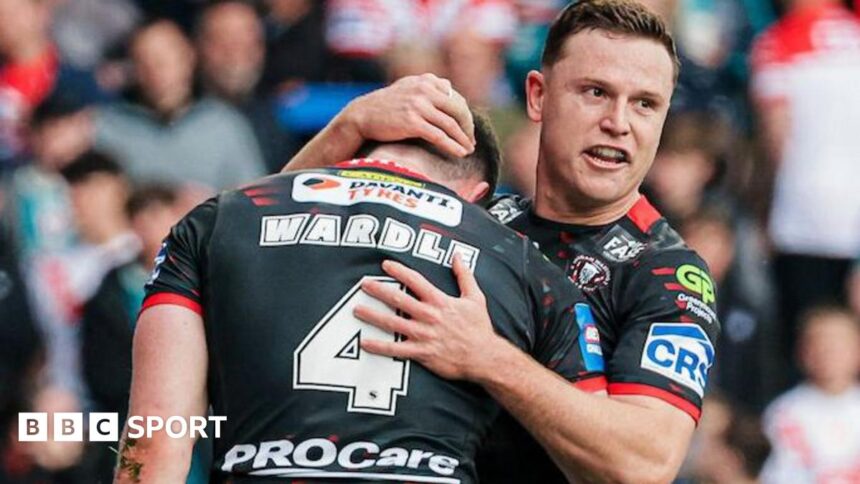
Six-try Wigan shut out St Helens to reach Challenge Cup final
The Wigan Warriors delivered a performance for the ages at the Betfred Challenge Cup semi-final, obliterating their fiercest rivals St Helens with a stunning 6-0 try count to book their place in the final. In a match that was billed as a tight, tactical arm-wrestle, Matt Peet’s side instead produced a clinical attacking display and a magnificent defensive effort that left Saints scoreless for the first time in a major semi-final in over a decade.
The final scoreline—a comprehensive shutout—did not flatter Wigan. From the first whistle, the Warriors imposed their will on the derby, suffocating St Helens’ creative spine and exploiting every gap in their defensive line. This was not just a victory; it was a statement. Wigan are heading to their third Challenge Cup final in five years, and on this form, they will take some stopping.
Clinical finishing: The Farrimond and Eckersley show
Wigan’s attack was ruthlessly efficient, with two young guns stealing the headlines. Teenage sensation Jack Farrimond and dynamic centre Zach Eckersley both crossed for braces, showcasing the depth of talent in the Warriors’ ranks. Farrimond, in particular, was a constant menace, using his electric footwork to ghost through the Saints defensive line twice in the first half.
- Jack Farrimond (2 tries): His first came from a clever dummy and step inside the 20-metre line. His second was pure instinct—a chip-and-chase that he regathered with composure beyond his years.
- Zach Eckersley (2 tries): Eckersley’s power and pace were too much for the Saints wingers. His first try was a classic centre’s finish, cutting back against the grain. The second was a barnstorming run from 30 metres out, brushing off three defenders.
- Liam Wardle (1 try): The forward barged over from close range after a sustained period of pressure, underlining Wigan’s ability to score in multiple ways.
- Adam Keighran (1 try): The fullback capped a man-of-the-match performance with a well-taken try, supporting a break down the short side.
The conversion duties were shared between Keighran (2 goals) and Harry Smith (2 goals), but the points were almost academic. The real story was the five-try blitz in the first 50 minutes that effectively ended the contest. Wigan’s ability to turn half-chances into full points was the difference between the two sides.
“We knew we had to be clinical against a side like St Helens,” said head coach Matt Peet post-match. “We spoke all week about taking our opportunities when they came. The boys executed that plan to perfection.”
A defensive masterclass: How Wigan shut out St Helens
While the tries will make the headlines, the foundation of this victory was built on uncompromising defence. St Helens, a team that prides itself on its attacking flair and physicality, were completely nullified. They managed zero tries, zero line breaks of note, and were forced into a staggering number of errors by Wigan’s aggressive line speed.
The statistics are telling: Wigan made over 40 dominant tackles, with forwards like Kaide Ellis and Ethan Havard leading the charge. Every time Saints attempted to build momentum, a Warriors player shot out of the line to cut down the ball carrier. The defensive structure was so well-drilled that St Helens’ key playmakers—Jonny Lomax and Jack Welsby—were reduced to kicking from deep and hoping for a mistake that never came.
“We knew St Helens would try to shift the ball wide early,” explained Wigan captain Liam Farrell. “Our edge defenders were outstanding. We trusted our systems, and we never let them get a roll on.”
This was not merely a win; it was a defensive shutout of a team that had scored 40 points in their previous two matches. It was the kind of performance that wins trophies. In a sport where momentum is king, Wigan’s ability to shut out their rivals for 80 minutes is a terrifying prospect for whoever awaits them in the final.
Expert analysis: Where the semi-final was won and lost
From a tactical perspective, the game was decided in the middle third of the field. Wigan’s kick-chase game was superb. Harry Smith and Adam Keighran pinned St Helens deep in their own half repeatedly, and the Wigan chasers—led by the tireless Bevan French—applied relentless pressure. Saints could not build any field position, and their exits were often hurried and ineffective.
Contrast that with Wigan’s own sets. The Warriors completed at over 90% in the first half, and their play-the-ball speed was lightning fast. This allowed their halves to pull the strings, with Jai Field causing chaos with his late footwork at the line. St Helens’ defensive line, usually so resolute, began to tire and fracture as the half wore on.
Another key factor was the discipline of the Wigan side. They conceded only three penalties in the entire match, keeping St Helens’ set-restart count to a minimum. In contrast, Saints gave away six penalties in the first half alone, gifting Wigan easy field position. You cannot afford to give a side of Wigan’s quality that many opportunities.
“The difference was Wigan’s intensity,” said former Great Britain international and pundit Barrie McDermott. “They were faster, sharper, and smarter. St Helens looked flat-footed. Wigan defended like their lives depended on it, and they attacked with real purpose. That’s a championship-winning formula.”
Predictions: Can anyone stop Wigan now?
With this performance, Wigan have sent a clear message to the remaining teams in the competition. They are not just reaching finals; they are dominating them. The question now is: who can stop them?
The Warriors will face either Leigh Leopards or Hull KR in the final, but based on this semi-final showing, both sides will be nervous. Wigan’s defensive system is currently the best in the competition, and their attack—when it clicks—is devastating. The combination of Farrimond’s youth and Eckersley’s power adds a layer of unpredictability that opposing coaches will struggle to game-plan for.
Prediction: If Wigan maintain this level of defensive intensity and clinical finishing, they will lift the Challenge Cup. The key will be managing the occasion. The final atmosphere at Wembley is unique, but this group of players have big-game experience. With leaders like Farrell, Smith, and Keighran steering the ship, they have the temperament to handle the pressure.
“We’re not getting ahead of ourselves,” warned Peet. “We’ve won nothing yet. But if we can reproduce that defensive effort and that clinical edge, we’ll give ourselves a great chance.”
Strong conclusion: A new era of Wigan dominance?
The six-try shutout of St Helens was not just a semi-final victory; it was a changing of the guard. For years, Saints have been the benchmark in Super League and the Challenge Cup. But on this day, Wigan were superior in every department—physically, tactically, and mentally.
The Warriors now stand on the cusp of history. A third Challenge Cup final appearance in five years is a testament to the club’s recruitment, coaching, and culture. But this team feels different. They have a ruthless edge, a defensive steel, and an attacking flair that makes them must-see rugby.
For St Helens, this will be a bitter pill to swallow. To be shut out by your biggest rivals in a semi-final is a painful result. They will need to regroup and refocus for the Super League run-in. But for Wigan, the path is clear: one more win, and the Challenge Cup returns to the DW Stadium.
As the final whistle blew and the Wigan players celebrated in front of their ecstatic fans, the message was clear: this is a team on a mission. The Betfred Challenge Cup final awaits, and if they play like this, the trophy is theirs to lose.
To play this video you need to enable JavaScript in your browser.
Source: Based on news from BBC Sport.