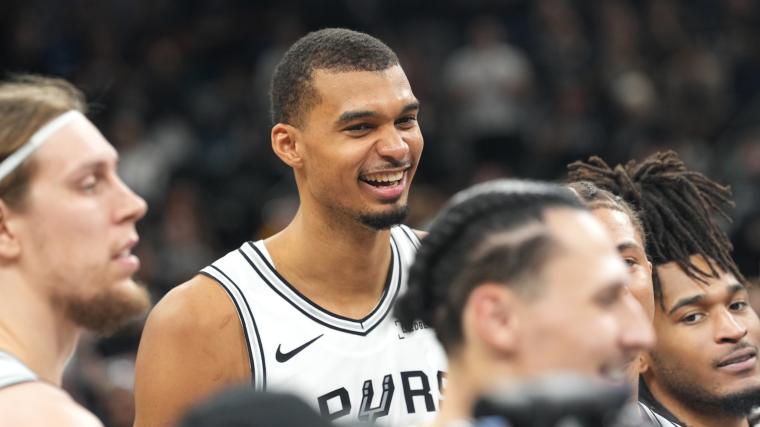
Victor Wembanyama Ejected: Inside The Flagrant 2 That Rocked The Spurs-Timberwolves Series
The atmosphere inside the Target Center was already electric. The Minnesota Timberwolves, hungry to even their playoff series against the San Antonio Spurs, had the home crowd behind them. But no one in the building—not the officials, not the coaches, and certainly not the 18,000 fans—expected the seismic shift that would occur with just under nine minutes left in the second quarter. That is when Victor Wembanyama, the Spurs’ transcendent 7-foot-4 franchise cornerstone, was assessed a Flagrant 2 foul and summarily ejected from Game 4.
The play itself was a blur of raw frustration and physical consequence. Wembanyama had just snatched a defensive rebound over Minnesota’s Naz Reid. As he turned to initiate the break, he became entangled with both Reid and Timberwolves wing Jaden McDaniels. What happened next changed the trajectory of the game. Wembanyama, appearing agitated by the contact, looked over his shoulder and delivered a backward elbow that caught Reid directly in the throat. Reid crumpled to the hardwood as the whistle blew, and the entire arena held its breath.
After a lengthy replay review, the officials upgraded the call to a Flagrant 2—defined as unnecessary and excessive contact—and ejected the Spurs’ superstar. The crowd erupted, the Timberwolves bench roared, and the Spurs were left scrambling. This article breaks down the incident, the expert analysis, the immediate fallout, and what this means for the rest of the series.
The Incident: A Frame-by-Frame Breakdown of the Flagrant 2
To understand the severity of the call, we have to look at the specific mechanics of the play. With 8:47 remaining in the second quarter, the Timberwolves had just missed a field goal. Wembanyama, using his incredible wingspan, secured the rebound over Naz Reid. As he came down, Reid and Jaden McDaniels closed in, creating a tight pocket of contact near the baseline.
Here is what the replay showed in slow motion:
- The Gather: Wembanyama secures the ball with two hands. He is clearly off-balance, with Reid’s body pressed against his left hip and McDaniels hovering to his right.
- The Turn: The Spurs center attempts to pivot and push the ball up the floor. Instead of creating separation with his legs or a standard pivot, he hunches his shoulders.
- The Elbow: This is the critical moment. Wembanyama looks over his right shoulder—directly at Reid’s position—and then swings his right elbow backward with significant force. The contact is direct to the throat area of Naz Reid.
- The Aftermath: Reid immediately goes down, clutching his neck. Medical staff from both teams rush out. Wembanyama, meanwhile, looks at the officials, seemingly confused by the escalation.
The officiating crew spent nearly four minutes reviewing the angles. The league’s standard for a Flagrant 2 is contact that is not only unnecessary but also excessive and carries a high risk of injury. Striking an opponent in the throat—a vulnerable area—almost always triggers an upgrade. While Wembanyama may have been attempting to clear space, the retrospective nature of the swing and the targeted location of the blow left the officials with no choice but to eject him.
Expert Analysis: Was It a Justified Ejection or an Overreaction?
As a veteran NBA observer, I have seen hundreds of flagrant foul reviews. Some are soft. Some are malicious. This one sits in a gray area that leans heavily toward a correct call. Let’s break down the arguments from both sides.
Why the Flagrant 2 was justified:
- Intent (or lack of control): Wembanyama looked before he swung. That is a critical detail. If he had simply spun and his elbow accidentally caught Reid, it would have been a Flagrant 1. The look-over-the-shoulder suggests he was aware of Reid’s proximity and chose to use force.
- Vulnerable area: The throat is one of the most dangerous places to be struck in sports. The NBA has a zero-tolerance policy for contact to the neck and head area, especially when the elbow is used as a weapon.
- Game context: This was a physical, playoff-style game. The Timberwolves had been pressuring Wembanyama all series. Frustration was building. The officials had to send a message that retaliation—even accidental-looking retaliation—would not be tolerated.
Why some argue it was excessive:
- No prior history: Wembanyama is not a dirty player. He has never been ejected for a flagrant foul in his young career. Critics argue that a Flagrant 1 and a technical foul would have been sufficient punishment.
- Reid’s embellishment: While Reid was genuinely hit, some analysts noted that the fall appeared slightly theatrical. However, getting hit in the throat often causes an involuntary reaction, so this point is debatable.
- Momentum killer: Ejecting a superstar in a playoff game for a single play—even a bad one—feels heavy-handed. It essentially decided the game in the second quarter.
My expert take: The call was technically correct by the rulebook. The NBA has prioritized player safety, specifically regarding head and neck contact. However, the spirit of the playoffs usually allows for more physicality. Wembanyama made a rookie mistake in a high-leverage moment. He lost his composure, and it cost his team dearly.
Fallout: How the Ejection Changed the Game and the Series
The immediate impact was devastating for San Antonio. Without their 7-foot-4 anchor, the Spurs lost their rim protection, their primary offensive threat, and their emotional leader. The Timberwolves, sensing blood in the water, went on a 17-4 run to close the half.
Key statistics from the game post-ejection:
- Points in the paint: Minnesota scored 22 points in the paint in the second half alone, compared to just 14 for the Spurs.
- Rebound margin: The Timberwolves out-rebounded San Antonio by 12 after Wembanyama’s exit.
- Rudy Gobert’s impact: The Timberwolves center, freed from Wembanyama’s defensive length, posted a double-double with 18 points and 15 rebounds.
For the Spurs, this is a gut punch. They came into Game 4 with a chance to tie the series at 2-2. Now, they head back to San Antonio trailing 3-1, facing elimination. The loss of Wembanyama for the remainder of this game also raises questions about his availability for Game 5. The league office will review the play. While a suspension is unlikely—Flagrant 2 ejections rarely carry automatic suspensions unless it is a pattern of behavior—there is always a chance the league fines him for the reckless nature of the swing.
Predictions for the rest of the series:
- Game 5: Expect Wembanyama to come out with a vengeance. He will be angry, motivated, and under a microscope. The Spurs will need him to score 40+ to force a Game 6.
- Series outcome: The Timberwolves now have a stranglehold. They are deeper, more experienced, and have the home crowd behind them. I predict Minnesota closes this out in 5 games. The Spurs simply cannot survive another game without Wembanyama on the floor for 40 minutes.
- Long-term lesson: This ejection will be a learning moment for Wembanyama. He is the future of the league, but he must learn to channel his frustration into dominance, not retaliation. If he stays composed, he will win multiple championships. If he lets opponents bait him, he will have more nights like this.
Conclusion: A Costly Lesson for a Young Superstar
The ejection of Victor Wembanyama for a Flagrant 2 foul in Game 4 is the kind of moment that defines a player’s early career. It was a split-second decision born from frustration, physicality, and the immense pressure of playoff basketball. Naz Reid will be fine—he returned to the game and played well—but the damage to the Spurs’ season may be irreversible.
Wembanyama walked off the court to a chorus of boos, his head down, his hands on his hips. He knew he had let his team down. In the locker room, veteran Spurs players likely pulled him aside. They told him what every great player eventually learns: you cannot win a war if you lose your temper in a single battle.
For the San Antonio Spurs, the road to a championship just got steeper. For the Minnesota Timberwolves, this was a gift. They now have a 3-1 series lead and a clear path to the second round. But for the NBA as a whole, this incident serves as a stark reminder: even the most graceful giants can stumble when the pressure is highest. The question is not whether Wembanyama will learn from this—it is how quickly he will adapt. The future of the Spurs depends on it.
This article originally appeared on The Sporting News. Add The Sporting News as a Preferred Source by clicking here.
Source: Based on news from Yahoo Sports.