Wemby Ejected in Career First After Elbowing Reid: A Costly Flash of Frustration in the Playoffs
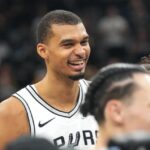
The San Antonio Spurs’ dream season hit a sudden, jarring speed bump on Sunday afternoon. In the heat of Game 4 of the Western Conference semifinals against the Minnesota Timberwolves, rookie sensation Victor Wembanyama was ejected for the first time in his professional career. The incident, which occurred early in the second quarter, saw the 7-foot-4 phenom throw an elbow that connected with the throat of Timberwolves forward Naz Reid. What was initially a tightly contested playoff battle immediately spiraled into controversy, leaving fans, analysts, and the Spurs organization scrambling for answers.
The ejection came at a pivotal moment. The series was tied 2-1, and the Spurs had clawed back from a double-digit deficit to keep Game 4 within reach. Then, in a split second of raw emotion, Wembanyama’s frustration boiled over. The rookie, who has been lauded for his composure and maturity all season, finally showed a crack in his armor—and it cost his team dearly.
The Incident: A Moment of Madness in the Second Quarter
With 8:32 remaining in the second quarter, Wembanyama was fighting for position in the post against Reid. The Timberwolves’ big man had been physical all series, using his strength to disrupt Wembanyama’s rhythm. On this particular possession, Reid wrapped an arm around the rookie’s waist, preventing him from sealing the lane. Frustrated by the constant contact and perhaps by a lack of foul calls, Wembanyama swung his right elbow backward in a sweeping motion. The elbow caught Reid squarely in the throat, sending the Timberwolves forward to the court in visible discomfort.
Referees immediately blew their whistles. After a brief consultation at the scorer’s table, the crew chief signaled a Flagrant 2 foul, which carries an automatic ejection. Wembanyama stood motionless, his face a mix of shock and regret, as he was escorted off the floor by Spurs assistant coach Mitch Johnson. Reid remained on the ground for several minutes before being helped to the locker room for evaluation. He was later diagnosed with a throat contusion but did not return to the game.
- Key Moment: Elbow to the throat of Naz Reid at 8:32 of the second quarter.
- Ruling: Flagrant 2 foul, automatic ejection.
- Impact: Wembanyama’s first career ejection in 87 games (regular season and playoffs combined).
- Injury: Reid suffered a throat contusion and did not return.
The ejection sent shockwaves through the arena. Spurs fans, who had been riding a wave of optimism after a stunning Game 3 victory, fell silent. Timberwolves supporters, meanwhile, erupted in a mix of anger and vindication. Social media exploded within seconds, with debates raging over whether the punishment was too harsh or whether Wembanyama had crossed an unforgivable line.
Expert Analysis: Was the Ejection Justified?
From a technical standpoint, the NBA’s rulebook is clear. A Flagrant 2 foul is defined as “unnecessary and excessive contact.” When a player swings an elbow with force and makes contact with an opponent’s head or neck area, the league has historically come down hard. In this case, the contact was to the throat—a vulnerable and dangerous area. The referees had little choice but to eject Wembanyama, especially given the heightened stakes of a playoff game.
However, context matters. Wembanyama is not a dirty player. Throughout his rookie season, he has been praised for his sportsmanship and his ability to absorb physical punishment without retaliating. He leads the league in blocks and has been targeted by opposing teams who try to bully him under the basket. The Timberwolves, in particular, have employed a strategy of constant physicality, with Reid and Karl-Anthony Towns taking turns bumping, grabbing, and shoving the rookie.
“This was a heat-of-the-moment reaction,” says former NBA referee and current ESPN analyst Steve Javie. “Wembanyama has been frustrated all series by the physical play. He’s not used to being manhandled. But you cannot swing an elbow at someone’s throat. The league will almost certainly review this and could issue a fine or even a suspension for Game 5.”
Indeed, the possibility of a suspension looms large. The NBA’s Player Safety department will review the footage. If they deem the elbow intentional or reckless, Wembanyama could face a one-game ban. That would be catastrophic for the Spurs, who are already without starting guard Devin Vassell due to a knee injury. Losing their franchise player for a potential elimination game would be a nightmare scenario.
But not everyone agrees with the severity of the ejection. Some analysts argue that Reid’s constant grabbing and holding should have been called more strictly, which might have prevented the escalation. “The officials lost control of the game early,” says TNT’s Shaquille O’Neal. “When you let guys grab and hold without calling fouls, you’re going to get retaliation. Wemby made a mistake, but the refs set the stage.”
Regardless of the debate, the result is undeniable: the Spurs lost their best player for 42 minutes of game time. Without Wembanyama, the Timberwolves went on a 22-6 run to close the second quarter and never looked back, winning 112-98 to tie the series at 2-2.
What This Means for the Spurs and the Series
The Western Conference semifinals are now a best-of-three series, with Game 5 set for Tuesday in San Antonio. The Spurs have a massive problem: they need to win without their superstar, or at least with a potentially distracted version of him. Wembanyama’s ejection not only cost them Game 4 but also exposed a vulnerability in their game plan. Without him on the floor, the Spurs’ defense collapsed. The Timberwolves scored 38 points in the paint in the second half, a number that would have been unthinkable with Wembanyama patrolling the rim.
Furthermore, the mental toll cannot be underestimated. Wembanyama has been the emotional leader of this team. He is the one who calms his teammates during timeouts, who delivers clutch plays, and who carries the weight of the franchise on his shoulders. Seeing him lose his composure—and get ejected—could shake the confidence of a young Spurs roster.
“This is a test of character,” says Spurs legend Tim Duncan, who was seen speaking to Wembanyama in the tunnel after the ejection. “Victor is a rookie. He’s going to make mistakes. The question is how he responds. If he comes back in Game 5 focused and dominant, this will be a learning moment. If he lets the criticism get to him, the Spurs are in trouble.”
The Timberwolves, meanwhile, have seized the momentum. Naz Reid’s injury is a concern, but early reports suggest he is day-to-day and could play in Game 5. Minnesota’s defense, which had been shredded by Wembanyama in Game 3 (37 points, 14 rebounds), suddenly looks formidable again. Anthony Edwards, who scored 31 points in Game 4, is playing with a swagger that has made him the best player in the series so far.
For the Spurs to survive, they need a three-pronged approach: first, Wembanyama must avoid a suspension. Second, role players like Keldon Johnson and Jeremy Sochan must step up. Third, the team must find a way to counter the Timberwolves’ physicality without crossing the line. If Wembanyama is suspended, the Spurs’ season is likely over. If he plays, they have a chance—but only if he can channel his frustration into production.
Predictions: How Will Wembanyama Respond?
History suggests that great players use adversity as fuel. Michael Jordan was ejected multiple times. LeBron James has had his moments of frustration. Even Tim Duncan, the ultimate professional, was ejected once in his career. Wembanyama is cut from a similar cloth. He has a fierce competitive streak, but he also has an unusually high basketball IQ. He knows he made a mistake.
Expect Wembanyama to issue a public apology before Game 5. Expect him to reach out to Naz Reid personally. And most importantly, expect him to come out with a vengeance. The rookie has a chip on his shoulder now. He has been painted as a villain by Timberwolves fans and a hothead by national media. That narrative will motivate him.
“I’ve seen this before,” says NBA analyst Charles Barkley. “Wemby is going to be angry. But he’s also smart. He’ll use this as fuel. I predict he has a monster Game 5—maybe 30 points, 15 rebounds, and 5 blocks. The Spurs will win that game. But the series? That’s a toss-up. The Timberwolves have the experience and the home-court advantage in Game 6.”
My prediction: The Spurs win Game 5 in a nail-biter, fueled by a dominant, focused Wembanyama. However, the Timberwolves take Game 6 in Minneapolis, setting up a winner-take-all Game 7 in San Antonio. In that game, the pressure will be immense. Wembanyama will have to prove he has learned from his ejection. If he does, the Spurs advance. If he doesn’t, the season ends in disappointment.
Conclusion: A Defining Moment for a Generational Talent
Victor Wembanyama’s first career ejection was not just a footnote in a playoff game—it was a defining moment in his young career. It showed that even the most composed rookies can crack under the pressure of the NBA playoffs. It showed that the Timberwolves have found a way to get under his skin. And it showed that the Spurs’ championship hopes are fragile, resting on the shoulders of a 20-year-old who is still learning how to manage his emotions.
But this is also a story of redemption waiting to be written. Wembanyama has the talent, the work ethic, and the support system to turn this negative into a positive. The question is whether he can do it in real time, under the bright lights of the Western Conference semifinals. The next few days will tell us a lot about the kind of player—and person—Victor Wembanyama is destined to become.
One thing is certain: the NBA is watching. The fans are watching. And the Timberwolves are watching, too. They know they have rattled the giant. Now, they have to finish the job. But if Wembanyama has anything to say about it, this ejection will be remembered not as the moment he lost control, but as the moment he learned to control his greatness.
Source: Based on news from ESPN.