Wembanyama Ejected Early in Game 4: Elbow to Reid’s Throat Flips the Script for Spurs and Timberwolves
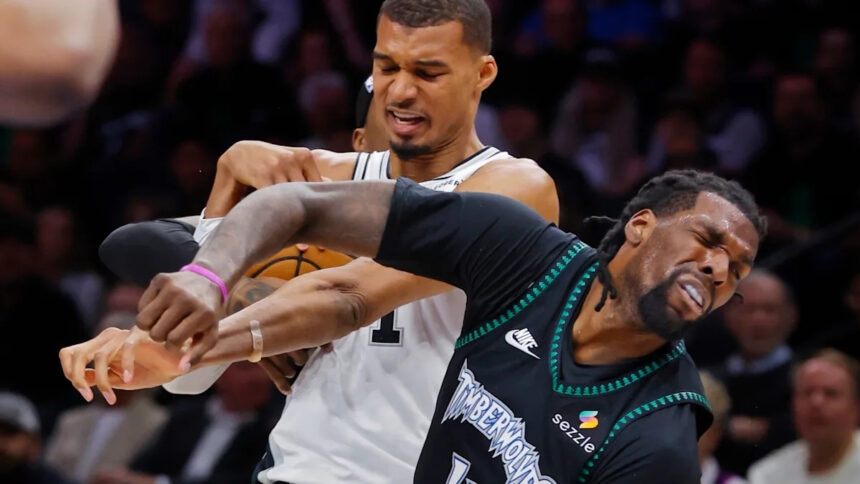
MINNEAPOLIS — The electricity inside Target Center was already crackling with playoff intensity when Victor Wembanyama’s night came to a sudden, violent halt. In the span of a single, frustrated swing of an elbow, the San Antonio Spurs’ transcendent superstar went from being the focal point of a tied series to a spectator in the tunnel. The moment of madness—or, depending on your perspective, the inevitable result of relentless physical pressure—came early in the second quarter of Game 4 of this rugged second-round NBA playoff series. Wembanyama, after rebounding a missed 3-pointer, found himself smothered by Naz Reid and Jaden McDaniels outside the paint. In a flash of frustration, the 7-foot-4 French phenom threw an elbow directly into the throat of Reid. The result? A Flagrant 2 foul, an automatic ejection, and a seismic shift in momentum that the Minnesota Timberwolves would ride to a series-altering victory.
The play unfolded with 9:47 remaining in the second quarter. Wembanyama, who had been held to just four points and four rebounds in 13 minutes, grabbed the offensive board and was immediately met by a double-team. As he attempted to pivot and pass, his elbow caught Reid flush in the neck area. The contact was immediate, violent, and above the shoulders—a combination that the NBA rulebook treats with zero tolerance. After a lengthy video review, the officials upgraded the initial offensive foul to a Flagrant 2, triggering an automatic ejection. The crowd at Target Center, already roaring, erupted into chants of “Kick him out! Kick him out!” as the arena sound system blared Michael Jackson’s “Beat It!”—a piece of audio theater that felt both cruel and fitting.
Wembanyama, to his credit, did not argue. He slapped hands with each of his Spurs teammates on his way off the floor, a gesture of accountability mixed with resignation. But the damage was done. Reid sank both free throws, giving the Timberwolves a 38-34 lead they would never relinquish. The Spurs, who took a 2-1 series lead with a 115-108 win in Game 3, now face a 2-2 tie and a massive question mark: Can they survive without their star for a full game in a hostile environment?
The Anatomy of the Ejection: Frustration Meets Physicality
To understand the ejection, you have to understand the context of the series. The Timberwolves have built their defensive identity around physicality, length, and intimidation. With Reid, Julius Randle, and McDaniels rotating in their frontcourt, Minnesota has thrown a relentless wave of muscle and tenacity at Wembanyama. In Game 3, the Spurs’ star responded with a masterpiece: 39 points on 13-for-18 shooting, a performance that seemed to break the Timberwolves’ spirit. But Game 4 was different. The Timberwolves adjusted, swarming Wembanyama earlier and harder, refusing to let him catch the ball cleanly. The frustration was palpable.
On the play in question, Wembanyama had just grabbed a defensive rebound and was immediately trapped. Reid, a 6-foot-9 forward who has been a defensive pest all series, was attached to his hip. McDaniels, a 6-foot-9 wing with elite lateral quickness, closed the gap. Wembanyama, with nowhere to go and no whistle coming, swung his elbow in a motion that was part clearing space, part frustration. The contact to Reid’s throat was undeniable. The officials’ decision to upgrade to a Flagrant 2 was based on the “excessive contact above the neck” clause, which carries an automatic ejection. There is no gray area in the rulebook for this. Wembanyama’s intent—whether it was accidental or retaliatory—became irrelevant the moment the elbow landed.
This is not the first time a superstar has been ejected in a playoff game, but the timing and stakes make it particularly devastating. The Spurs entered Game 4 with a chance to take a commanding 3-1 lead. Instead, they lost their best player before halftime. The Timberwolves, sensing blood, turned the game into a slugfest, outmuscling the Spurs in the paint and forcing their role players to beat them. Without Wembanyama’s rim protection and offensive gravity, the Spurs’ offense became predictable and stagnant.
Expert Analysis: How the Ejection Reshaped the Series
From a tactical perspective, Wembanyama’s ejection was a chess piece removed from the board before the game truly began. The Spurs had built their Game 3 win around the “Wembanyama gravity”—the way his presence on the perimeter forces defenses to stretch, opening driving lanes for guards like De’Aaron Fox and Devin Vassell. Without him, the Timberwolves could collapse on the paint, daring the Spurs’ shooters to beat them from deep. They did not. San Antonio shot just 32% from three-point range in Game 4, a far cry from the 44% they posted in Game 3.
Defensively, the loss was even more acute. Wembanyama is the NBA Defensive Player of the Year for a reason: his 8-foot wingspan and instinctive shot-blocking alter every possession. Without him, the Timberwolves’ offense found rhythm. Julius Randle, who had struggled in Games 2 and 3, exploded for 28 points and 12 rebounds, finding seams in the paint that Wembanyama would have closed. Naz Reid, the recipient of the elbow, turned into a folk hero, finishing with 18 points and a defiant energy that energized the crowd. The Timberwolves’ frontcourt, already physical, became dominant.
Key factors that changed after the ejection:
- Rebounding battle: Minnesota outrebounded San Antonio 48-36, with nine offensive boards leading to 14 second-chance points.
- Paint scoring: The Timberwolves scored 52 points in the paint, compared to 38 for the Spurs. Without Wembanyama’s rim protection, drives became layups.
- Momentum swing: The ejection happened with the score tied at 34. The Timberwolves went on a 12-2 run immediately after, and the Spurs never led again.
- Foul trouble: The Spurs’ backup centers, Zach Collins and Charles Bassey, combined for six fouls in the second half, unable to handle the physical load.
The ejection also exposed a psychological vulnerability in the Spurs’ roster. Without their leader on the floor, the team looked disjointed. Coach Gregg Popovich, usually a master of adjustments, was visibly frustrated on the sideline, unable to stem the tide. The Spurs’ bench, which had been a strength in Game 3, scored just 19 points. The Timberwolves, by contrast, played with a freedom and confidence that had been missing in their Game 3 loss.
Predictions: What Comes Next in This Pivotal Series?
The series is now tied 2-2, with Game 5 set to return to San Antonio. The question on everyone’s mind: Can Wembanyama avoid a repeat of this frustration? The Timberwolves have clearly decided that the only way to stop him is to rough him up, to crowd him, to make every catch a war. In Game 3, Wembanyama answered with brilliance. In Game 4, he answered with an elbow. The difference between a superstar and a legend is how he responds to adversity.
I predict that the Spurs will win Game 5 at home, but only if Wembanyama shows discipline and composure. He has to understand that the Timberwolves are baiting him. Reid and McDaniels will continue to play physical, borderline aggressive defense. The officials, now on high alert, will be watching every interaction. If Wembanyama retaliates again, he risks another ejection—or worse, a suspension. The Spurs cannot afford to lose him for even a quarter, let alone a game.
However, the Timberwolves have momentum. They have the confidence of a team that just beat a top seed without its star for three quarters. Julius Randle is finding his rhythm. Anthony Edwards, who had a quiet Game 4 by his standards (22 points), is due for an explosion. If the Timberwolves can steal Game 5 in San Antonio, this series could be over in six games. The Spurs’ depth is being tested, and without Wembanyama on the floor, they are a middle-of-the-pack team.
Three bold predictions for the rest of the series:
- Wembanyama will have a 40-point game in Game 5 as a statement of redemption. He is too talented and too proud to let this ejection define him.
- Naz Reid will become a household name after this series. He has become the Timberwolves’ emotional anchor, and his physicality is a weapon.
- The series will go to seven games, with the winner being the team that better manages the physicality. Right now, that edge goes to Minnesota.
Strong Conclusion: A Defining Moment for Wembanyama’s Playoff Legacy
Victor Wembanyama’s ejection in Game 4 was not just a moment of frustration—it was a defining test of his maturity. The NBA playoffs are a crucible, and the Timberwolves have decided to make this series a war of attrition. They are trying to get under his skin, to make him lose his cool, to turn his brilliance into a liability. For three quarters in Game 4, they succeeded. But the series is not over. The Spurs still have the best player in the series, and they have home-court advantage for Game 5.
The legacy of this season will be written in the next few days. If Wembanyama learns from this, if he channels his frustration into dominance rather than retaliation, he will emerge as a true playoff force. If he lets the Timberwolves’ physicality rattle him again, the Spurs’ championship hopes will evaporate. For now, the basketball world is watching. The elbow to Reid’s throat will be replayed a thousand times, but the real story is what happens next. Can the alien adjust to the rough-and-tumble reality of the NBA playoffs? The answer will determine not just this series, but the trajectory of Wembanyama’s career.
One thing is certain: The Timberwolves have drawn first blood. They have shown that the Spurs’ superstar is human. But humans, as history reminds us, are capable of the most remarkable comebacks. Game 5 is on Tuesday. Buckle up.
Source: Based on news from Yahoo Sports.