Resolute Gauff Avoids Rome Exit – But Must Improve Ahead of French Open Defence
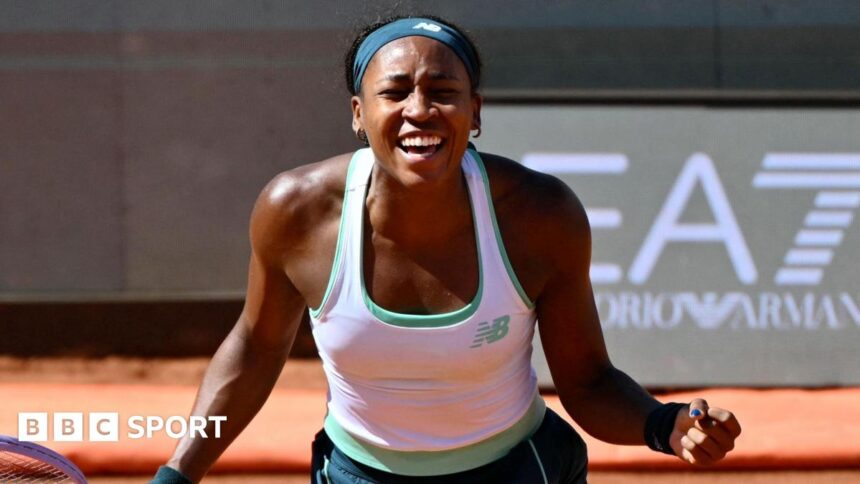
In the sweltering heat of the Foro Italico, Coco Gauff once again proved that her greatest weapon is not her forehand, her serve, or her blistering speed. It is her resolve. The reigning French Open champion stared down the barrel of an early exit in Rome, saving a match point against a fearless 18-year-old American compatriot, Iva Jovic, to scrape through to the quarter-finals. The final scoreline of 5-7, 7-5, 6-2 flatters the world number four. For long stretches, Gauff was outplayed, outhit, and on the verge of a stunning defeat.
Yet, she survived. That is the headline. But for anyone watching closely, the warning signs are flashing like a Roman traffic light. If Gauff is to successfully defend her Roland Garros crown—a title that begins its defence on 24 May—she must find a level of tennis that has been conspicuously absent in her first two matches in the Italian capital.
Houdini Act in Rome: How Gauff Escaped Against Jovic
Let’s be brutally honest: for most of the first set and a half, Coco Gauff looked like a player carrying the weight of expectation rather than the freedom of a champion. Iva Jovic, ranked outside the top 200 and playing in only her second WTA 1000 event, came out swinging with the audacity of youth. She dictated play from the baseline, hammering winners past a flat-footed Gauff.
The first set slipped away 7-5 after a series of unforced errors from Gauff’s racquet. The second set was worse. Trailing 5-3 and facing Jovic serving for the match, Gauff’s title defence in Rome looked over. Then came the turning point. At 30-40, match point down, Gauff dug deep. A deep return forced a Jovic error, and the momentum shifted like a Mediterranean tide.
“I just tried to get one more ball in,” Gauff said after the match. “Iva played incredible tennis. I just had to find a way to stay in the point.”
That is the hallmark of a champion—winning when you are playing poorly. But it is also a dangerous habit. Gauff won the final eight games of the match, a testament to her fitness and mental fortitude, but the performance left more questions than answers.
The Alarming Pattern: Slow Starts and Sloppy Errors
This was not an isolated incident. In the previous round, Gauff also dropped the first set against Argentina’s Solana Sierra, another qualifier ranked outside the top 100. Against Sierra, Gauff recovered to win in three sets. Against Jovic, she did the same. But the pattern is unmistakable: Gauff is starting matches in a fog.
Statistically, the numbers are concerning. In her two matches in Rome, Gauff has committed over 50 unforced errors. Her first-serve percentage has dipped below 55% in critical moments. Against Jovic, she was broken four times in the first set alone. The forehand, long considered a work in progress, remains a liability under pressure. Too often, she resorts to pushing the ball deep rather than taking the initiative.
- First-serve percentage: Below 55% in both matches
- Unforced errors: 28 in the first set against Jovic
- Break points converted: Just 5 of 14
The mental toughness is elite. The technical execution is not. If Gauff faces a top-10 opponent in the later rounds of Rome—or, more critically, in Paris—those slow starts will be irrecoverable. You cannot give Iga Swiatek, Elena Rybakina, or Aryna Sabalenka a set and a break lead and expect to survive.
Gauff’s French Open Challenge: What Needs to Change
The clay court season is a marathon, not a sprint. Gauff’s run to the Italian Open final last year was a career highlight, where she eventually lost to Italy’s own Jasmine Paolini in a thrilling three-setter. That result announced her as a genuine contender on the surface. She followed it up with a maiden Grand Slam title at the French Open, cementing her status as the next great American hope.
But tennis is a sport of constant evolution. Opponents have studied Gauff’s game. They know her patterns. They know that if you can target her forehand wing and force her to generate pace, she will eventually crack. Jovic did exactly that for a set and a half. So did Sierra. The difference was that both ran out of steam, physically and emotionally.
At Roland Garros, the matches are best-of-three sets from the first round. The depth of the draw is relentless. Gauff cannot rely on her opponents fading. She must develop a more aggressive mindset from the first ball. Specifically, she needs to:
- Improve forehand consistency: She must trust the shot and step into the court.
- Increase first-serve percentage: Free points on clay are rare; she needs to set up points.
- Shorten points: She is defending too much. On clay, she should be the aggressor.
The good news? Gauff is aware of these flaws. She is a student of the game, constantly tweaking her technique with coach Brad Gilbert. The bad news? The French Open is less than three weeks away. Time is running out to find her best form.
Expert Analysis: A Champion’s Grit vs. Technical Fragility
As a journalist who has covered Grand Slam tennis for over a decade, I can say this: winning ugly is a skill. Some players never learn it. Gauff has mastered it. Her ability to problem-solve mid-match, to adjust her tactics, and to raise her intensity when down is reminiscent of a young Serena Williams. She has the heart of a lion.
However, there is a fine line between grit and luck. Against Jovic, Gauff was lucky that her opponent was an inexperienced teenager who tightened up when serving for the match. A seasoned veteran would have closed the door. In Paris, every opponent from the quarter-finals onward will be a seasoned veteran.
Gauff’s draw in Rome now opens up. With several top seeds already eliminated, she has a genuine chance to reach the final again. But the path requires her to play significantly better. If she can string together two or three clean matches, the confidence will return. If she continues to rely on Houdini escapes, the Roman sun will eventually set on her run.
My prediction: Gauff will reach the semi-finals in Rome, but she will lose to a power hitter like Danielle Collins or a crafty clay-courter like Beatriz Haddad Maia. The experience will be valuable, but it will expose the same technical issues. For the French Open, I see her as a dangerous floater—capable of beating anyone on a good day, but vulnerable to an early upset if she draws a hot-handed opponent in the first week.
Strong Conclusion: The Clock is Ticking
Coco Gauff avoided the Rome exit. She showed the resilience of a champion, the fight of a warrior, and the spirit of a born competitor. But in the brutal world of elite tennis, survival is not enough. She must improve. The margin for error is shrinking with every passing match.
The French Open trophy is waiting to be defended. But right now, the path to holding it aloft again looks perilous. Gauff has the mental tools to win multiple Grand Slams. The question is whether she can refine the technical ones in time. The next two weeks in Rome and the subsequent preparation period will define her season.
For the fans, the heart races. For the analysts, the notes are written. For Coco Gauff, the work is just beginning. One thing is certain: she will not go quietly. And that, perhaps, is the most dangerous quality of all.
Source: Based on news from BBC Sport.