IndyCar Overhauls Full Course Yellow Protocol After Alexander Rossi’s Dangerous Stalled Car Saga at Sonsio Grand Prix
In a move that feels both overdue and instantly controversial, IndyCar Officiating has once again rewritten its playbook mid-season. Following a harrowing sequence of events during Saturday’s Sonsio Grand Prix at Indianapolis Motor Speedway, the series announced a sweeping change to how it deploys full-course yellow flags. The new directive: race control will no longer consider pit windows or the running order of cars when deciding whether to throw a caution. This is a direct, and some would say necessary, reaction to the Alexander Rossi incident that left a stalled car sitting dead on the start-finish line while the field raced past at 170 mph.
- The Incident That Broke the Camel’s Back: Rossi’s Hybrid Failure at IMS
- What the New IndyCar Full Course Yellow Rule Actually Changes
- Expert Analysis: Why This Change Was Inevitable—and Dangerous That It Wasn’t Made Sooner
- Predictions: How the New Yellow Flag Protocol Will Reshape the 2026 Season
- Strong Conclusion: A Necessary Evolution for IndyCar’s Safety Culture
For fans who watched the drama unfold, the moment was stomach-churning. For the drivers, it was a glaring example of a safety protocol that prioritized strategy over survival. Let’s break down exactly what happened, why the rule changed, and what this means for the rest of the 2026 IndyCar season.
The Incident That Broke the Camel’s Back: Rossi’s Hybrid Failure at IMS
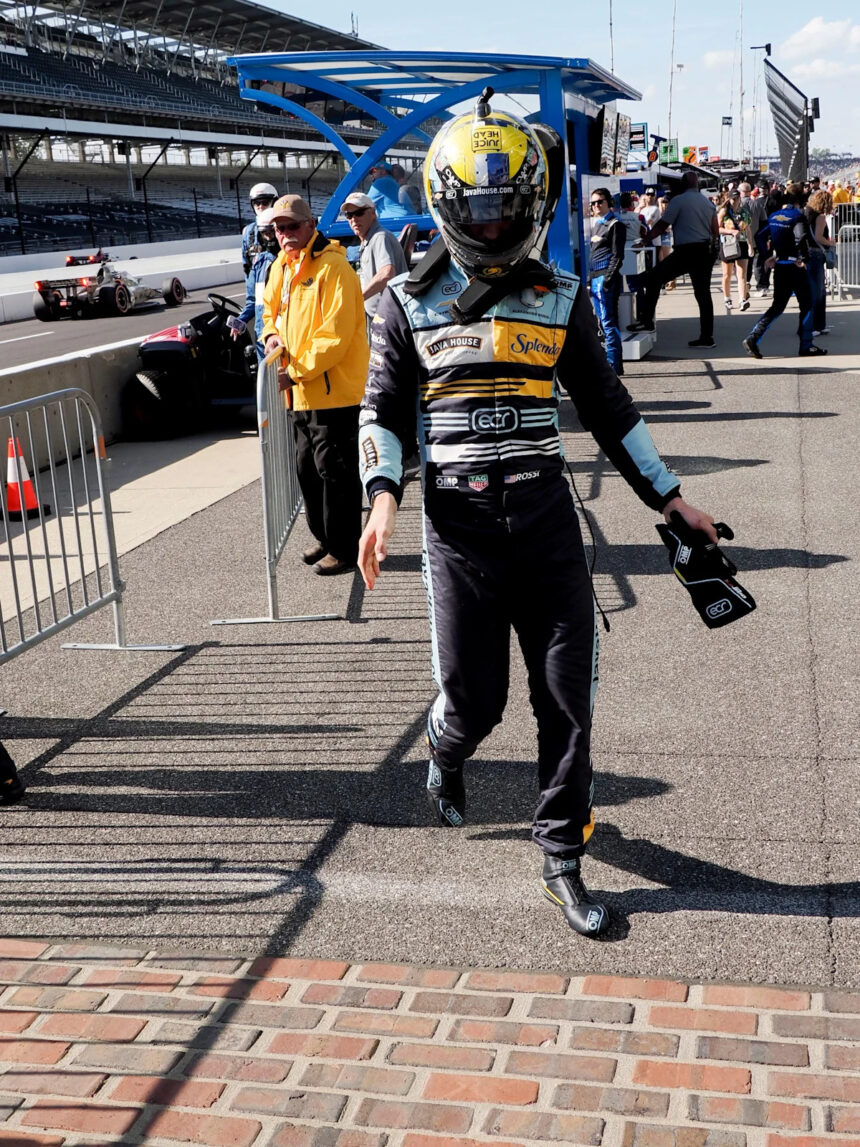
The trouble began on Lap 21 of the Sonsio Grand Prix. Alexander Rossi, piloting the No. 20 Chevrolet for Ed Carpenter Racing, suffered a sudden hybrid system failure as he crossed the start-finish line. The car went completely dead. No power. No steering assist. No way to move. Rossi was parked directly on the racing line of the IMS road course, a spot where drivers accelerate hard toward Turn 1.
What happened next sparked immediate outrage. IndyCar race control opted to deploy only a local yellow in the immediate vicinity of the stalled car. This meant that while the corner workers waved flags at that specific sector, the rest of the 2.439-mile circuit remained green. Drivers approaching the front straight were forced to navigate around a stationary race car—with no lights, no engine, and a driver still inside—at full racing speed.
Rossi eventually exited the car and, in a moment of self-preservation, hopped over the pit lane wall. Only then did race control escalate the situation to a full-course caution. The delay was measured in seconds, but in motorsport, seconds can be fatal.
Rossi’s post-race comments on Fox were blistering:
- “The fact that it took that long to throw a full-course yellow, when a car’s on the front straight and people are going by at 170 miles an hour, also seems insane.”
- “When they don’t let us drive in the wet yesterday… So, I don’t really know where the priorities lie. So pretty frustrated.”
Rossi’s frustration was not just about the danger. It was about the inconsistency. The previous day, IndyCar had controversially called a session off due to light rain. Yet here, on a dry track, they allowed a stationary car to become a target.
What the New IndyCar Full Course Yellow Rule Actually Changes
The rule change is simple in wording but seismic in application. Moving forward, IndyCar Officiating will no longer take pit windows and the running orders of cars into consideration when deciding whether to deploy a full-course yellow. In plain English: they will not wait to see if a caution would hurt a driver’s strategy or benefit another. If a car is stopped in a dangerous position, the yellow flag flies immediately.
This is a direct admission that the previous approach was flawed. During the Sonsio Grand Prix, race control was reportedly weighing the impact of a full-course caution on the pit cycle. A yellow at Lap 21 would have bunched the field, negated the advantage of drivers who had already pitted, and handed a free stop to those who had not. That kind of strategic calculus should never enter the equation when a driver’s life is at risk.
Key elements of the new protocol:
- Immediate deployment: A full-course yellow will be called the moment a car is deemed immobile in a high-speed zone, regardless of track position.
- No strategy interference: Race control will not factor in pit windows, lap counts, or championship implications.
- Driver safety first: The decision will be based solely on the location and severity of the incident.
This change effectively removes the grey area that has plagued IndyCar officiating for years. It also puts the series in line with global standards seen in Formula 1 and the FIA World Endurance Championship, where a stationary car on a racing line triggers an immediate Virtual Safety Car or full-course yellow.
Expert Analysis: Why This Change Was Inevitable—and Dangerous That It Wasn’t Made Sooner
As a journalist who has covered IndyCar for over a decade, I can tell you that the tension between race control decisions and driver safety has been simmering for years. The Rossi incident was not an isolated failure; it was the culmination of a culture that prioritized entertainment and strategic nuance over basic hazard management.
Let’s look at the math. At 170 mph, a car covers roughly 250 feet per second. If a driver crests the hill on the back straight and sees Rossi’s car for the first time, they have less than a second to react. A local yellow does not slow down the cars approaching from behind. It only warns the drivers in that specific zone. But if a car is already committed to a corner or distracted by a battle, that warning may come too late.
What the new rule fixes:
- Predictability: Drivers now know that any stationary car in a high-speed area will trigger a full-course caution. This removes the guesswork from their mental checklist.
- Marshaling safety: Corner workers and safety crews can approach the scene without worrying about traffic flying past at race speed.
- Championship integrity: While some will argue that this “artificially” bunches the field, it actually ensures the race is decided by driver skill, not by who gets lucky with a delayed caution.
The irony is that IndyCar has some of the best safety technology in the world—from the aeroscreen to the HANS device—but the officiating has lagged behind. This rule change is a step toward closing that gap.
Predictions: How the New Yellow Flag Protocol Will Reshape the 2026 Season
Now that the full-course yellow guidelines have been rewritten, expect immediate ripple effects across the paddock. Here are my predictions for how this will play out:
1. More cautions, shorter green-flag runs. Teams will need to adjust their pit strategies. Previously, a driver with a mechanical issue could crawl to a safe zone, hoping race control would hold the yellow. Now, if you stall in a bad spot, the caution comes instantly. This will lead to more frequent, shorter cautions, which could make races more chaotic—and more exciting.
2. Strategic gambling will decrease. Under the old system, teams sometimes gambled on staying out under yellow, hoping the caution would end before they lost a lap. With immediate full-course yellows, that gamble becomes less profitable. Expect more conservative pit calls, especially on road and street courses.
3. Driver trust will slowly return. Rossi’s comments reflected a broader sentiment among drivers that race control was not listening to them. This change signals that the series is willing to adapt. Over time, drivers will feel safer pushing the limits, knowing that the officiating has their back.
4. Controversy will shift to other areas. Let’s be honest: IndyCar fans love a good officiating debate. With this issue resolved, expect the conversation to move to restarts, push-to-pass usage, and track limits. There will always be something to argue about.
Strong Conclusion: A Necessary Evolution for IndyCar’s Safety Culture
The Alexander Rossi incident at the Sonsio Grand Prix was a wake-up call that IndyCar could not afford to ignore. A stalled car on the front straight at 170 mph is not a strategic puzzle. It is a life-threatening hazard. The fact that race control hesitated—even for a few seconds—speaks to a systemic problem that has now been addressed.
This rule change is not about punishing teams or altering the entertainment value of the sport. It is about ensuring that every driver who straps into an IndyCar knows that the series will prioritize their safety over the championship standings. It is about consistency. It is about trust.
Rossi’s frustration was valid. But his voice, combined with the public pressure from fans and media, has forced a change that will make the series safer for everyone. The 2026 season is still young, but this moment will be remembered as the turning point where IndyCar finally put safety ahead of strategy.
As the series heads to the next round, one thing is clear: the yellow flag will fly faster than ever before. And that is exactly how it should be.
Source: Based on news from Yahoo Sports.