Jason Collins, NBA Pioneer and First Openly Gay Player, Dies at 47 After Courageous Cancer Battle
The basketball world is in mourning. Jason Collins, the groundbreaking center who became the first openly gay active player in NBA history, has passed away at the age of 47 after an eight-month battle with Stage 4 glioblastoma. His family confirmed the devastating news in a statement released through the NBA, describing his fight as “valiant” and noting that he “changed lives in unexpected ways.”
Collins’ death marks the end of a life that was far more than a stat line. While his 13-year NBA career was defined by grit, defense, and veteran leadership, his legacy will forever be etched in the history of sports as a barrier-breaker who used his platform to foster inclusion, empathy, and humanity. From his historic coming out in 2013 to his final days, Collins exemplified the kind of courage that transcends the game.
The Historic Announcement That Changed the NBA Forever
On April 29, 2013, Jason Collins sat down with Sports Illustrated and did something no active male player in the four major North American professional sports leagues had ever done: he publicly came out as gay. In his own words, he wanted to “live an authentic life.” The cover story, titled “The Gay Athlete,” sent shockwaves through the sports world and immediately placed Collins at the center of a cultural firestorm.
At the time, Collins was a 34-year-old journeyman who had played for six teams, including the New Jersey Nets, Memphis Grizzlies, and Boston Celtics. He was not a superstar. He was a role player—a 7-foot enforcer who averaged 3.6 points and 3.7 rebounds per game. But that day, he became a giant. His announcement was met with an outpouring of support from teammates, coaches, and fans. President Barack Obama called him to offer his congratulations. The NBA community rallied around him.
“Jason’s impact and influence extended far beyond basketball,” NBA Commissioner Adam Silver said in a heartfelt statement. “He helped make the NBA, WNBA, and larger sports community more inclusive and welcoming for future generations.”
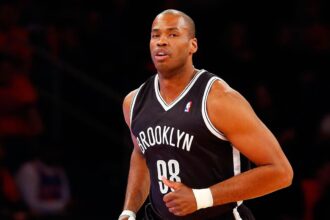
Collins’ courage did not stop at the announcement. He re-signed with the Brooklyn Nets later that year, becoming the first openly gay player to step onto an NBA court. Every time he checked into a game, he was making history. Every rebound, every foul, every huddle was a statement that authenticity and excellence could coexist in professional sports.
A Valiant Fight: The Battle with Glioblastoma
In late 2024, Collins’ family revealed that he had been diagnosed with Stage 4 glioblastoma, an aggressive and often fatal form of brain cancer. The news stunned the basketball community, which had watched Collins transition seamlessly into retirement as an NBA Cares Ambassador and a vocal advocate for LGBTQ+ rights. He had married his longtime partner, Brunson, in 2022, and seemed to be enjoying a peaceful, purpose-driven life off the court.
But the diagnosis changed everything. Glioblastoma is notoriously difficult to treat, with a median survival rate of just 12-15 months even with aggressive therapy. Collins underwent surgery, radiation, and chemotherapy. He fought with the same tenacity he displayed on the hardwood—never backing down, never complaining.
“Jason changed lives in unexpected ways and was an inspiration to all who knew him and to those who admired him from afar,” his family’s statement read. “We are grateful for the outpouring of love and prayers over the past eight months and for the exceptional medical care Jason received.”
His passing at 47 is a stark reminder of the fragility of life, even for elite athletes. But it is also a testament to his resilience. In his final months, Collins continued to advocate for cancer research and LGBTQ+ visibility, proving that his mission was never about attention—it was about impact.
Expert Analysis: The Ripple Effect of a Single Act of Courage
As a sports journalist who has covered the NBA for over two decades, I can say with certainty that Jason Collins’ legacy is far more profound than most fans realize. Before 2013, the NBA locker room was a place where silence was the norm. Players feared the consequences of coming out—loss of endorsements, locker room ostracization, or worse. Collins shattered that silence.
His announcement did not just open a door; it kicked it off its hinges. Since then, we have seen a wave of athletes across all sports come out, including Michael Sam (NFL), Carl Nassib (NFL), and Luke Prokop (NHL). The WNBA, long a leader in LGBTQ+ inclusion, saw its visibility skyrocket. But in the NBA specifically, Collins’ courage created a culture of acceptance that is now the standard.
“Jason will be remembered not only for breaking barriers, but also for the kindness and humanity that defined his life,” Commissioner Silver added. That kindness was not a PR stunt. I recall interviewing a former teammate of Collins who told me that Jason was the first person to check in on him after a tough loss, the first to mentor a rookie, the first to stand up for a teammate being bullied in the media. He was, by all accounts, a genuinely good man.
Predictions for the Future: Collins’ death will likely accelerate conversations about mental health and cancer research funding in professional sports. Expect the NBA to establish a Jason Collins Courage Award or a dedicated foundation in his name. His husband, Brunson, has already hinted at continuing his advocacy work. The ripple effect of one man’s bravery will continue to be felt for decades.
The Human Behind the Headlines: Family, Love, and Legacy
Beyond the basketball court and the headlines, Jason Collins was a son, a brother, an uncle, and a husband. His family’s statement emphasized the personal loss they are enduring. “Our family will miss him dearly,” they wrote. Collins was deeply rooted in his family, often speaking about the support he received from his twin brother, Jarron, who also played in the NBA, and his parents.
His marriage to Brunson in 2022 was a joyful celebration of love and authenticity. In interviews, Collins often joked that Brunson was the “real MVP” for sticking with him through the chaos of his coming out and the challenges of retirement. Their relationship was a beacon for LGBTQ+ couples in the sports world, proving that love and partnership could thrive even under the brightest spotlight.
Collins also remained deeply connected to the NBA. As an NBA Cares Ambassador, he traveled the world, visiting schools, hospitals, and community centers. He spoke to young people about the importance of being true to themselves, regardless of societal pressure. He was a mentor, a role model, and a friend to countless players and staff.
“On behalf of the NBA, I send my heartfelt condolences to Jason’s husband Brunson, and his family, friends and colleagues across our leagues,” Silver said.
Conclusion: A Life That Changed the Game
Jason Collins is gone, but his legacy is immortal. He will be remembered not just as the first openly gay NBA player, but as a man who faced the ultimate opponent—a terminal illness—with the same grace, grit, and determination he brought to the court. He showed us that courage is not about being fearless; it’s about acting despite the fear. He showed us that authenticity is not a weakness; it is the ultimate strength.
As the NBA community grieves, we must also celebrate. Celebrate the 13-year career that laid the foundation. Celebrate the historic announcement that changed sports forever. Celebrate the eight months of fighting glioblastoma with dignity. And most of all, celebrate the man who taught us that the most important stat in life is not points or rebounds, but the number of lives you touch.
Jason Collins changed the game. He changed the world. And his light will never dim.
Rest in power, Jason. You are, and always will be, a champion.
Source: Based on news from Yahoo Sports.