Job of LIV Chiefs to Fix Breakaway Circuit – Rahm
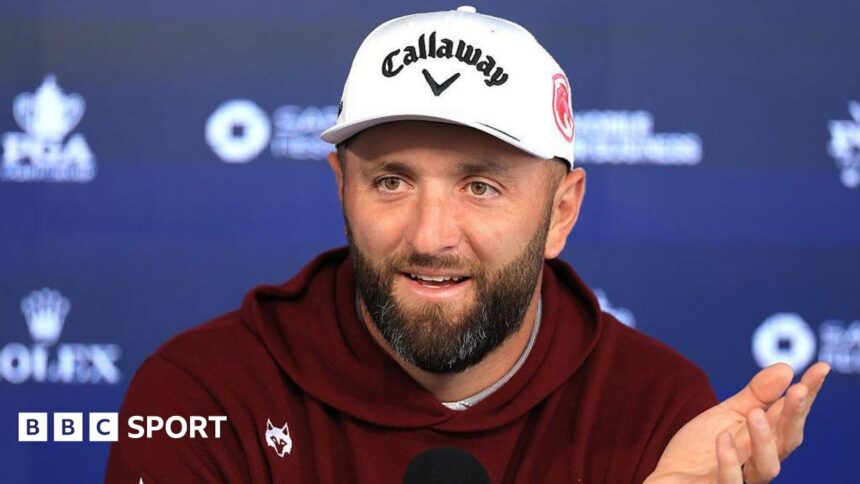
Two-time major champion Jon Rahm has delivered a stark reality check for the breakaway LIV Golf circuit, admitting that the task facing its leadership to secure the league’s future is unenviable. The Spanish star, who famously jumped ship from the PGA Tour in December 2023 for a reported £222m ($300m), has broken his silence on the seismic financial shake-up that threatens the very existence of the Saudi-backed series.
Speaking candidly about the league’s uncertain horizon, Rahm stated he does not envy the job of LIV’s chiefs but remains confident they will find a solution to ensure its survival. His comments come just weeks after Saudi Arabia’s Public Investment Fund (PIF) announced it will withdraw its multi-billion dollar backing at the end of the year—a move that has sent shockwaves through the golfing world.
As the circuit scrambles to reinvent itself, Rahm’s perspective offers a unique insider’s view: the man who was once the poster child for LIV’s ambition is now watching the league fight for its life. This article breaks down the crisis, Rahm’s measured response, and what the future holds for the rebel tour.
The PIF Pullout: A Defining Moment for LIV Golf
The bombshell announcement that the Public Investment Fund would withdraw its financial backing at the end of 2025 has left LIV Golf in a precarious position. For three years, the Saudi sovereign wealth fund had been the league’s financial backbone, bankrolling astronomical signing bonuses and record-breaking purses that lured stars like Rahm, Phil Mickelson, and Brooks Koepka away from the PGA Tour.
In response, LIV announced a “strategic evolution”—including the establishment of a newly independent board tasked with finding replacement financial investors. This board, which includes former executives from global sports and entertainment, now carries the weight of the entire circuit on its shoulders.
- Financial Reality: Without PIF’s multi-billion dollar injection, LIV’s current business model—which relies on guaranteed prize money and no-cut events—is unsustainable.
- Investor Hunt: The league is actively courting private equity firms, sovereign wealth funds from other nations, and high-net-worth individuals to fill the gap.
- Player Anxiety: Many players who signed long-term contracts are now privately questioning the security of their deals, though Rahm publicly remains optimistic.
Rahm’s stance is telling. “I don’t envy the job of the people in charge right now,” he said. “But I have faith they will figure it out. They’ve done a lot in a short time.” Yet, faith alone does not pay the bills. The clock is ticking.
Rahm’s Unique Position: Star Recruit to Crisis Witness
When Jon Rahm signed with LIV in December 2023, it was hailed as the circuit’s greatest coup. The 31-year-old had already won two of golf’s majors—the 2021 US Open and the 2023 Masters—and was widely considered the best player in the world. His defection legitimized LIV as a genuine rival to the PGA Tour.
Now, less than two years later, Rahm finds himself in an awkward position. He is both the league’s most valuable asset and a living symbol of its fragility. His words carry weight because he has the most to lose: a reported $300m contract that depends on the league’s survival.
Expert Analysis: Rahm’s public confidence is likely a calculated move to stabilize the brand. If he starts panicking, the entire house of cards could collapse. But behind the scenes, sources suggest he is closely monitoring the investor search. “Jon is smart,” said a former Tour executive. “He knows that if LIV dies, his contract is essentially a piece of paper.”
Yet Rahm’s game has not suffered. He remains a contender every time he tees it up, recently finishing inside the top 10 at the LIV event in Hong Kong. His focus on the course is a testament to his professionalism, but the off-course drama is impossible to ignore.
The Strategic Evolution: Can LIV Survive Without Saudi Money?
LIV’s newly formed independent board faces a Herculean task. Their mission is to transform a league built on unlimited Saudi wealth into a self-sustaining commercial entity. The “strategic evolution” includes several key pillars:
- New Revenue Streams: Aggressive sponsorship deals, broadcast rights negotiations, and expanded merchandise sales.
- Cost Cutting: Potential reduction in team budgets, smaller travel perks, and a leaner operational structure.
- Global Expansion: Targeting new markets in Asia and the Middle East to attract local investors.
However, the biggest hurdle is credibility. LIV has never turned a profit. Its viewership numbers, while growing, still lag far behind the PGA Tour. And the stigma of being a “Saudi sportswashing project” makes it difficult to attract mainstream corporate sponsors.
Prediction: The most likely outcome is a partial merger or investment from another sovereign wealth fund—perhaps from the UAE or Qatar. Alternatively, a media giant like Endeavor or Discovery could step in to acquire a controlling stake. But a full collapse is still on the table if no viable investor emerges by mid-2025.
Rahm’s confidence may be rooted in private assurances from LIV CEO Greg Norman and PIF governor Yasir Al-Rumayyan. But public statements from PIF have been deliberately vague, leaving the door open for a complete exit.
What This Means for Golf’s Future: A Power Shift or a Reset?
The uncertainty surrounding LIV has already reshaped the landscape of professional golf. The PGA Tour, which spent billions fighting the rebel circuit, is now in a position of strength. Tour commissioner Jay Monahan has been quietly re-signing top players to loyalty deals, and the Tour’s new “Signature Events” have raised prize money to compete with LIV’s offerings.
For Rahm, the stakes are personal. If LIV folds, he will likely be forced to apply for reinstatement to the PGA Tour—a process that could involve fines, suspensions, or a lengthy legal battle. The Tour has already made it clear that defectors will not be welcomed back with open arms.
Yet Rahm remains defiant. “I made a choice, and I stand by it,” he said recently. “LIV has given me the freedom to play the schedule I want and spend more time with my family. That matters.”
Expert Analysis: The next six months will be decisive. If LIV secures a new investor by the end of 2025, the circuit will survive—albeit in a scaled-down form. If not, the breakaway experiment will be remembered as a short-lived, expensive disruption that ultimately failed to change golf’s power structure.
Rahm’s role in this drama cannot be overstated. As the highest-paid player in the league, his continued presence is a signal to potential investors that the product still has star power. But he cannot single-handedly save the circuit. That job falls to the chiefs he does not envy.
Conclusion: The Clock Is Ticking
Jon Rahm’s words are a masterclass in diplomacy—expressing faith in LIV’s leadership while acknowledging the gravity of the situation. But beneath the calm exterior, a storm is brewing. The breakaway circuit that promised to revolutionize golf is now fighting for its very existence.
The job of LIV’s chiefs is not just to fix a broken business model; it is to convince the world that a league built on Saudi billions can stand on its own feet. Rahm, for his part, is betting his legacy—and his $300m contract—that they can.
Whether they succeed or fail will determine not just the fate of one league, but the entire future of professional golf. And as the deadline approaches, all eyes are on the boardroom, not the fairway.
Final Prediction: LIV will survive, but in a radically different form—likely as a smaller, invitation-only series backed by a consortium of investors rather than a single sovereign fund. Rahm will remain the face of the league, but his paychecks may look very different. The era of unlimited Saudi money is over. The era of accountability has begun.
Source: Based on news from BBC Sport.