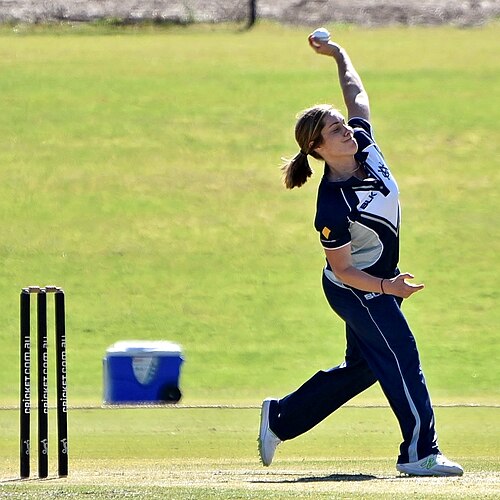
Sophie Molineux to Lead as Australia Drop Darcie Brown for Women’s T20 World Cup 2026
The landscape of Australian women’s cricket has officially shifted. In a move that signals both a changing of the guard and a tactical recalibration, Cricket Australia has announced its 15-player squad for the 2026 ICC Women’s T20 World Cup, with Sophie Molineux appointed as captain. The most eye-catching decision? The omission of express pace bowler Darcie Brown, a player once considered the future of the attack.
- The Molineux Era Begins: Why This Leadership Shift Matters
- The Big Call: Dropping Darcie Brown and the Pace Paradox
- Grace Harris and Annabel Sutherland: The Return of the Match-Winners
- Expert Analysis: Strengths, Weaknesses, and the Path to Victory
- Predictions for the 2026 T20 World Cup
- Conclusion: A New Identity, Same Ambition
This squad, set to defend Australia’s crown on home soil, is a fascinating blend of proven champions, rising stars, and strategic pivots. With Ashleigh Gardner and Tahlia McGrath named as vice-captains, the leadership group has a new, multi-dimensional feel. Let’s break down every detail of this seismic squad announcement.
The Molineux Era Begins: Why This Leadership Shift Matters
The retirement of Alyssa Healy left a void that was always going to be impossible to fill with a like-for-like replacement. Healy was more than a wicketkeeper-batter; she was the emotional engine of the side. However, the selection of Sophie Molineux as captain is a masterstroke of strategic thinking. Molineux is not the loudest voice in the room, but she is arguably the most respected.
Molineux, a left-arm orthodox spinner and a reliable middle-order batter, brings a calm, analytical approach to leadership. Her experience in the WBBL and on the international stage, including her pivotal role in Australia’s 2020 T20 World Cup triumph, makes her a natural fit. This is not a caretaker appointment; this is a long-term investment in a tactical leader.
Why Molineux over Gardner or McGrath? The answer lies in balance. By appointing Ashleigh Gardner and Tahlia McGrath as vice-captains, Australia creates a triumvirate that covers every base. Gardner brings the aggressive, game-breaking energy. McGrath brings the hard-nosed, all-round reliability. Molineux provides the steady hand. It is a leadership structure built for high-pressure knockout cricket.
What Molineux Brings to the Captaincy
- Tactical Acumen: Known for her deep game awareness, especially in the field, Molineux reads the game like a chess grandmaster. Her bowling changes and field placements are rarely reactive; they are premeditated.
- Bowling Versatility: As a spinner who can bowl in the powerplay, the middle overs, and even at the death, she gives the team incredible flexibility. She can be the defensive anchor or the attacking wicket-taker.
- Batting Depth: While not a power-hitter like Healy, Molineux is a composed finisher. Her ability to rotate strike and build partnerships in a collapse is underrated.
The Big Call: Dropping Darcie Brown and the Pace Paradox
The most debated topic in Australian cricket circles right now is the exclusion of Darcie Brown. At just 22 years old, Brown possesses genuine raw pace—consistently clocking over 130 km/h. In previous years, she was viewed as the heir to Megan Schutt’s throne. So, why is she out of the World Cup squad?
The answer is not about talent; it is about control and consistency. In recent bilateral series, Brown’s economy rate has ballooned. In T20 cricket, where every run is precious, a bowler who leaks boundaries while searching for wickets becomes a luxury Australia cannot afford. The selectors have clearly prioritized line-and-length discipline over outright speed.
Instead of Brown, the selectors have backed a pace attack built on precision. Megan Schutt remains the non-negotiable leader of the attack. She is the best powerplay bowler in the world, period. Alongside her, Kim Garth offers a similar profile: economical, swing-friendly, and reliable. The surprise inclusion is Lucy Hamilton, a left-arm seamer who has been turning heads in domestic cricket.
Lucy Hamilton: The Left-Arm X-Factor
Hamilton’s selection is the most exciting wildcard. A left-arm swing bowler who can move the ball both ways, she offers something Australia has lacked: a different angle of attack. In the WNCL and WBBL, Hamilton has consistently troubled right-handed batters with her away swing and left-handers with her sharp in-duckers. She is not as quick as Brown, but her bowling intelligence is significantly more advanced for her age. Expect to see her used as a first-change bowler to break partnerships.
Grace Harris and Annabel Sutherland: The Return of the Match-Winners
Two massive names return to the T20 squad: Grace Harris and Annabel Sutherland. Their inclusion fundamentally changes the batting lineup’s ceiling.
Grace Harris is the definition of a game-changer. She can win a match in a single over with her brutal power-hitting. However, her previous omission from the T20 side was due to inconsistency and a perceived weakness against high-quality spin. In the lead-up to 2026, Harris has worked tirelessly on her sweep shots and her ability to rotate strike against slower bowlers. She is not just a pinch-hitter anymore; she is a genuine middle-order enforcer who can bat at No. 4 or No. 5.
Annabel Sutherland is arguably the most complete all-rounder in the squad. She bowls consistent medium-pace, fields brilliantly in the ring, and bats with a maturity beyond her years. Her return adds batting depth that allows the top order to play with more freedom. Sutherland can bat anywhere from No. 3 to No. 7, making her the ultimate utility player in the XI.
Projected Top Seven Batting Order
- 1. Beth Mooney (wk) – The world’s best T20 batter. Her consistency is the backbone of the chase.
- 2. Phoebe Litchfield – The young left-hander who can dismantle attacks in the powerplay.
- 3. Tahlia McGrath (vc) – The power-hitter who anchors the innings.
- 4. Ashleigh Gardner (vc) – The destroyer of spin. She will target the middle overs.
- 5. Grace Harris – The X-factor. If she fires, the game is over.
- 6. Annabel Sutherland – The finisher and the fifth bowling option.
- 7. Sophie Molineux (c) – The captain who provides stability and tactical bowling.
Expert Analysis: Strengths, Weaknesses, and the Path to Victory
On paper, this is a squad built for a home World Cup. The balance of spin and seam, the depth of batting, and the experience of the leadership group are formidable. However, no squad is perfect. Let’s look at the critical factors.
Strengths
- Spin Dominance: With Molineux, Gardner, and potentially Georgia Wareham, Australia can strangle teams in the middle overs. On Australian pitches that historically assist turn, this is a massive advantage.
- Batting Depth: The top seven can all score at a strike rate of over 120. There is no “weak link” in the batting order. This allows the team to take risks early, knowing the lower order can rebuild.
- Fielding: This is one of the most athletic fielding units in the world. Gardner, Litchfield, and Sutherland are exceptional in the deep, while Mooney is elite behind the stumps.
Weaknesses
- Powerplay Wickets: Without Darcie Brown’s raw pace, the new-ball attack relies heavily on Schutt and Garth. If they fail to strike early, Australia could struggle to contain aggressive openers like India’s Smriti Mandhana or England’s Danni Wyatt.
- Death Bowling: While Schutt is a master at the death, she cannot bowl all four overs. Who bowls the 18th and 20th overs? Gardner’s off-spin can be targeted, and Sutherland’s pace can be predictable. This is the one area where the squad looks vulnerable.
- Injury Concerns: Molineux has a history of knee issues. If she breaks down, the captaincy and the spin attack are disrupted. The selectors have no specialist backup spinner in the squad.
Predictions for the 2026 T20 World Cup
Australia enters this tournament as the overwhelming favorite. The combination of home advantage, a settled leadership group, and a batting lineup that can score 180+ on any given day makes them the team to beat. However, the margin for error is razor-thin.
Key Matchup: Australia vs. India. India’s spin-heavy attack (led by Deepti Sharma and Radha Yadav) will test Australia’s middle order. If Harris and Sutherland can dominate the spin, Australia wins. If not, India has the firepower to pull off an upset.
Player to Watch: Lucy Hamilton. If she can take 3-4 wickets in the group stage, she will cement her place in the knockout XI. Her left-arm angle could be the difference in a tight semi-final.
Bold Prediction: Australia will reach the final undefeated, but they will lose a group-stage match to England due to a middle-order collapse. They will then win the final against India by 15 runs, with Molineux taking Player of the Match honors for a 3-wicket haul.
Conclusion: A New Identity, Same Ambition
The dropping of Darcie Brown is a brave, controversial, and ultimately correct decision. It signals that the selectors are prioritizing team balance over individual potential. Sophie Molineux’s captaincy is a statement: Australia will win this World Cup with brains, not just brawn.
This squad is not a tweaked version of the past; it is a reinvention. With Grace Harris providing the fireworks, Annabel Sutherland providing the glue, and Lucy Hamilton providing the surprise factor, Australia has built a squad that is both deep and dangerous. The 2026 Women’s T20 World Cup is theirs to lose. And if Sophie Molineux has anything to say about it, they won’t lose it.
Get your tickets. This is going to be a show.
Source: Based on news from Yahoo Sports.
Image: CC licensed via de.wikipedia.org