


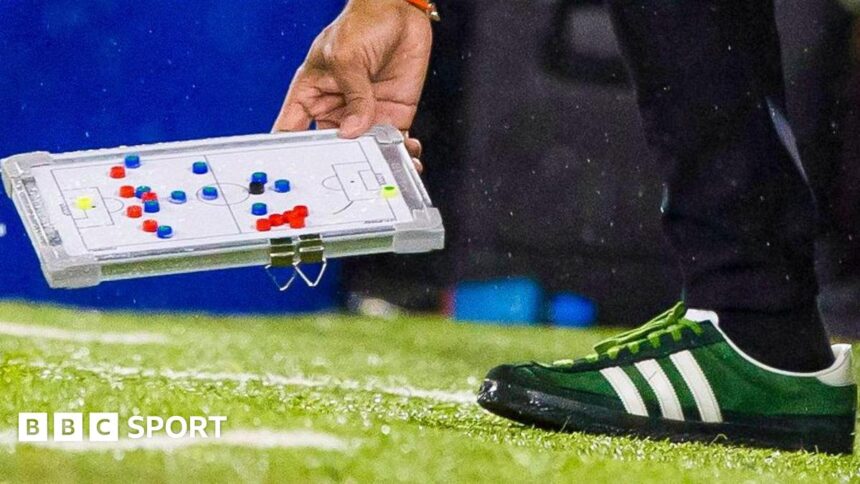
Wilfried Nancy’s Green Shoes & Tactics Board: A Bizarre Scottish Football Obsession
If you had told Wilfried Nancy that his managerial debut at Celtic would be dissected not through the prism of tactical nuance or player performance, but through the lens of his footwear and a small plastic rectangle, he would have been justified in questioning your sanity. For the uninitiated, such a focus seems absurd, a parody of sports analysis. Yet, for anyone steeped in the unique, often feverish culture of Scottish football, the week’s consternation over Nancy’s green trainers and handheld tactics board felt like a familiar, if wearying, ritual. In a land where the suit is sometimes seen as a symbol of respect and tradition can trump innovation, a new manager’s first impression is often judged by a bizarrely specific sartorial and accessory-based checklist.
The Scene of the “Crime”: A Debut Defeat Under a Microscope
Wilfried Nancy, the highly-regarded French coach tasked with steering Celtic into a new era, saw his first match end in a narrow, disappointing defeat. The post-mortem was inevitable. However, the trajectory of the conversation quickly veered from the pitch to the touchline. Cameras captured Nancy, deep in thought, clutching a small, clear handheld tactics board, scribbling notes and diagrams. On his feet, a pair of vibrant green trainers provided a splash of color against the monochrome backdrop of a tense dugout. In most footballing nations, these details would be mere footnotes—idiosyncrasies of a modern, hands-on coach. In Scotland, they became headlines.
The reaction was a cocktail of bemusement, criticism, and staunch defense. Pundits questioned whether the board was a prop or a necessity. Fans on social media debated the sartorial message of the shoes. Was the board a sign of meticulous preparation or over-complication? Were the green shoes a confident fashion statement or a disrespectful breach of unspoken dress code? The intensity of the debate revealed a deep-seated tension within the Scottish game, one that precedes Nancy’s arrival by decades.
Not the First, Won’t Be the Last: A History of Touchline Tribunals
To understand the furor, one must recognize that Nancy has unwittingly stepped into a long-running Scottish subplot: the manager’s touchline appearance. This is not a debate about football. It is a cultural litmus test.
- The Russell Martin Suit Saga: Just months earlier, Rangers’ then-manager Russell Martin was persistently criticized by a section of the support for not wearing a suit on the touchline, often opting for a club tracksuit. The criticism escalated to include his choice of brown shoes with formal wear, which some fans deemed a sartorial faux pas. This was framed, astonishingly, as a lack of gravitas or respect for the club.
- The Danny Rohl “Victory”: When Martin was replaced by Danny Rohl, the German’s decision to wear a crisp suit was heralded in some quarters as an immediate and symbolic “win.” The narrative wasn’t about his coaching pedigree, but his wardrobe. The fact that conforming to a traditional dress code was seen as a meaningful step forward laid bare the peculiar priorities at play.
- The Unwritten Rulebook: This pattern points to an unwritten Scottish football rulebook that extends beyond the laws of the game. It suggests a conservative environment where deviation from a perceived norm—be it in attire or method—is viewed with suspicion and often used as a ready-made stick with which to beat a new figure, especially after a negative result.
Nancy, with his modern tools and casual footwear, didn’t just lose a football match. He breached this unwritten code, becoming the latest protagonist in a tired, recurring drama.
Substance vs. Symbolism: What the Obsession Really Reveals
This fixation on the superficial is more than just trivia. It acts as a convenient distraction and a proxy for deeper anxieties. When a team like Celtic loses, the need for immediate, tangible explanations is overwhelming. Dissecting a complex tactical failure or squad deficiency is hard. Critiquing a pair of shoes or a coach’s prop is easy.
It also reveals a clash of footballing cultures. Nancy represents a new generation of coaches—data-informed, visually aided, and often less formal in demeanor. His mini tactics board is a tool for rapid, clear communication, a common sight in leagues across Europe and North America. His shoes are comfortable for the long, active hours of a matchday. Scottish football, however, with its intense pressure and historical weight, can be deeply traditional. The image of the manager in a suit, a commanding figure who leads through presence alone, remains powerfully ingrained.
The debate, therefore, becomes a struggle between modern coaching methods and traditionalist expectations. Is the manager a CEO in a boardroom or a technician in a workshop? The green shoes and plastic board forcefully argue for the latter, and that makes some uncomfortable.
Looking Ahead: Will the Noise Fade or Follow?
The path forward for Wilfried Nancy is clear, albeit challenging. The Scottish football media and fan landscape is unforgiving, and the spotlight on his peripherals will only intensify if results don’t swiftly improve. However, history shows us that winning is the ultimate deodorant, capable of neutralizing even the strongest stench of controversy.
- The Short-Term Prediction: The “shoe-and-board” narrative will linger for another news cycle or two, especially if Celtic stumbles again. Pundits will reference it as shorthand for Nancy’s “unconventional” start. It will be a go-to topic for talk radio until on-pitch events overtake it.
- The Long-Term Forecast: If Nancy’s methods translate into victories, attractive football, and trophies, the narrative will flip entirely. The green shoes will become a trademark of a maverick genius. The tactics board will be hailed as a symbol of his meticulous, winning mindset. They will be seen not as quirks, but as the artifacts of a successful revolution.
- The Real Test: The consternation will only truly matter if it seeps into the player’s perception or Nancy’s own confidence. A strong manager, which his pedigree suggests he is, will dismiss the noise and double down on his process. The focus must remain on translating those board diagrams into cohesive, winning performances on the grass.
Conclusion: A Distraction from the Real Theatre
The great irony of the Wilfried Nancy “controversy” is that it highlights everything except what truly matters in football. The theatre of the Scottish game is legendary for its passion, its noise, and its drama. Yet, too often, the audience gets fixated on the curtain, the stage lights, or the director’s clothes, rather than the play unfolding before them.
Nancy’s green shoes and tactics board are irrelevant to the core mission of rebuilding Celtic. They are props in a sideshow. The real story—the one of tactical philosophy, player recruitment, and navigating immense pressure—is harder to tell but infinitely more important. Scottish football’s tendency to judge a book by its cover (and its author’s shoes) is a quaint tradition, but it is one that ultimately sells the sport’s own complexity short. The hope must be that the conversation swiftly moves from what’s on Nancy’s feet and in his hands, to what he puts in the heads and hearts of the players on the pitch. That is the only analysis worthy of this famous old club, and the only consternation that should ever truly matter.
Source: Based on news from BBC Sport.

