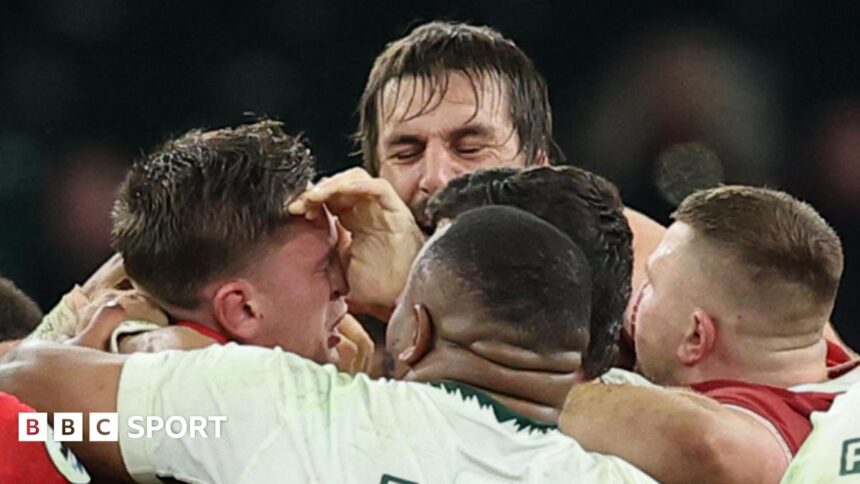
Etzebeth Breaks Silence: Springbok Star Explains Eye Contact “Mistake” That Earned 12-Week Ban
In the ruthless arena of international rugby, few names command as much respect and trepidation as Eben Etzebeth. The 2.03m, 120kg Springbok lock is the embodiment of South Africa’s physical dominance, a double World Cup-winner whose very presence can alter the course of a game. Yet, for the first time in a storied 141-test career, Etzebeth’s name is now inextricably linked to a red card and a lengthy suspension. Following a 12-week ban for making contact with the eye of Wales flanker Alex Mann, the veteran enforcer has broken his silence, calling the incident a “mistake” and offering a public explanation. This moment reveals more than just the details of a disciplinary hearing; it exposes the fragile line between controlled aggression and catastrophic error in the sport’s most brutal contests.
A Career First: The Incident That Marred a Record Win
The setting was Twickenham on November 29, 2024, a day destined to be remembered for South Africa’s staggering 73-0 demolition of Wales. In the 73rd minute, with the result long beyond doubt, a routine clearing kick from Wales saw Etzebeth and Mann tussle for position. What followed was a brief, ugly exchange captured by multiple camera angles. As Mann attempted to clear out the ruck, Etzebeth’s left hand made clear contact with the Welshman’s face, his fingers appearing to press near the eye area. After a TMO review, referee Nika Amashukeli produced the red card, a first in Etzebeth’s 13-year international tenure. The independent disciplinary panel later described the act as “reckless” and involving “contact with the eye or eye area,” resulting in the hefty suspension that will see him miss crucial matches for both club and country.
This moment stood in stark contrast to the preceding 72 minutes of rugby. The Springboks were at their imperious best, executing a game plan with chilling efficiency. Etzebeth himself had been a central figure in that dominance. The incident, therefore, raises an immediate question: was this a moment of lost composure, a split-second lapse in a high-intensity environment, or something more intentional? The panel’s finding of “recklessness” rather than outright intent is a key legal distinction, but in the court of public opinion, the damage to a player’s reputation can be just as severe.
Etzebeth’s Explanation: Between Accountability and Context
After the disciplinary process concluded, Etzebeth took to social media to address the controversy directly. “Now that my hearing is done I think I owe everyone an explanation,” he began, acknowledging the gravity of the situation. His central claim is that the contact was “a mistake” and “unintentional.” He framed his actions within the chaotic dynamics of a ruck, stating his intention was to “push” Mann away to protect his space, not to gouge.
To understand this, one must consider the ruck environment. It is a lawless, milliseconds-long scramble of bodies, flying limbs, and obscured vision. Players operate on instinct. Etzebeth’s explanation hinges on this context: a reflexive, forceful action in a dark corner of the game that went horribly wrong. He expressed regret that his hand made contact with Mann’s eye area and was quick to note he immediately contacted the Welsh forward privately to apologize.
- Unprecedented Record: The red card was a first in 141 tests, suggesting a pattern-breaker, not a pattern of behavior.
- The “Reckless” Standard: Judicial panels often differentiate between “intentional” and “reckless” acts, with the latter still carrying major sanctions but implying a lack of premeditation.
- Immediate Remorse: The private apology to Alex Mann, confirmed by Welsh management, is a significant marker of accountability.
However, for critics, the explanation only goes so far. At the highest level of professional rugby, players are drilled relentlessly on technique and discipline, especially in the contact area. The argument is that a player of Etzebeth’s vast experience has a duty of care to control his actions, regardless of the game’s ferocity. The 12-week ban itself is a statement that “mistakes” of this nature, given their potential for catastrophic injury, cannot be excused by context alone.
Expert Analysis: The Fine Line and Its Consequences
From a tactical and psychological standpoint, this incident is a fascinating case study. Etzebeth’s role is to walk the finest of lines: to be the most physically intimidating player on the pitch without crossing into illegality. For 141 tests, he mastered this balance. His rugby legacy is built on a foundation of fearsome, yet largely legal, aggression. This incident shows how that line can vanish in an instant.
“What we see here is the culmination of a career spent on the edge,” analyzes a former international forwards coach who wished to remain anonymous. “Etzebeth’s entire value is in his ability to dominate the collision, to impose himself physically and mentally. The ruck is where that war is won and lost. In that split second against Wales, the instinct to dominate overrode the technical discipline. It’s not an excuse, but it is the reality of playing in the engine room. The ban reflects World Rugby’s necessary, zero-tolerance approach to anything involving the eyes.”
The consequences are multifaceted. For Etzebeth, at 34, a 12-week ban represents a significant chunk of remaining high-level playing time. It will see him miss the start of the Sharks’ season and potentially key Springbok alignment camps. For the sport, it serves as another stark warning. Eye contact, whether deemed intentional or reckless, is one of rugby’s cardinal sins. The lengthy ban is designed to be a deterrent, sending a clear message to all players about the sanctity of player safety.
Looking Ahead: Legacy, Leadership, and a Warning to the Rugby World
As Etzebeth serves his suspension, the broader implications come into focus. Firstly, for his legacy. Will this single red card define his career? Unlikely. His two World Cup rings and decade of monumental performances are a powerful counterweight. However, it will forever be a footnote, a blemish on an otherwise exemplary disciplinary record for a man of his position. It serves as a reminder that no player, no matter how decorated, is immune to the game’s laws or its moments of madness.
Secondly, it places a spotlight on Springbok leadership. As a senior leader, Etzebeth is held to a higher standard. His response—apologizing to Mann and publicly explaining himself—is the correct one from a leadership perspective. It models accountability. Moving forward, his role may evolve to include mentoring younger locks on how to channel their aggression without committing career-altering errors.
Prediction: Etzebeth will return hungrier and more focused. A player of his pride will view this as a unique stain on his career and will be determined to ensure his final chapters are defined by his power and skill, not by disciplinary lapses. The incident will be a constant reference point in coaching sessions worldwide, a case study in what not to do.
Conclusion: More Than Just a Mistake
Eben Etzebeth’s “mistake” is a watershed moment in a legendary career. It is a complex tapestry woven from the innate violence of forward play, a rare lapse in professional discipline, and the stringent, non-negotiable protocols of modern player welfare. His explanation provides necessary context but does not absolve him of the consequence. The 12-week ban is a firm, justified ruling that underscores a fundamental truth in modern rugby: the protection of players is paramount, and actions in the contact area, especially near the eyes, carry the severest of penalties.
Ultimately, this episode transcends one player’s error. It is a cautionary tale for the entire sport. In the pursuit of physical supremacy, the line between legal force and dangerous play is razor-thin. Etzebeth, a man who has spent his career dancing on that line, has now felt its sharp edge. His legacy will survive, but his experience stands as a powerful, costly reminder to all: in the dark places of the game, control must always conquer instinct.
Source: Based on news from BBC Sport.