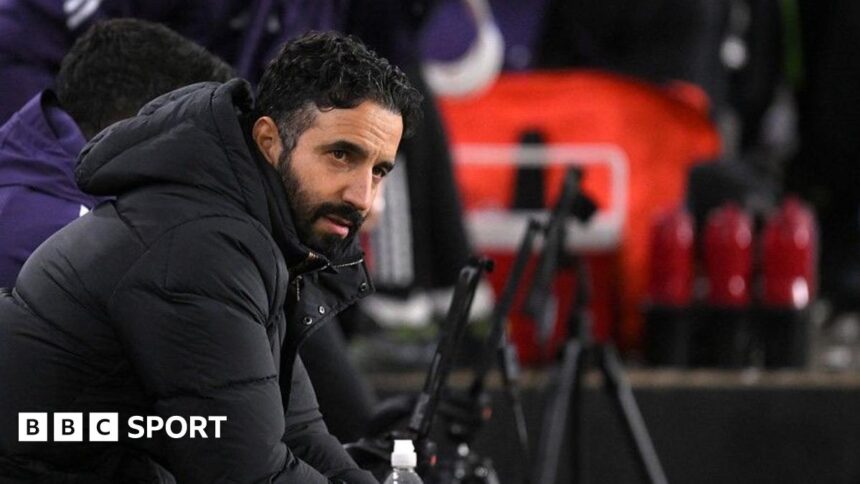
‘Not Good Enough’: Ruben Amorim’s Candid Admission Exposes Manchester United’s Painful New Reality
The air at Carrington is thick with a familiar, uncomfortable truth. For the latest Manchester United manager tasked with reviving a sleeping giant, the weight of history is not an inspiration but an incessant, glaring reminder of failure. Ruben Amorim, the highly-touted successor to Erik ten Hag, has looked in the mirror and at the league table, and delivered a verdict that cuts through the usual managerial platitudes: it is “not good enough.” In a stark admission, Amorim has shouldered the blame for United’s “underachieving” status, framing the fierce criticism from club legends not as a burden, but as a justified consequence of fallen standards.
The Amorim Era: A Statistical Reality Check
Amorim’s honesty is grounded in a cold, hard statistical reality. Fifty-eight games into his tenure, his record reads: 23 wins, 15 draws, and 20 losses. For a club of United’s financial might and ambition, a near 35% loss rate is untenable. The team’s performances have been a volatile mix of fleeting brilliance and profound fragility, lacking the consistency required for a sustained top-four challenge. As they prepare to face Bournemouth on Monday, the stakes are symbolic of their diminished stature. A victory would, remarkably, keep them in the Premier League’s top six for a second successive week—a modest feat they have not managed since the tail end of the 2023-24 season.
This context itself is damning. The fact that stringing together two consecutive weeks in the European places is noted as an “achievement of sorts” speaks volumes about how far the club has drifted from its elite moorings. It underscores a cycle of false dawns and immediate setbacks that has defined the post-Ferguson landscape.
The Ferguson Shadow and the Legendary Jury
Amorim’s reference to criticism from “legendary former players” is a direct acknowledgment of the unique and relentless pressure at Old Trafford. The ghosts of past triumphs are not silent. The era Amorim is constantly measured against—Sir Alex Ferguson’s dynasty—set a bar that now seems almost mythical. From Ferguson’s first Premier League title in 1993 until his retirement in 2013, Manchester United never finished lower than third. The club was synonymous with relentless success and a winning mentality that permeated every corner of the institution.
Today, legends like Roy Keane, Gary Neville, and Rio Ferdinand serve as a vocal, unforgiving jury from the television studios. Amorim’s shrewd move is to validate their criticism rather than deflect it.
- He accepts their right to critique, understanding it stems from love for the club and higher expectations.
- He aligns himself with their frustration, stating he and the team are underachieving, thus disarming potential “us vs. them” narratives.
- He implicitly acknowledges the contract at United: trophies and title challenges are the minimum, not top-six consolidation.
This is a smart, if sobering, public relations strategy. It admits the problem exists, but the real test is whether it can be solved.
Anatomy of Underachievement: More Than Just Results
So, where exactly is the underachievement manifesting? It extends beyond the points column. Amorim inherited a squad with glaring structural issues: a porous midfield, an inconsistent defensive line, and an over-reliance on moments of individual genius rather than cohesive system play. While he has attempted to instill a more disciplined, pressing philosophy, the execution has been sporadic.
The team’s mentality in big games has been repeatedly questioned, echoing the problems of his predecessors. Furthermore, the club’s activity in the transfer market continues to be scrutinized, with questions over whether the recruitment strategy fully supports the manager’s tactical vision. Underachievement at Manchester United in 2025 is a systemic issue—one that encompasses the boardroom, the recruitment department, and the pitch. Amorim’s admission, while focused on the football, hints at this broader institutional challenge.
The Road Ahead: Can Amorim Bridge the Gulf?
The immediate path offers little respite. The Bournemouth game is a perfect microcosm of United’s modern challenge: a fixture once viewed as a guaranteed three points now represents a tricky, must-win obstacle to maintain a hold on a Europa League spot. Looking further ahead, Amorim’s future hinges on his ability to demonstrate tangible progress. The club’s hierarchy and fanbase will demand evidence of a clear playing identity and a squad evolving into something greater than the sum of its parts.
Key predictions for the remainder of Amorim’s season will focus on:
- Consistency vs. Fragility: Can they build a run of form, or will setbacks like the infamous 4-0 defeat at Crystal Palace that nearly cost Ten Hag his job continue to recur?
- Youth Integration: Will Amorim more boldly integrate the club’s promising academy talent to add hunger and a new identity?
- Summer Window Pivot: Will his candid assessment force a more aggressive and aligned summer transfer strategy?
Ultimately, Amorim has done something rare for a modern United manager: he has told the unvarnished truth. He has stated publicly what the league table and the eyes of the world have shown for over a decade. This is not the Manchester United of Ferguson, and pretending it is serves no one. The Portuguese coach’s tenure will be defined not by this admission, but by what follows it. Does this moment of clarity become the foundation for a genuine rebuild, or merely another poignant footnote in the club’s long post-Ferguson decline? The answer will determine whether “not good enough” is a temporary diagnosis or a permanent epitaph.
Conclusion: A Necessary Truth for a Club Lost in the Past
Ruben Amorim’s “not good enough” declaration is more than a soundbite; it is a necessary confrontation with reality. For too long, Manchester United has been navigating by the faded maps of its glorious past, bewildered by why they no longer lead to treasure. By admitting he and the team are underachieving, Amorim has effectively thrown away those old maps. He has stated that the current coordinates are unacceptable. This is a crucial first step, but only a step. The monumental task ahead is to chart a new course. The patience for this project will be thin, the criticism from legends will remain relentless, and the shadow of Ferguson will never fade. But by starting with raw honesty, Amorim has at least ensured the rebuilding effort begins on the solid ground of truth, rather than the shifting sands of nostalgia and denial. The long journey back starts by admitting you are lost.
Source: Based on news from BBC Sport.