The Old Gunslinger’s Cadence: Philip Rivers’ Vintage First Half Sparks Colts’ Hope
The narrative was irresistible, a siren song for the nostalgic football soul. Philip Rivers, the quarterback who retired with a southern drawl, a father’s brood, and a Hall-of-Fame-worthy stat line, was back. Not as a coach or a commentator, but as the starting quarterback for the Indianapolis Colts. The NFL world spent the week oscillating between disbelief and delight, wondering if this was a desperate gambit or a storybook prologue. On Sunday against the Seattle Seahawks, Rivers provided the first, compelling chapter. And in a controlled, cerebral first half, the Colts and their fans saw something profound: the unmistakable, vintage cadence of Philip Rivers.
More Than a Stat Line: The Rhythm of a Veteran Mind
On paper, the first-half numbers against a stout Seahawks defense are solid, not spectacular: 10-for-16, 81 yards, one touchdown, and a 96.1 passer rating. But to focus solely on the box score is to miss the entire point of the Philip Rivers experiment. This was never about recreating the cannon-armed passer of 2013. This was about importing a processor.
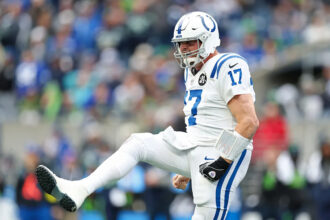
The most striking takeaway was the pre-snap orchestration. From his first snap, Rivers was in full conductor mode. The exaggerated gestures, the pointing, the audible checks at the line—it was all there. He identified blitzes, redirected protection, and put the offense in the right play against a Seattle defense ranked second in scoring. The game, as fast as it is for young quarterbacks, appeared to move at a deliberate, manageable speed for him. This cerebral command is what the Colts bet on, and it paid immediate dividends in building a 13-6 lead.
Dissecting the Vintage Rivers Blueprint
So, what exactly does “vintage Rivers” look like in 2024? It’s a specific, and now more refined, operational blueprint. The physical tools have diminished, but the intellectual framework is not only intact but perhaps sharper after five years of study.
- The Quick Game as an Extension of the Run: With limited arm strength, Rivers and head coach Shane Steichen leaned heavily on a rapid-fire, timing-based passing attack. Quick slants, hitch routes, and check-downs served as his running game, moving the chains methodically and protecting a patchwork offensive line.
- Anticipation Over Velocity: Rivers never won with a rocket arm. He won by throwing receivers open. His touchdown pass was a clinic in this: reading the linebacker’s leverage and delivering the ball to a spot only his tight end could secure, well before the break. The lack of zip was evident on deeper out-routes, but his anticipation on short-to-intermediate throws remains elite.
- Emotional Catalyst: The fire, the competitive fury, is undimmed. The first fist pump after a third-down conversion energized the entire Lucas Oil Stadium. He remains the emotional heartbeat of the huddle, a trait that galvanizes an offense.
The Inevitable Limitations and Strategic Adjustments
To view this return through only rose-colored glasses would be disingenuous. The limitations are clear and will define the ceiling of this Colts season. The deep ball threat is virtually nonexistent, which allows opposing safeties to creep into the box. He was sacked once and felt pressure often, a reminder of his legendary lack of mobility. The offense, therefore, becomes a tightly-scripted, mistake-averse operation.
This is where the Shane Steichen partnership becomes critical. Steichen’s game plan was a masterclass in working around limitations. It featured play-action boots to get Rivers on the move, a heavy dose of 12 personnel (two tight ends) for protection, and a clear emphasis on winning first and second down to avoid obvious passing situations. They are not asking Rivers to be Justin Herbert; they are asking him to be a point guard, distributing the ball accurately and intelligently within a constrained system.
What This Means for the Colts’ Playoff Push
The first-half performance against Seattle provides a clear roadmap—and a sobering reality—for Indianapolis. Rivers’ return has stabilized the quarterback position in a way that a struggling young player could not. He provides a high floor of competency that keeps the Colts competitive in every game, especially with their formidable defense.
However, the ceiling is contingent. Can this offense score 24-27 points against the elite defenses of the AFC? Can it mount a fourth-quarter comeback if the run game is stifled? The second half against Seattle, where adjustments were made and points became scarcer, highlighted these very questions.
Predictions must be tempered. This is not a fairy tale leading to a Super Bowl. It is, however, a legitimate path to a wild-card berth. Rivers’ veteran savvy gives the Colts a significant advantage in close, low-possession games. He will not lose games with catastrophic errors. He will manage the clock, convert critical third downs, and maximize the talent around him.
Conclusion: A Testament to Football IQ
Philip Rivers’ first half back was not a display of physical rejuvenation. It was a celebration of football intellect. In an era obsessed with athleticism and arm talent, Rivers offered a two-quarter masterclass in how quarterback mastery can transcend physical decline. He reminded us that the position is, at its core, about leadership, preparation, and seeing the field one step ahead of everyone else.
The Colts don’t have the 2008 version of Philip Rivers. They have the 2024 edition: a diminished arm attached to a brilliant mind. For a team clinging to playoff hopes, that mind—with its vintage cadence, its pre-snap diagnostics, and its unquenchable fire—might just be enough to author a surprising and compelling final act to this NFL season. The gunslinger’s draw is slower, but his aim, guided by decades of experience, remains true.
Source: Based on news from Yahoo Sports.