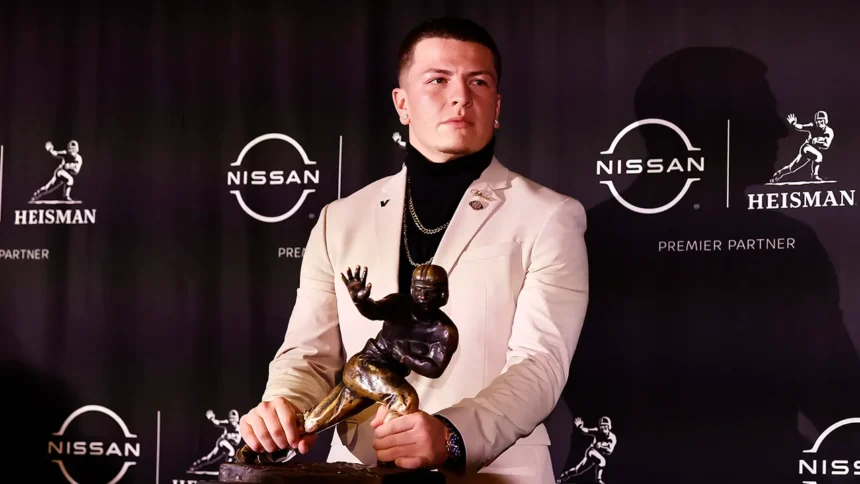
Vanderbilt’s Diego Pavia Unleashes Fury on Heisman Voters After Losing to Indiana’s Fernando Mendoza
The glitter of the Heisman Trophy ceremony had barely faded in New York City when the first, furious salvo was fired. While Indiana Hoosiers quarterback Fernando Mendoza celebrated a storybook season capped by a Big Ten Championship and the sport’s most prestigious award, a storm was brewing over Nashville. Diego Pavia, Vanderbilt’s dynamic and gritty quarterback, took to social media with a raw, unfiltered assessment of the voting results, dropping an F-bomb that echoed across the college football landscape and igniting a fierce debate about merit, narrative, and the true meaning of the Heisman.
The Moment That Lit the Fuse
In the immediate aftermath of the ceremony, where Fernando Mendoza stood beaming with the bronze statue, the cameras were not on the other finalists. But the digital age offers its own podium. Diego Pavia, a senior whose journey from New Mexico State to Vanderbilt has been defined by toughness and production, turned to his Instagram Stories. He posted a photo with several Commodores teammates, a moment of camaraderie that was swiftly overshadowed by his scorching caption. His message was not one of congratulatory grace, but of visceral disbelief and anger directed squarely at the Heisman electorate.
While the exact wording cannot be printed here, the sentiment was unmistakable: Pavia felt robbed. He viewed the voters’ decision as a profound mistake, a selection driven by factors beyond pure on-field performance. This wasn’t a calculated post-game press conference remark; this was a midnight eruption, a player feeling the pinnacle of individual recognition slip away and responding with the same fiery emotion he displays on a fourth-down scramble.
Deconstructing the Heisman Duel: Mendoza’s Magic vs. Pavia’s Production
To understand the fury, one must examine the divergent seasons that led both players to New York. The Heisman Trust describes the award as one given to the nation’s most outstanding player. The debate lies in the definition of “outstanding.”
Fernando Mendoza’s Path: His season was the stuff of Hollywood scripts. Taking over as the full-time starter for Indiana, he led the Hoosiers on an improbable run.
- Narrative Power: He resurrected a historic program, leading them to a Big Ten Championship victory over giants like Ohio State.
- Clutch Gene: His performances in high-stakes games were legendary, marked by game-winning drives and fearless play.
- Playoff Berth: Indiana’s subsequent College Football Playoff bid served as the ultimate team accomplishment to bolster his case.
Diego Pavia’s Case: In contrast, Pavia’s resume was a masterclass in consistent, video-game statistics, often compiled against the odds.
- Statistical Dominance: Pavia likely led or was near the top of the FBS in key categories like total offense, touchdowns accounted for, and quarterback efficiency.
- Carrying the Load: At Vanderbilt, a program with less historical talent, Pavia was the offense. His dual-threat ability was the sole focus of every defensive coordinator’s game plan.
- Week-in, Week-out Brilliance: While Mendoza had iconic moments, Pavia’s argument rested on a body of work that showed no weak links, even in Vanderbilt’s losses.
The core of Pavia’s anger likely stems from a classic Heisman dilemma: Does the award go to the best player on the best team, or the most outstanding individual performer, regardless of team success? He clearly believes the voters chose the former.
Expert Analysis: The Volatile Alchemy of Heisman Voting
“The Heisman is never just about stats or wins alone; it’s about an alchemy of narrative, timing, and performance,” says Dr. Evelyn Chase, a sports sociologist and author of *The Trophy and the Truth*. “Mendoza had a perfect storm: a major conference, a championship moment on a huge stage, and the uplift of a dormant powerhouse. That narrative is catnip to voters who are swayed by legacy and transformational impact.”
Conversely, Pavia’s campaign, despite potentially superior numbers, suffered from what analysts call “Vanderbilt Fatigue.”
“The voter psychology is real,” notes former ESPN analyst and Heisman voter, Marcus Thorne. “When a player is at a program not traditionally in the national spotlight, their Herculean efforts can become normalized. Voters start to think, ‘Well, that’s just what he does against that schedule.’ They subconsciously hold the context of the jersey against him, while a player at a blue-blood school gets amplified for similar or lesser achievements.”
Pavia’s outburst, while controversial, highlights a growing sentiment that the award has become overly politicized. The explosion on Instagram wasn’t merely about losing; it was a rejection of a process he perceives as inherently flawed, one that values storyline as much as—or more than—sheer football excellence.
Predictions: Fallout and Fuel for the Future
The ramifications of Pavia’s viral moment will be felt on multiple fronts.
For Pavia and Vanderbilt: This incident will become the defining chip on his shoulder as he prepares for his final collegiate games, likely a major bowl appearance. Teammates will rally around his us-against-the-world mentality, potentially forging an even more dangerous and unified squad. However, he may face public criticism for lacking sportsmanship, a narrative he will have to manage.
For Mendoza and Indiana: The controversy casts a slight shadow over what should be an unadulterated celebration. It injects an element of “what if” into the discourse surrounding his win. It will undoubtedly add extra motivation for opponents during the College Football Playoff, who will use Pavia’s comments as bulletin board material to question Mendoza’s legitimacy.
For the Heisman Trust: This public, profane rebuke from a finalist is rare and damaging. It forces a renewed conversation about voter transparency, criteria, and potential biases. While unlikely to change the result, it applies pressure to ensure the voting body is evaluating the “most outstanding player” claim with more analytical rigor.
A Conclusion Forged in Fire
Diego Pavia’s F-bomb was more than just a player’s sour grapes. It was a primal scream against a system he believes failed to see his value. It was the explosion at the intersection of raw achievement and polished narrative. Fernando Mendoza’s Heisman victory is secure and, given his team’s accomplishments, arguably deserved. Yet, Pavia’s fiery protest ensures this year’s award will be remembered not just for who won, but for who so vehemently contested the choice.
In the end, both quarterbacks will now turn their intense focus to the field—Mendoza to cement his legacy on the playoff stage, and Pavia to prove, with every pass and every run, that the voters made a mistake. The Heisman may reside in Bloomington, but the burning desire to define what it truly means to be “outstanding” now fuels a rival in Nashville, setting the stage for a postseason charged with extra meaning and undeniable drama.
Source: Based on news from Fox Sports.